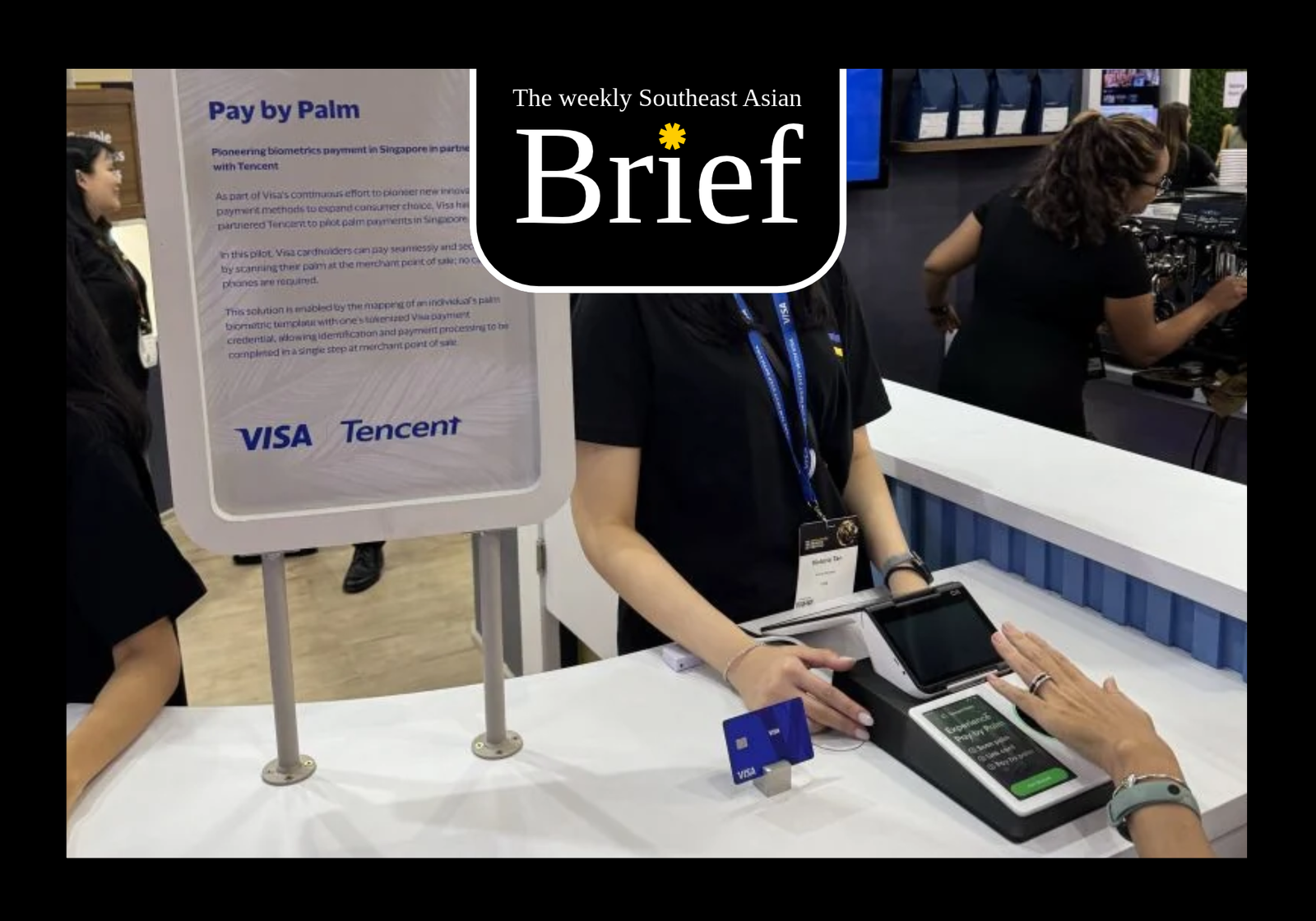
Pay by Palm, an innovative payment method where users only need to scan their palm to make a payment, showcased during the Singapore FinTech Festival. It has since been implemented in Singapore’s Alchemist cafe along Robinson Road. (Visa)
Strengthen financial crime defence, expand financing access for small and medium-sized enterprises (SMEs) and enable safe AI-driven payments. Those are the three National AI Missions for Financial Services outlined by Singaporean Deputy Prime Minister (DPM) and Chairman of the Monetary Authority of Singapore (MAS), Gan Kim Yong, during his keynote speech at the opening of the 2026 Singapore FinTech Festival (SFF) on November 18.
Of note, SFF is one of the world’s biggest annual conferences and exhibitions for financial technology, banking and digital policy. Thus the DPM’s announcement, taken on its own, appears foremost to be another showcase of Singapore as a leading, trusted global financial hub. Viewed more broadly, however, the city-state could also deliver a considerable strategic catalyst that its neighbours in Southeast Asia are well positioned to leverage.
Singapore will take the helm as ASEAN chair in 2027, with Prime Minister (PM) Lawrence Wong having revealed the chairship’s theme, “Deeper Integration, Wider Partnerships”. Key priorities, as the PM outlined during the 49th ASEAN Summit, include enhancing the
region’s financial links and digital technologies, as well as expanding ties with external partners.
Consequently, there is clear scope to align Singapore’s domestic initiatives with regional goals.
To start, it is important to grasp the severity of financial crime in Southeast Asia. The United Nations Office on Drugs and Crime (UNODC) even labelled the region as “ground zero for the global scamming industry”, estimating scam losses at between 75 to 110 billion US dollar loss—within the Golden Triangle markets alone (criminal networks spanning across the Mekong River borders, involving Myanmar, Thailand, Laos and Cambodia).
Such vulnerabilities, unfortunately, are expanding as the digital space continues to advance illicit practices. Thus, the recent signing of ASEAN’s Digital Economy Framework Agreement (DEFA) yields paradoxical outcomes. On one hand, the framework, which will enter into force in 2027, will undoubtedly intensify cross-border transactions, carrying on the other hand, heightened crime exposure.
Layered onto this is the fact that DEFA is merely a starting point, with significant work still ahead. As DPM Gan highlighted, there is a wide disparity in digital maturity across the region. Nevertheless, as a regional tech hub Singapore is poised to lead the rollout of, not just a sophisticated economic system, but a secure one.
It bears emphasising that, despite being a notable global safe haven, Singapore is not immune to these threats. Quite the contrary, the city-state actually recorded the highest average scam loss per victim in the Southeast Asia region in 2024, hitting a historic high record of 822 million US dollar of total state losses. These realities rationalise the first National AI Mission to combat financial crime.
The second mission, pushing for broader financial inclusion for SMEs, is equally well-founded. It is crucial to note that SMEs are the backbone of Southeast Asia’s economy, accounting for roughly 97% of all businesses across the bloc and contributing almost 50% of ASEAN’s aggregate gross domestic product (GDP). And because they operate through localised supply chains, with highly inclusive participation, SMEs serve as a prominent engine for poverty reduction, women’s economic participation and local community stability.
It is fair to argue that SMEs are the largest untapped growth engine for Southeast Asia. As DPM Gan recognised, SMEs are “not fully capturing their creditworthiness” potential. And they are held back not by a lack of entrepreneurial drive, but by structural barriers to expansion—chiefly limited access to credit, alongside information, regulatory and infrastructure fragmentation.
Take, for example, Indonesia. In ASEAN’s largest economy, SMEs represent 99.9% of all businesses and contribute nearly 60% of the country’s GDP in 2024. Nevertheless, their share of total bank loans declined from 22% in 2021 to 17% in 2025, even as overall lending by finance companies edged up. Equally concerning is the downward financing trend for these businesses, falling 17.6% from 180 trillion Indonesian rupiah (9.7 billion US dollar) to less than 150 trillion Indonesian rupiah (8.1 billion US dollar).
In a broader sense, DEFA is indeed a viable entry point to crystallise support for SMEs across the region. But again, such a high-level accord cannot translate itself into a step-by-step implementation guide. Considering a deeper context, these smaller-scale businesses lack the resource buffer to fail. Addressing an essential prerequisite, as PM Wong stressed, requires fostering a thorough understanding and consistent interpretation of the framework. DEFA’s vision of doubling ASEAN’s digital economy to 2 trillion US dollar will not materialise if two-thirds of firms remain unfamiliar with it.
Last but not least, a projection to have AI settling transactions stands out as Singapore’s flagship mission to spearhead fintech innovation amidst unprecedented technological growth that is shifting the global financial landscape. MAS Managing Director, Chia Der Jiun, explained this agenda by noting that consumers “have a growing interest for agents to manage purchases and payments,” while “businesses see benefits for agents to manage cash, payments and liquidity”.
The upside of Singapore’s ambition is surely greater efficiency in settling transactions. Yet, as DPM Gan asserted, “greater autonomy must come with clear responsibility and accountability,” adding that AI agents must operate within “defined authority and limits”. Therefore, the critical initial focus will be robust AI governance, an area where Southeast Asia currently lacks investment.
At least in the near future, the rest of the Southeast Asian nations are unlikely to rush into adopting this sophisticated system—given asymmetrical technological readiness and the fact that Singapore itself is still developing regulatory sandboxes.
Altogether, Singapore’s newborn triplets, though relevant across virtually every facet of economic growth, can only be adopted widely by accounting for domestic contexts—and only once the foundational prerequisite of robust regulation is addressed.
About The Author