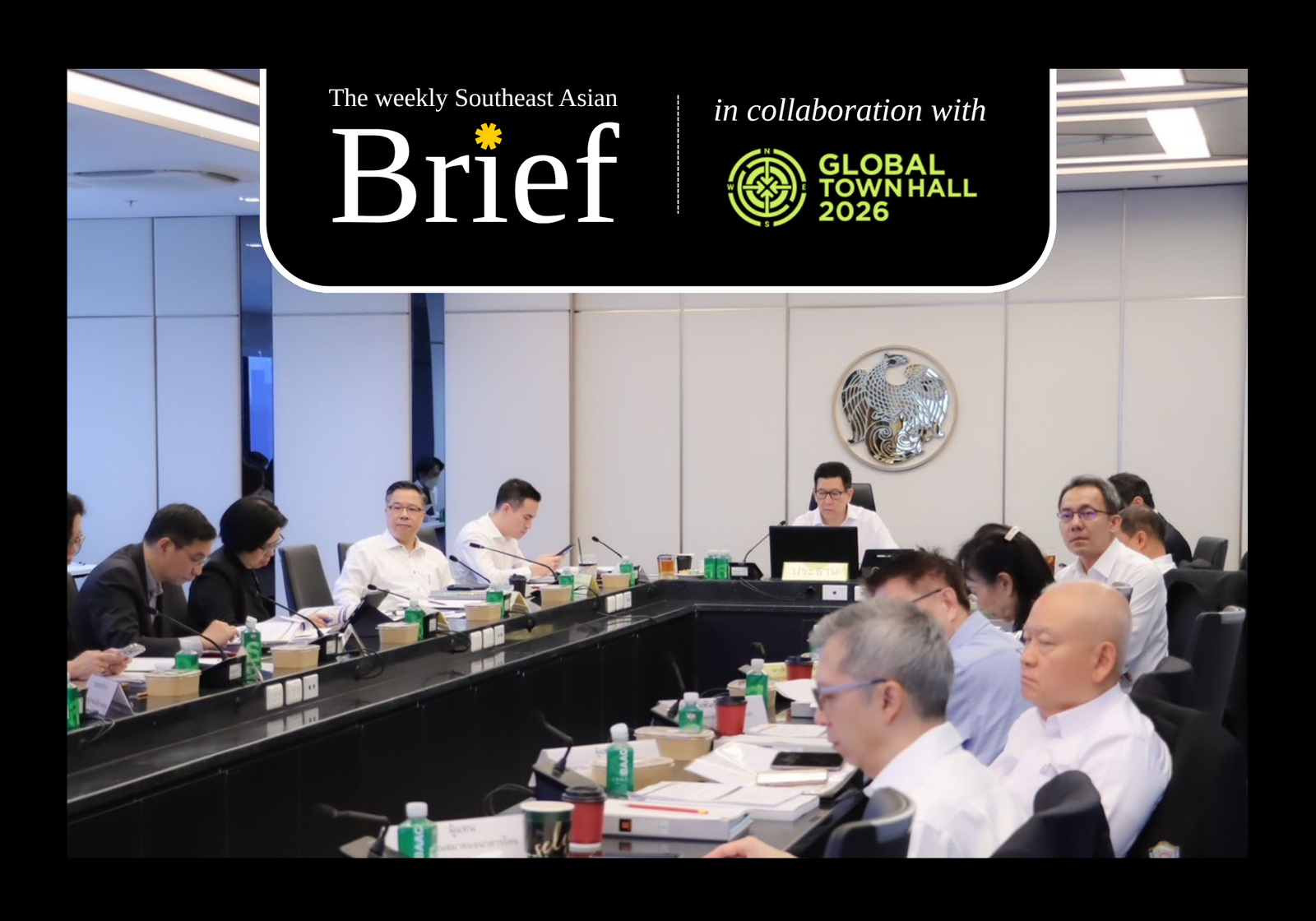
Thailand’s Board of Investment holding a meeting on data centre expansion chaired by Ekniti Nitithanprapas, Deputy Prime Minister and Minister of Finance in May 2026. (Board of Investment)
Artificial intelligence (AI) is growing at an unprecedented level, far beyond what humanity can comprehend, much less to control. The brakes on this development must therefore be pulled in the nick of time as the alternative threatens human extinction.
That peril is clearly understood. Yet this avant-garde technology is so engrained systematically to the point that, for Dario Amodei—in his essay published on September 12—the viable compromise is to “slow the pace [of advancement]” for risk prevention measures to “keep up”. The Anthropic CEO has made it clear that there is no turning back, and that stopping progress won’t be an option.
The integration of AI into the human condition, into our vita activa, inevitably extends to the state level. Accordingly, governments are entitled to deliberately establish green lights and red lines for this development.
For a region experiencing the peak of this AI boom—and seeking to leverage it to catalyse growth for its people—Southeast Asia is undeniably positioned at much higher, more intricate stakes in this “race to the top”.
A manifest example to start with is Thailand. The country was running the AI race on a green light until intensifying public concerns pushed the Royal government to halt development. On September 4, it voluntarily froze the construction of over 40 AI data centres, with authorities pledging to hash out stricter compliance regulations.
This case reflects a broader pattern rippling through Thailand’s neighbouring states across Southeast Asia, exposing a glaringly missing foundation; a comprehensive, rigid framework for AI governance, both nationally and regionally.
This deficit is crucial because for a region that has arguably benefited the most from an ever-interdependent world, Southeast Asia’s next leap to strengthen its value chain will not be defined by how “open” they are, but by how trusted they prove to be.
Indeed, foreign direct investment (FDI) remains a substantial driver for the region, attracting 244 billion US dollar in 2025. Yet, there is a glaring regional gap as the lion’s share (roughly 62%) of this capital flows into the smallest member state, Singapore. Crucially, this concentration has intensified in parallel with the new global capital incentives for AI infrastructure.
The rationale is straightforward; Singapore is trusted. Trust operates as a reflection of evidence, which generates the economic competitiveness necessary to foster a favourable business environment. And the structural underpinning for that environment is strategic regulation.
Nevertheless, comparative disadvantages certainly persist even for Singapore, notably a razor-thin vacancy rate of 1.4% stem from its land-constraints. Consequently, this concentrated capital has triggered a regional spillover effect, “forcing” tech giants to build their next data centres in neighbouring areas.
But are Singapore’s neighbours well set to leverage this spillover?
The parameters determining this dynamic will be, as mentioned, AI governance. Unfortunately, with the sole exception of Singapore, the remaining nations of Southeast Asia consist of developing economies. It is far more complex for these nations to establish themselves in such a “sophisticated” degree of “preparedness” as their AI commander, Singapore, given that they are still dealing with an entrenched polycrisis of geopolitical, geoeconomic, environment vulnerabilities, etc.
To put this into perspective, consider Malaysia, Singapore’s closest neighbour actively leveraging the city-state’s spatial limit, with a half-discount on operational costs.
Since at least 2024, global tech behemoths began building across the Malayan peninsula, highlighted by a remarkable 6.5-billion-US-dollar investment from Oracle Corp, which tripled the country’s year-on-year digital investment. Western titans like Google, Microsoft and Amazon Web Services (AWS), alongside Chinese giants Alibaba, ByteDance and Tencent, have since continued to expand their footprint in Malaysia, specifically in the states of Johor and Cyberjaya.
Examined closer, those funds are coupled with “training programmes” tailored to upskill the local workforce—exemplified by Microsoft Malaysia’s AIForMYFuture. Without diminishing the government’s furtherance of this momentum (chiefly through the technical and vocational education and training (TVET) agenda), it tacitly underscores a developing nation’s typical structural hurdle (namely a lack of institutional capacity and historically inadequate educational investment) that demand prior address. Such remedial work to develop the domestic talent for market demand (as well as to curb the risk of overdependence) puts Malaysia to play catch-up with a juggernaut technology.
With this contextualisation, it is fathomable how feasible it was for Singapore (with a workforce already ranked among the world’s most skilled) to constitute its Model AI Governance Framework (MGF) for traditional AI back in 2020, and for generative AI in 2024. The Little Red Dot is currently brewing its renewed MGF for Agentic AI, a first-of-its-kind blueprint designed to safeguard the deployment of autonomous AI systems safely and responsibly, and with a priority on green standards. Alas, even their best play still won’t put them ahead in the race.
Unlike Singapore, Malaysia—much like the aforementioned Thai case—lacks a rigid baseline of regulations, and has only begun tightening scrutiny, with its AI Governance Bill awaiting a cabinet hearing later this year. Woefully, the rest of the Southeast Asian nations mirror them while navigating layers of complexity stemming from an increasingly fragmented world order.
Nonetheless, the need for AI governance matters most not to secure a loftier rank within the capitalist system, but for the very preservation of humanity.
Grassroot communities have explicitly articulated concerns regarding the colossal volumes of land, power, water and workforce required for the AI infrastructure to function. It vividly manifested in domestic protests against the Philippines’ Pax Silica AI-native economic security zone proposal.
Ultimately, at the regional level, a convergence area articulated through the “ASEAN Guide on AI Governance and Ethics” can only be meaningful if member states translate and localise its principles. As assessed, a one-size-fits-all approach is impossible for nations that do not stand on equal footing.
Doing so will demand awareness, understanding, genuineness and empathy; an intersection to be explored in the 2026 Global Town Hall, an annual virtual international policy forum organised by the Foreign Policy Community of Indonesia (FPCI). Under the theme “Calling for a Global U-Turn: Recentering Development, Reclaiming Humanity, Restoring Justice in a Crazi(er) World,” modern technological advancement will be one of the key themes leveraged to discuss and craft solutions.


Register yourself here.
About The Author