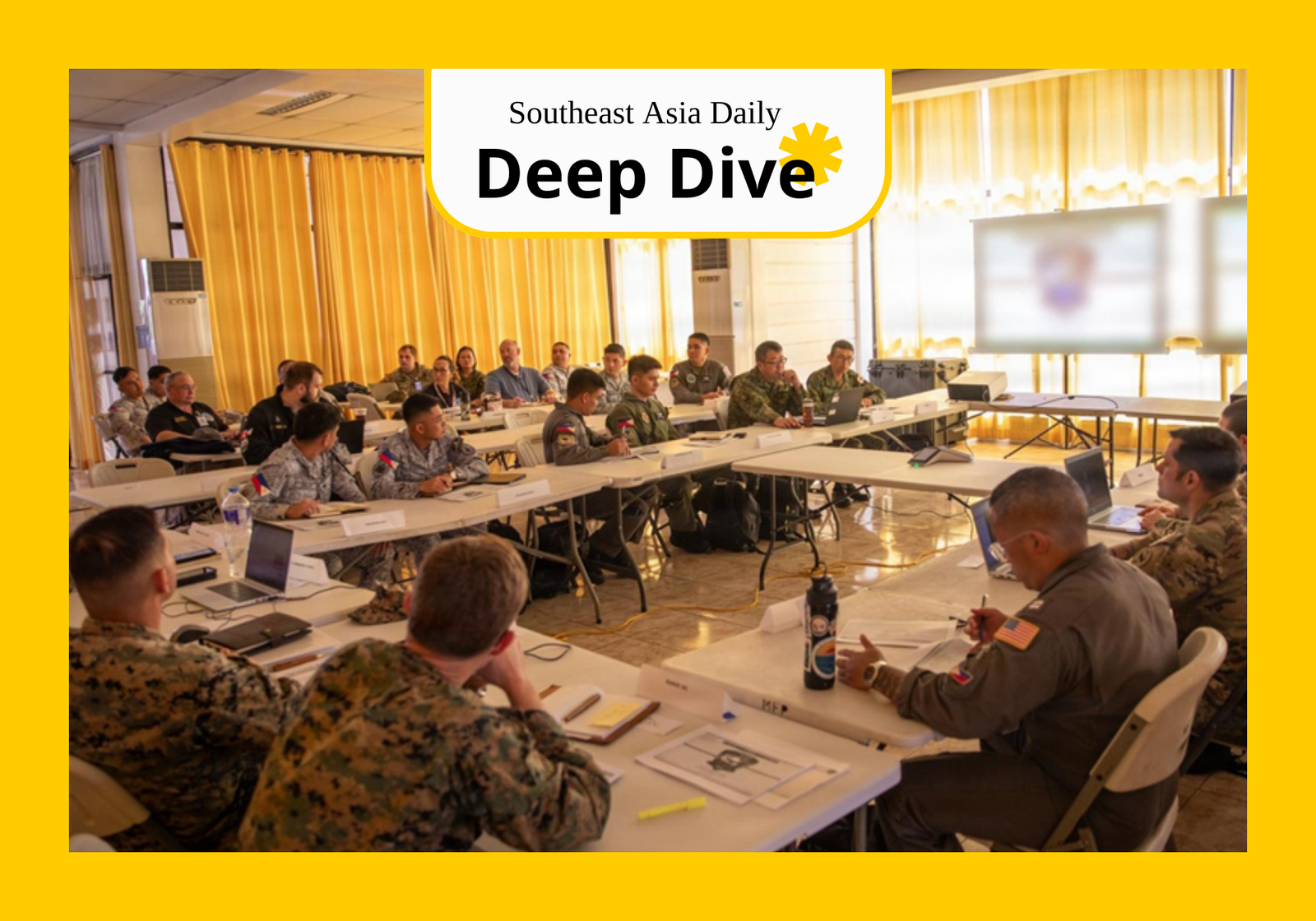
Senior officers from the Philippines, Japan, the US and Canada during a maritime-strike rehearsal at Exercise Balikatan 2026. (Wikimedia/Sgt. Sar Paw, US Army)
On September 6, Japanese government sources disclosed a plan to use Official Development Assistance (ODA) to upgrade Indonesian fishing ports so that Indonesian coastguard patrol vessels could use them as maritime-monitoring hubs. The Japan International Cooperation Agency (JICA) has examined seven possible locations, including the Natuna Islands, with two expected to be pilot projects. On the surface, this is fisheries infrastructure. Strategically, it captures a broader change. Tokyo is knitting together ports, patrol vessels, radar, logistics and defence-industrial relationships across Southeast Asia without asking the region to join a formal alliance. The emerging architecture is not the equivalent of the North Atlantic Treaty Organisation (NATO) in Asia, but a looser form of networked deterrence whose durability will depend on whether ASEAN states see it as strengthening their own autonomy rather than drawing them into a Japan-US bloc.
Security Now Begins Further South
The South China Sea forms the maritime hinge connecting Northeast Asia with much of Southeast Asia and the Indian Ocean. (Wikimedia/US Department of Energy)
Japan’s military shift has accelerated in 2026. On April 21, Tokyo revised its Three Principles on Transfer of Defense Equipment and Technology, removing the five-category restriction that had sharply limited transfers of finished defence equipment. At the Shangri-La Dialogue in Singapore a month later, Defence Minister Koizumi Shinjiro linked the change to a wider regional strategy. Japan, Minister Koizumi said, would expand defence-equipment, industrial, maintenance and sustainment cooperation while connecting partnerships across the Indo-Pacific—turning “points into lines and from lines into planes”. This is a larger change than the conventional narrative of Japanese military normalisation suggests. For Tokyo, security no longer ends at the Japanese archipelago. Japan remains heavily dependent on sea lanes connecting the Indian Ocean, the Strait of Malacca and the South China Sea to Northeast Asia. Disruption in Southeast Asian waters would affect Japanese energy access, trade flows and industrial supply chains. TheDefense of Japan 2026 white paper similarly treats defence production, technological resilience and supply-chain security as integral to national defence.
Yet Tokyo is not discarding the diplomatic foundations it built in Southeast Asia after the Second World War. The Fukuda Doctrine of 1977 emphasised trust, equal partnership and “heart-to-heart” relations, while decades of economic cooperation gave Japan substantial political capital. The Vientiane Vision, launched in 2016 and updated in 2019, then institutionalised Japan-ASEAN defence cooperation. TheJapan-ASEAN Ministerial Initiative for Enhanced Defense Cooperation (JASMINE), launched in 2023, added maritime and air situational awareness, capacity building, Official Security Assistance (OSA), equipment cooperation and personnel exchanges. The strategic change is therefore less a break with the Fukuda legacy than a conversion of accumulated trust into capability. ODA remains a development instrument and OSA is formally distinct, but Japan’s security engagement increasingly connects economic resilience, maritime infrastructure, surveillance, equipment and sustainment. Southeast Asia has moved from being a diplomatic neighbourhood to becoming part of the geography through which Japan seeks to produce its own security.
Deterrence Through Networks, Not Alliances
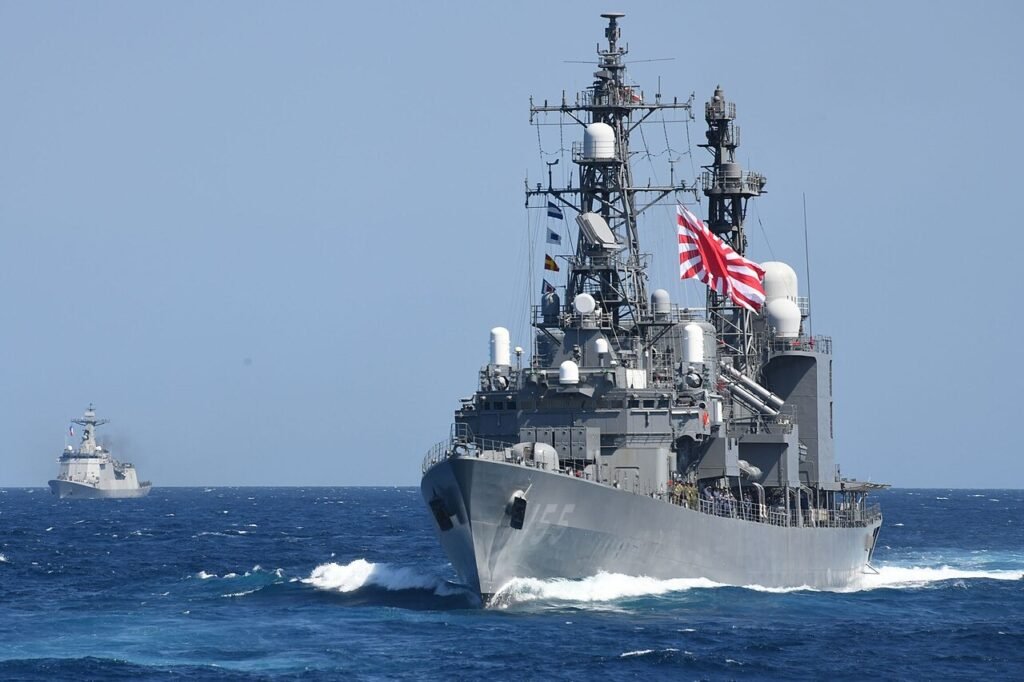
JS Hamagiri and Philippine Navy frigate BRP Jose Rizal during a Japan–Philippines goodwill exercise off Manila in February 2025, illustrating the expanding operational links underpinning Japan’s regional defence network. (Wikimedia/Japan Maritime Self-Defense Force)
What is emerging can be described as networked deterrence. The term is not an official Japanese doctrine. It describes the cumulative effect created when multiple states acquire stronger surveillance, maritime awareness, logistics, training, maintenance and operational links without entering a NATO-style collective-defence alliance. A radar installation or patrol vessel may be modest in isolation. Its strategic value rises when it becomes part of a wider system of platforms, infrastructure and information. The Philippines may remain the network’s most operationally integrated Southeast Asian partner . Tokyo has provided coastal radar under OSA, and the Reciprocal Access Agreement has enabled deeper training and operational cooperation. The Japan-Philippines Acquisition and Cross-Servicing Agreement entered into force on August 22, 2026, creating a framework for reciprocal provision of supplies and services. Tokyo and Manila are also discussing transfers of Abukuma-class destroyers and a TC-90 aircraft alongside training, maintenance, sustainment and information-sharing arrangements. The Philippines is not a template for ASEAN, but it illustrates the upper end of how far Japan’s network can develop where threat perceptions and political alignment are relatively compatible.
Indonesia occupies a different position. Jakarta’s free and active (bebas aktif), foreign policy makes alliance-style integration unattractive. Yet cooperation has deepened. Japan’s Fiscal Year 2025 OSA programme allocated 1.9 billion Japanese yen (12.2 million US dollar) for high-speed patrol boats for the Indonesian Navy, the two countries signed a Defence Cooperation Arrangement in May and subsequent talks opened discussion ofAsagiri-class destroyers, training, maintenance, classified maritime information and more effective use of ports. On August 26, Japan, Australia and Indonesia also held their first trilateral defence ministers’ meeting, illustrating how Tokyo’s bilateral relationships are beginning to overlap with smaller minilateral arrangements. The fishing-port plan reported in September makes the logic more visible. Patrol vessels extend operational reach; ports provide access, fuel and sustainment; radar and information-sharing improve awareness. Together they form a platform-infrastructure-information nexus. But Chinese state media offers a different reading of that nexus. A Global Times commentary on September 7 labelled the Indonesian initiative part of a Japanese “ship-plus-port” strategy and argued that ODA and OSA are increasingly reinforcing the same maritime-security environment. The commentary is polemical, but the underlying phenomenon it raises is legitimate: as development infrastructure and security assistance become operationally complementary, the boundary between capacity building and strategic alignment becomes harder to define.
That boundary, however, is not set by Tokyo or Beijing alone. ASEAN governments retain agency over how far they connect to the network. Malaysia has received monitoring and surveillance equipment and is due to receive a diving-support vessel through OSA, while Thailand’s Fiscal Year 2025 package focuses on disaster response and maritime search and rescue. Singapore is moving towardshigher-end defence technology, maritime and air cooperation and information-sharing. Vietnam may become particularly important industrially after Tokyo and Hanoi agreed in July to begin discussions on the possible joint development and production of fast landing craft. The unevenness is the point. Japan is not building a Southeast Asian version of its US alliance. It is constructing a layered network in which states can participate at different depths according to their threat perceptions, domestic politics and strategic preferences. That flexibility makes the model well suited to ASEAN, whose members generally value maritime stability and freedom from coercion but differ sharply over China and over how closely they wish to work with US-aligned security structures.
The Industry Will Determine How Deep the Network Goes
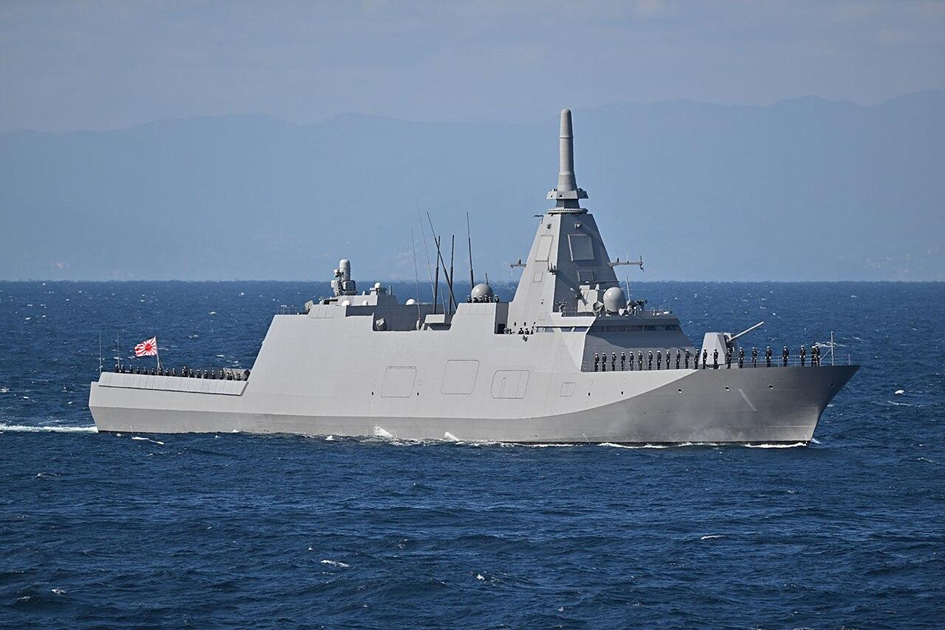
JS Mogami, a Japan Maritime Self-Defense Force frigate representing the industrial and technological capabilities Tokyo increasingly seeks to connect with external defence partnerships. (Wikimedia/Japan Maritime Self-Defense Force)
The next stage will be determined less by diplomatic declarations than by what happens after equipment is transferred. Modern defence procurement creates relationships that can last for decades. Ships, radar systems and aircraft require training, spare parts, software, maintenance, upgrades and eventual replacement. Equipment transfers can therefore produce defence-industrial embeddedness: durable strategic relationships created through technological and industrial interdependence. Tokyo increasingly recognises this. Japan’ Fiscal Year 2026 defence budget allocates about 95.7 Japanese yen (618 million US dollar) billion to reinforce the defence-production base, including 40 billion Japanese yen (258.3 million US dollar) for a fund to facilitate defence-equipment transfers. The logic is two-sided. Transfers can strengthen partner capabilities, but overseas demand can also help sustain Japan’s own production lines, suppliers and technological base.
For Southeast Asia, that creates both opportunity and risk. If cooperation consists mainly of finished platforms followed by decades of Japanese maintenance, recipients may improve military capability while creating new technological dependencies. If procurement is linked instead to local maintenance, repair and overhaul, component manufacturing, systems integration and eventually co-production, defence spending can contribute to industrial upgrading. Vietnam’s landing-craft discussions are therefore important beyond the platform itself. Genuine joint development would move Japan beyond a donor-recipient model. Indonesia is another test because it has its own shipbuilding ambitions and has long sought technology transfer from multiple suppliers. The question is not simply whether Jakarta acquires Japanese ships, but whether cooperation leaves behind engineering skills, maintenance capability and local production networks.
Three developments will indicate how far the network can deepen. First, ASEAN states will continue to hedge. Japan’s partnerships will remain politically sustainable only if governments can strengthen maritime capacity without surrendering strategic choice. Second, Japan must demonstrate that its industrial base can support exports over the full life cycle; agreements lose strategic value if production, spare parts or maintenance cannot keep pace. Third, Southeast Asian states will increasingly judge Japanese offers against South Korean, European, US and other suppliers. Competition among these suppliers gives ASEAN governments greater bargaining leverage, but diversification should not be confused with autonomy. Replacing dependence on one supplier with dependence on several may reduce strategic exposure without necessarily creating domestic technological capability. The stronger position for Southeast Asian states is therefore to convert supplier competition into technology transfer, maintenance capacity, engineering skills and local production networks.
Southeast Asia is therefore unlikely to become part of a formal Japanese-led security architecture. A more plausible outcome is a patchwork of overlapping radar coverage, patrol capacity, port access, logistics arrangements, exercises, technology cooperation and industrial relationships. The Philippines may remain the most operationally integrated network, while Indonesia and Vietnam test whether deeper defence-industrial cooperation can coexist with strategic autonomy. Malaysia, Thailand, Singapore and others will connect at different levels. Japan’s move beyond post-war pacifism should consequently be measured not only by its defence budget or the number of weapons it exports, but by the geography and durability of the relationships it is building. Whether networked deterrence ultimately strengthens Southeast Asian autonomy or creates another layer of dependency will depend on what remains after the ships, radar and infrastructure arrive: maintenance capacity, engineering skills, information control, production networks and, above all, the ability of ASEAN states to make strategic choices of their own.
About The Author