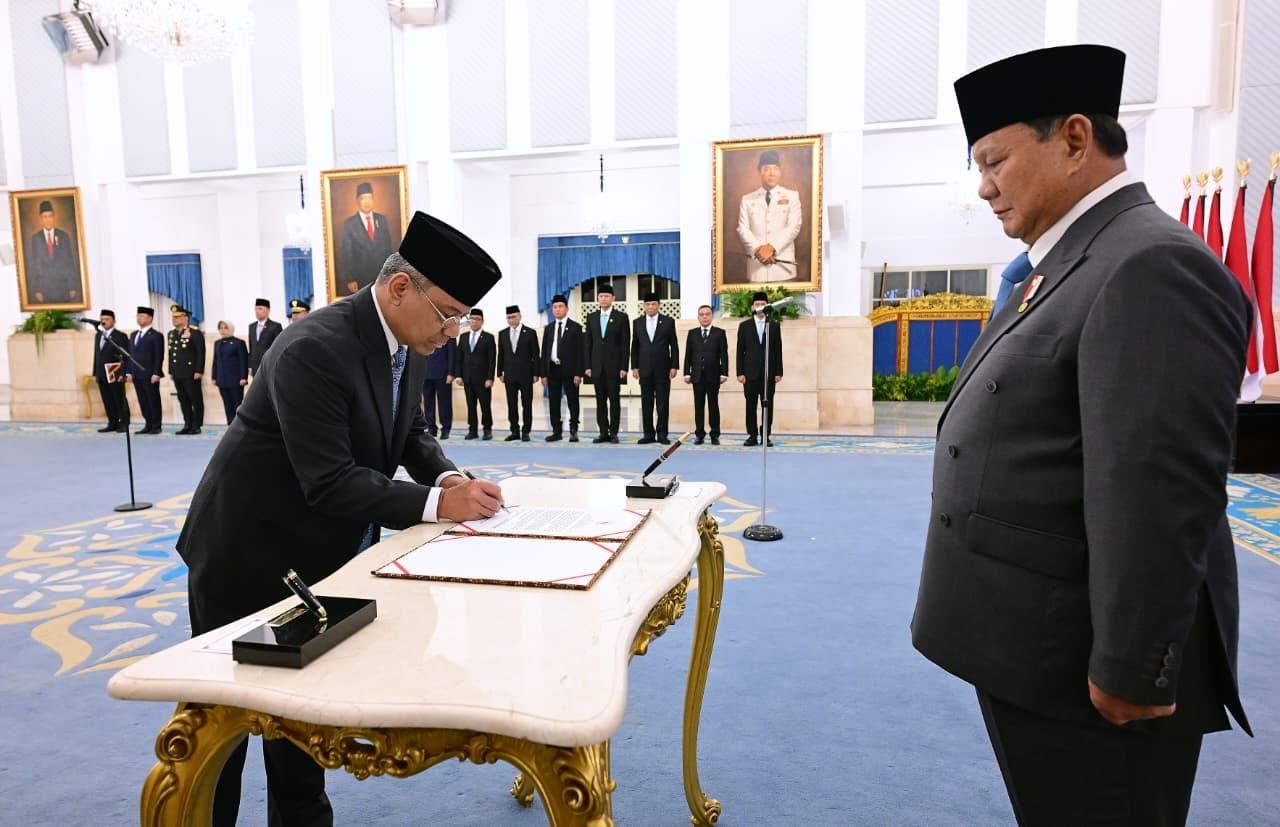
Indonesian President Prabowo Subianto attends the swearing-in of new Finance Minister Suahasil Nazara at the State Palace. (Kementerian Sekretariat Negara)
On September 14, Indonesian President Prabowo Subianto appointed Suahasil Nazara as the new Finance Minister, the same day the Corruption Eradication Commission (KPK) conducted an operation targeting officials linked to the Agrarian Affairs and Spatial Planning Ministry/National Land Agency (ATR/BPN).
President Prabowo appointed Suahasil as the new Indonesian Finance Minister under Presidential Decree No. 97/P of 2026, replacing Purbaya Yudhi Sadewa for the remainder of the 2024–2029 term as investor’s growing skepticism.
Indonesian Finance Minister Suahasil said President Prabowo had instructed him to maintain the health and credibility of state finances and ensure that the state budget, or APBN, continues to support the government’s priority programmes. He said the fiscal deficit would remain below the legal limit of 3% of gross domestic product (GDP).
The appointment came on the same day the Corruption Eradication Commission (KPK) conducted an operation in the Greater Jakarta area involving officials from the Ministry of Agrarian Affairs and Spatial Planning/National Land Agency (ATR/BPN). The commission said 17 people were taken into custody in an operation linked to the processing of Building Use Rights (HGB) in Bogor and suspected other receipts.
Among those detained were ATR/BPN Director General of Land and Spatial Control and Regulation Lampri, Head of the Bogor Regency Land Office I Sontang Coin Manurung and Head of the Tangerang City Land Office Tardi. The KPK said at the time that investigators were still determining the legal status of those involved.
The HGB case concerns the administration of land rights, an area with direct implications for property development and land governance. Indonesia’s anti-corruption body has previously identified weaknesses in land-service administration, including limited direct access to services and risks associated with the use of intermediaries.
The investigation therefore brings renewed attention to the exercise of regulatory authority within government institutions, while Suahasil’s appointment places renewed emphasis on the credibility of fiscal management.
Although the two developments concern different institutions, they occurred against the same broader backdrop of governance and public-sector accountability under the Prabowo administration. The longer-term significance will depend on whether the administration can maintain institutional credibility across fiscal management and regulatory administration.
This is the second time the administration has reshuffled its Finance Minister following veteran economist Sri Mulyani Indrawati, who initially held the position when the administration took office in October 2024.
About The Author