
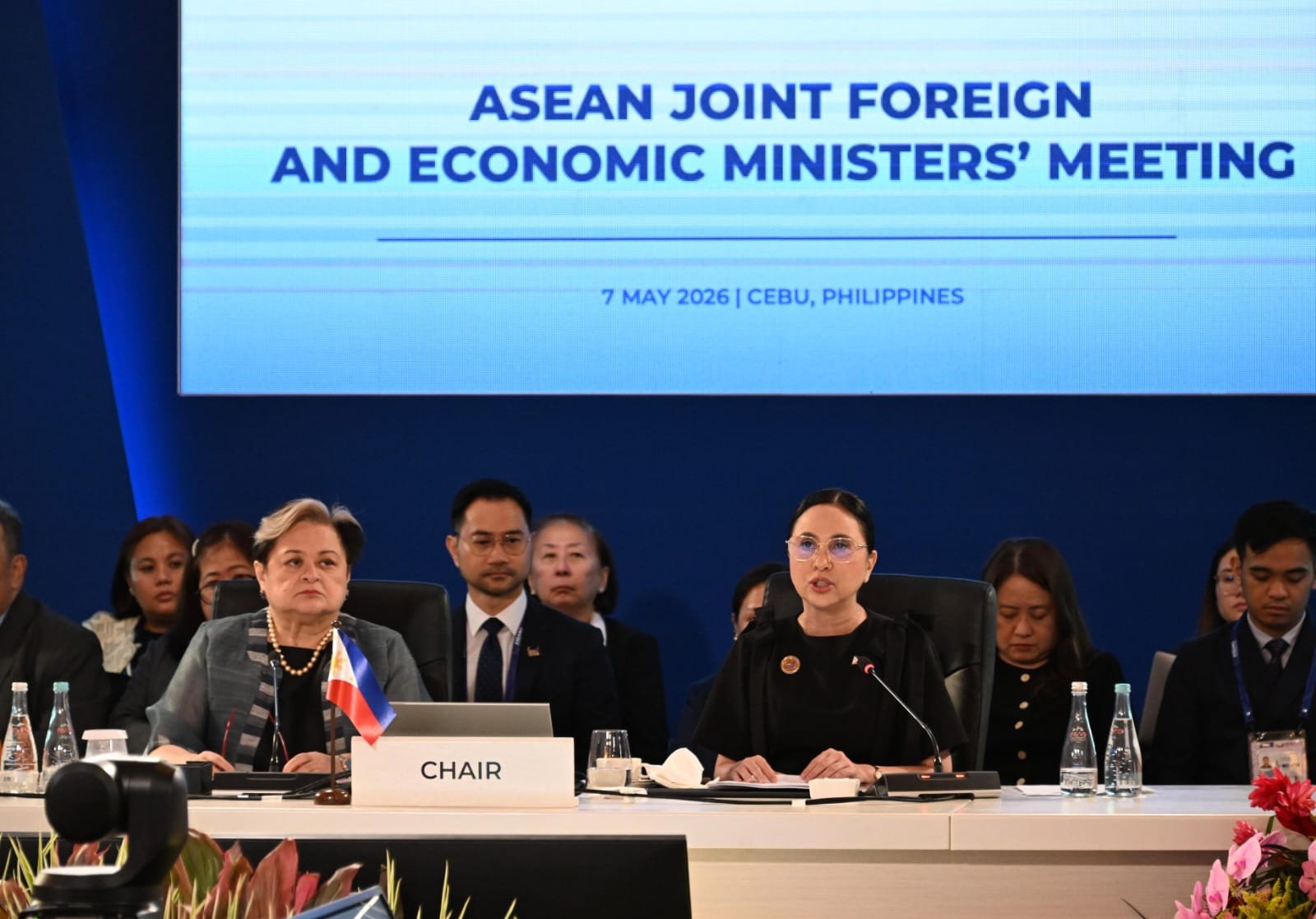
Ma. Theresa P. Lazaro and Cristina Aldeguer-Roque deliver opening remarks at the ASEAN Foreign and Economic Ministers’ joint meeting on May 7. (ASEAN Secretariat)
Ahead of the 48th ASEAN Summit scheduled for May 8, ASEAN Foreign and Economic Ministers convened a joint meeting on May 7, reaffirming their shared responsibilities in assessing and recalibrating policies in response to the Middle East crisis—a conflict that has disrupted the safety of ASEAN nationals.
The joint meeting was initiated by the ASEAN Foreign Ministers’ Meeting (AMM), chaired by Theresa P. Lazaro, Secretary of Foreign Affairs of the Philippines, following a series of the AMM special consecutive meetings held in March and April. In her opening remarks, Lazaro underscored the “urgent need” for the gathering, noting that “the challenges facing ASEAN ask us to master collective resolve”.
Echoing the AMM Chair’s view, Cristina Aldeguer-Roque, Chair of the ASEAN Economic Community Council (AECC), reinforced the significance of the meeting, observing that “the issues before us do not fall neatly into either foreign policy or economic policy. They cut across both”.
To that end, economic ministers sought to “recalibrate economic response” drawing on foreign ministers’ assessments of the situation and its evolving developments in the months ahead.
Cristina further stressed that any response must be “coordinated, practical and timely,” achievable by concentrating on clear priorities. She outlined the necessities to stabilising energy supplies, managing price pressures, mitigating risks to food security and supply chain disruptions as well as supporting businesses—particularly micro, small and medium enterprises (MSMEs)—to sustain their operations and growth.
The May 8 Summit is expected to operationalise these goals.
What does this mean for businesses?
The joint meeting signals that governments across the Southeast Asia region are moving towards a more coordinated, proactive stance in the face of external shocks. As the AECC Chair noted, “if we act together, we reinforce stability. If we act decisively, we strengthen confidence”.
With ministerial focus trained on energy supplies and supply chain disruptions, policy interventions are expected in the coming months, though businesses would do well to review their contingency plans and diversify their supplier base in the meantime.
For MSMEs specifically—the backbone of the region’s economy—the explicit mention of support mechanisms is noteworthy. Should the Summit translate ministerial intent into concrete measures, smaller enterprises may gain access to relief programmes and financing facilities to cushion the impact of rising input costs and trade disruptions amid the Middle East crisis.
About The Author

One thought on “ASEAN Foreign and Economic Ministers hold joint meeting ahead of main summit”