“We’re not replacing anyone’s job. We’re preserving what they know”
An AI startup that makes shoes, bags, jewelry, figurines and plastic goods design-ready in minutes says its real product isn’t speed. It’s the vanishing know-how of the artisans which infuse products with depth and elegance.
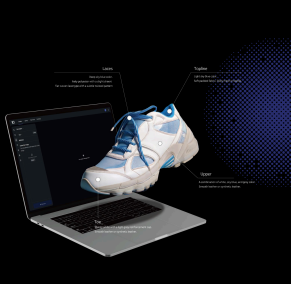
A VRING:ON-generated 3D shoe design breaks down material, colour, and construction details for each component. This is the kind of manufacturing-ready output the company says separates a buildable product from a mere rendering. (Image: RebuilderAI)
“When I first entered university, there was a professor who always said to his students’ ‘Why not?’ And I found myself wanting to live the way he said it. I was wondering how he could approach everything with that ‘why not’ attitude, believing that if you give it a try, you can make it happen. That mindset became a model for the kind of life I wanted to lead.”
Type a prompt into ChatGPT or Nano Banana today and a passable sneaker concept renders itself in under a minute. Jeonghyeon Kim, the co-founder of Rebuilder AI, doesn’t dispute that. What he disputes is that the design was never the hard part. The real question was never how to generate an attractive design, but how to turn one into something a factory can build.
Before a shoe or a bag becomes a physical object, it has to survive a transformation into materials, tolerances, cost and the thousand small physical constraints that a rendering
doesn’t know exist. That translation is what Rebuilder AI, and its platform VRING:ON, is built to automate. The distinction Rebuilder AI says most of the AI-fashion industry still elides: a pretty rendering and a buildable shoe are not the same point. The name Rebuilder AI comes directly from this gap. “Rebuild”, plus “-er,” the people who rebuild. Kim describes the company as a group taking a traditional, expertise-heavy process and reconstructing it with AI, rather than a group trying to make prettier pictures faster.
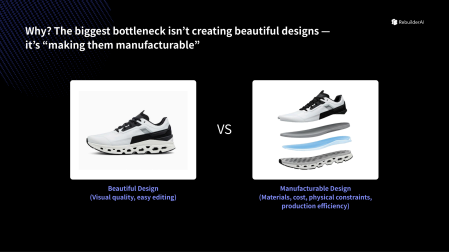
RebuilderAI’s own framing of the problem says much of the AI-fashion industry still overlooks: a visually appealing render and a design a factory can actually produce are not the same thing. (Image: RebuilderAI)
Three Months, Compressed to Under an Hour
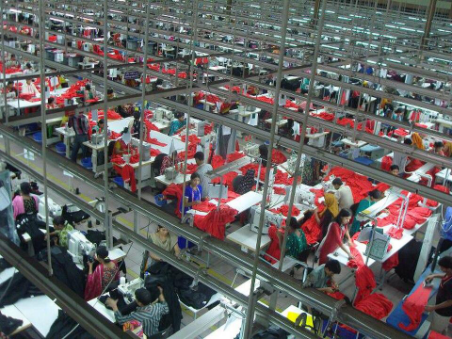
Footwear and garment manufacturing still relies heavily on manual labour. (Image: Wikimedia)
Ask Kim to describe the old way of making a shoe and he moves through it step by step, the way someone does when they’ve watched it fail too many times to summarize it. A brand’s design team sketches something. An engineering team turns it into 3D. That 3D model gets simulated to figure out how it feels underfoot, how weight distributes across a stride, how it fits against a last, the physical mold of a human foot. If the fit is off, or the simulation misses the brand’s own numeric targets, the design gets scrapped and the cycle restarts.
A single design can take weeks. Turning it into 3D adds three days to a week. Each simulation round takes roughly another week on its own. Multiplying that by the three to fifteen rounds of revision Kim says is typical, and a brand is looking at two to three months per product inside an industry where, by the company’s own figures, 68% of brands report launch delays, and each week of delay costs roughly 6% in lost revenue.
VRING:ON’s pitch is to fold that entire loop into one continuous AI workflow. A single design renders in one to two minutes. Let an AI agent handle the front end by researching competitor products, current and next-year color trends, compiling that into a brief before generating options and a finished concept takes about thirty minutes. Turning a chosen design into 3D takes roughly three minutes; separating it into manufacturable parts, running a manufacturability check and simulating it takes about ten more. A key achievement highlighted by Kim is that the AI agent operated almost autonomously, completing the entire process within one hour.
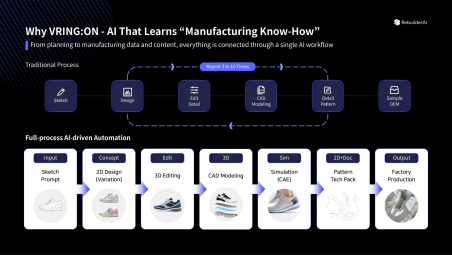
VRING:ON’s workflow compresses a process that traditionally takes weeks, from sketch to factory-ready output, into a single AI-driven pipeline. The company says the full sequence can run in under an hour. (Image: RebuilderAI)
Asics serves as a prime example demonstrating the effectiveness of Rebuilder AI. According to a case study released by the company, the Asics Institute of Sport Science, which had struggled to consistently produce innovative designs at the pace required for launching over 200 products (SKUs) annually, deployed more than 150 engineers and 100 researchers to test VRING:ON. The results showed that they were able to cut lead times by more than half and increase design efficiency approximately threefold, all while maintaining high design quality.
Why Not Just Use Other Foundation Models
General-purpose foundation models are powerful, but they weren’t built to learn the material tolerances and precision a manufacturing process demands. (Image: Wikimedia)
The obvious question that follows then is why build a proprietary foundation model at all. For instance, some luxury houses based in Paris, largely stitch together existing tools, such as Nano Banana for images, GPT or Claude for prompting, layered with brand security rather than train anything from scratch. Kim doesn’t reject the comparison so much as relocate it. For pure 2D design generation, he concedes, Rebuilder AI’s own models aren’t necessarily stronger than what’s already commercially available, and the platform lets users plug in outside models there if they prefer. The proprietary work happens one layer deeper, in what Kim calls manufacturing data, 2D pattern and stitching data on one side, 3D CAD data for molds or 3D printing on the other. VRING:ON is built as eight modules that brands assemble like blocks, with an open design layer at the front and a closed, fine-tuned manufacturing layer behind it. For instance, jewelry that will be 3D-printed and cast needs geometry accurate to within 0.02 millimeters, a precision CEO Kim says today’s general 3D-generation models can’t reliably guarantee. None of that is a matter of taste. It’s a manufacturing process, and every brand’s process is slightly different.
That is what Kim calls the feedback loop: each brand’s fine-tuned model keeps absorbing corrections as it’s used, so that a brand’s engineers are, in effect, training their own tacit knowledge like sole tolerances, material rules, in-house design language, directly into a model no other company has access to.
“We’re Not Replacing Anyone’s Job”
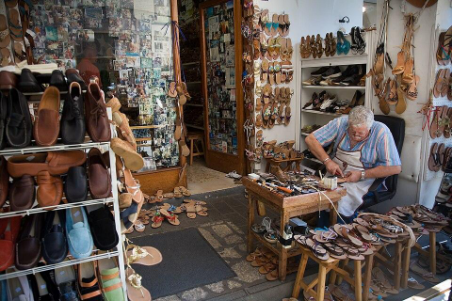
Kim says the shrinking pipeline of workers willing to replace retiring veteran staf is a growing concern across Southeast Asia. (Image: Wikimedia)
Yet, if AI for the manufacturing industry can compress two to three months of skilled labor into an hour, what happens to the people who used to do that labor?
“We view our work as preserving the knowledge and expertise that would otherwise be lost when a person leaves, effectively transforming that artisanal know-how into a permanent, secure asset for companies. Therefore, rather than offering AI services designed to replace people, we provide services that help companies build the essential assets they need.”
Kim’s answer took the question seriously rather than deflecting it. In manufacturing, he said, the anxiety is playing out now. Factories and brand partners Rebuilder AI works with are watching veteran staff, the people who hold decades of unwritten, tacit knowledge about how a product actually gets made, retire, with fewer people willing to replace them. In South Korea, and increasingly in Southeast Asia too, the pipeline of people willing to go work in a factory is thinning. Governments, Kim said, are treating this as a national-level problem, part of why, in his view, “physical AI” has become such a live category in Korean tech policy over the past year. Rebuilder AI’s framing, Kim highlighted, is not that AI takes over the industry’s job. AI catches the knowledge before the person who holds it retires, and locks it into a permanent, company-owned asset instead of letting it disappear. On the design side specifically, Kim was direct that human creativity is not something the company is trying to automate at all. Here, the AI’s role there is closer to a research assistant while the person still makes the call.
Asia Isn’t a Starting Point. It’s the Advantage.

Capital and brand partnerships move across borders. (Image: Wikimedia)
“I think that, fundamentally, software companies must compete with global players. The global market sets the standard. It does not matter whether a company started in Korea or the US”
The founder of Rebuilder AI is clearly aware of the fact that software has to compete globally. However, the CEO thinks that the fact that a manufacturing AI company was founded in South Korea shouldn’t matter as much as it once did. While venture capital tends to prize American platforms and European brand heritage, and Korea’s usual pitch to the world runs through K-pop and K-beauty, Kim argues Asia’s real underlying asset is manufacturing itself: China and Southeast Asia are where the world’s goods are actually made, and Korea and Japan are where much of the traditional know-how and artisan expertise that makes manufacturing work still lives.
That, in Kim’s account, is the concrete reason the company’s manufacturing-data models are trained on data drawn from Korean and Japanese partners rather than treating geography as incidental. It’s also, he said, the basis on which he expects Rebuilder AI to compete for global capital and global brand partnerships going forward.
Southeast Asia Is Already the Important Client

Southeast Asia is already an undeniable client and market for RebuilderAI. (Image: Wikimedia)
For a Southeast Asia-focused publication, the more immediate news may be how far along that expansion already is. Rebuilder AI already works with ODM and OEM manufacturers across Southeast Asia mainly in footwear and figurines, with jewelry manufacturing still concentrated in Italy, Japan and Korea. As the company pushes further into manufacturing automation rather than just design software, he framed Southeast Asia as the primary target market. The tacit knowledge the company has learned from Korean and Japanese partners is meant to be applied and automated at scale specifically in Southeast Asian factories.
Much of Rebuilder AI’s Southeast Asian work, he noted, still runs through partners headquartered in Korea, and the company has done comparatively little to introduce itself directly to Southeast Asian brands and manufacturers on its own terms. Getting in front of that audience and potential partners, more than any single deal, was what pushes his company forward.
Moreover, Rebuilder AI shared current clients and partners’ names: Hong Kong ODM group Dream International; luxury house MCM; jewelry brand Dorocy; handmade-footwear label Movlon; and bag and apparel names including Benatto, STCO, André Kim and Arthur & Grace. At VivaTech Paris in June, the company exhibited with several of these partners directly to demonstrate, physically, that an AI-generated design could be traced all the way to a manufactured object. Kim said the next version of that demonstration, planned for a US exhibition in 2026, will push one step further: connecting manufacturing data not just to factory production, but to the humanoid robots and robotic arms that might eventually build the product itself.
Whether Rebuilder AI’s bet pays off will depend on things outside its control, whether brands trust a startup’s proprietary model with their manufacturing rules, whether “physical AI” turns into policy and capital rather than a slogan, whether the factories it’s targeting in Southeast Asia want to be automated at the pace Kim is describing. But the pitch itself is unusually specific for an industry currently flooded with good-looking pictures, not a faster way to imagine a product, but a way to keep the knowledge of how to build one from disappearing along with the people who hold it.
“I believe that human creativity and the artistic aspect of humanity are realms that AI cannot touch. Therefore, I view AI as merely a tool that can support human creativity, experiences, and ideas. In line with this perspective, we are developing design modules specifically designed to provide that kind of support.”
About The Author