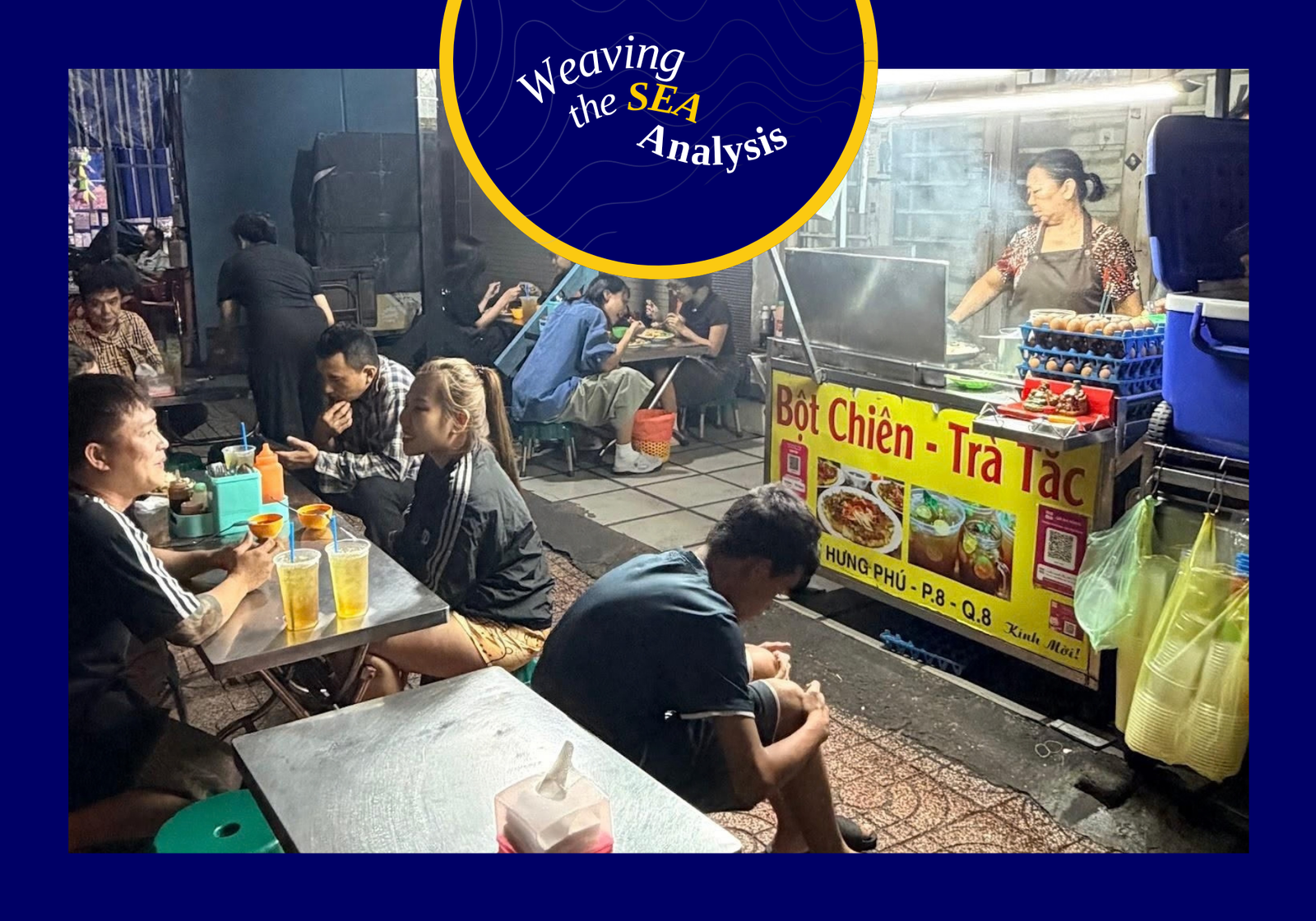
Mr. Tuấn’s food cart stall at 9 p.m. in Ho Chi Minh City, Vietnam (Trần Bảo Ngọc)
This is a top 10 entry in the Weaving the SEA Essay Competition 2026, written by Trần Bảo Ngọc. Her essay reads the food cart and its low plastic stool as a shared social institution across Vietnam, Indonesia and Thailand, one that levels social class even as air-conditioned urbanism closes in on it.
If one were to select an image visible across almost every Southeast Asian metropolis, from Ho Chi Minh City at six in the morning to an alleyway in Yogyakarta at midnight or a market corner in Bangkok in the heat of mid-afternoon it would be neither a monumental architectural structure nor a government-sanctioned cultural emblem, but rather a mobile food cart alongside a stack of low plastic stools. Known in Vietnam as xe đẩy, in Indonesia as kaki lima, and in Thailand as rot khen. The mobile cart and the low plastic stool constitute not merely a culinary enterprise, but an informal social institution. Within this institution, Southeast Asian identity is articulated through daily spatial practices rather than grand national monuments. It is a cultural practice currently facing severe pressure from the encroaching model of air-conditioned, enclosed urbanism.
A Regional Shared Form
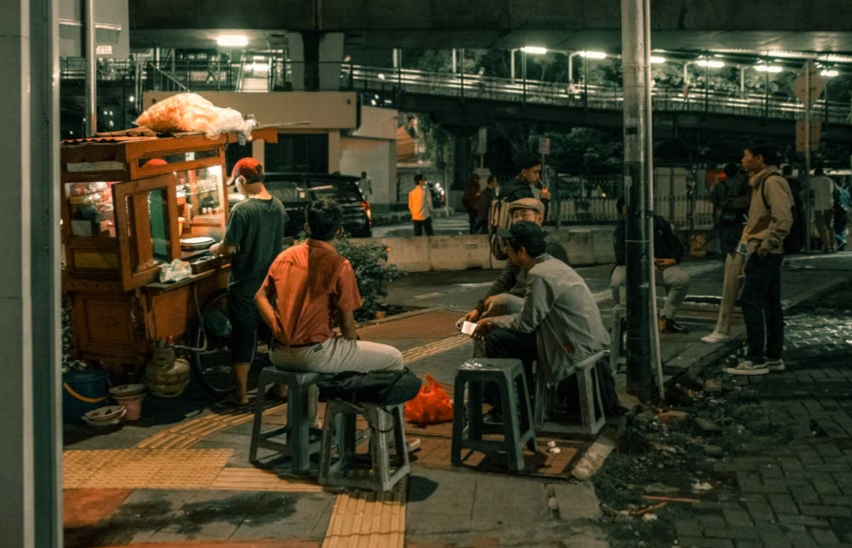
A street food vendor at night with people gathered, in Indonesia. (Pexels/Dee Onederer)
The first notable aspect is the structural similarity of the food cart across the entire region, despite significant differences in language, religion and political history among these nations. In all three countries, the cart is constructed on a wooden or metallic frame mounted on wheels, topped with a cooking surface that doubles as a counter, utilising mini gas canisters or charcoal stoves as heat sources. The Indonesian designation kaki lima (literally “five feet”: two wheels, one kickstand, and the vendor’s two feet) provides an accurate description of this structural morphology, which applies equally to a hủ tiếu cart in Ho Chi Minh City or a som tam cart in Bangkok.
This regional similarity extends to the accompanying condiment arrangements. Atop the cart, diners almost invariably find an array of condiments to adjust their meals. The custom whereby diners self-season, add sauces or introduce chili is a shared regional norm, transforming the meal from a passively consumed finished product into a participatory practice involving both vendor and diner. A methodological note must be stated: this paper does not propose a definitive historical etiology for the food cart. A common explanation, that it emerged due to rapid urbanisation and tropical climate constraints making indoor cooking inconvenient which appears plausible but remains unverified by empirical documentary evidence. Consequently, the arguments presented herein are constructed entirely upon contemporary empirical observations.
The Economics of Low Entry Barriers
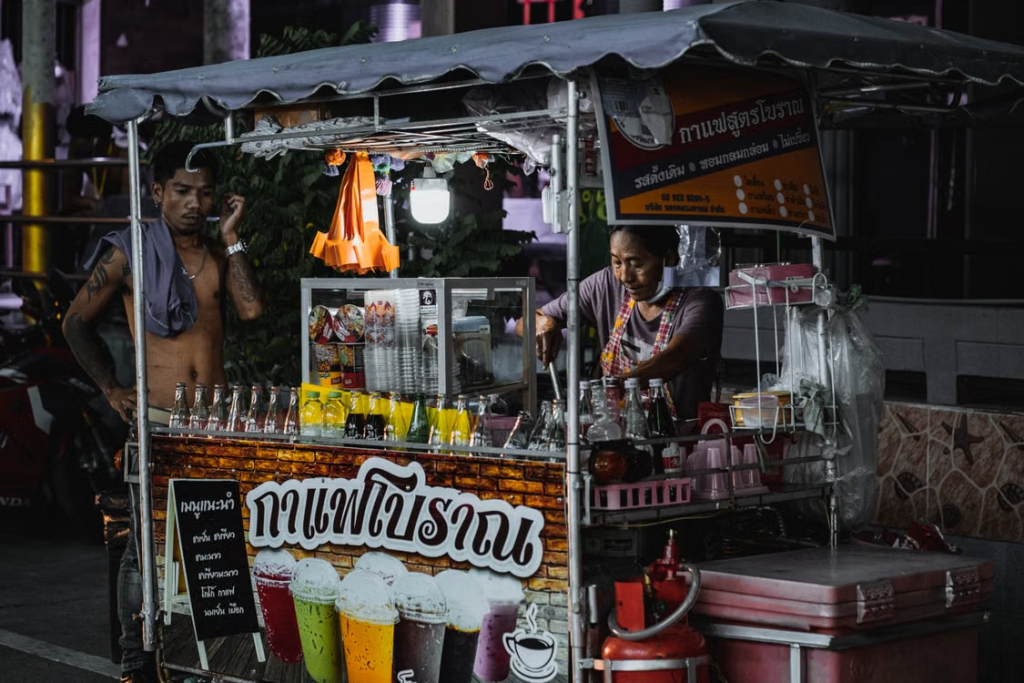
Two vendors operating a colorful beverage cart in Bangkok at night. (Pexels/Nandhu Kumar)
Informal employment accounts for the majority of the workforce in developing Southeast Asian nations, with street vending representing one of its most prevalent modalities. The food cart serves as a primary point of entry into this economic realm due to its minimal capital requirements: vendors require neither land leases, formal business registration, nor hired labor beyond family members. The entire physical capital, comprising the cart, pots, stove and a few dozen plastic stools can be acquired at a cost substantially lower than renting a market stall.
Pausing in front of 146 Hưng Phú Street in Ho Chi Minh City at 9 p.m. reveals the peak operating hours of Mr. Tuấn (54), originally from Bình Định Province, who has sold street food on this sidewalk for nearly 20 years. His cart is fitted with a cast-iron skillet over a gas burner below, compartments for egg trays and clean plates, and recently, a custom front-mounted smoke exhaust unit. Having migrated to Ho Chi Minh City in the early 2000s, he pursued various livelihoods before establishing his vending business here.
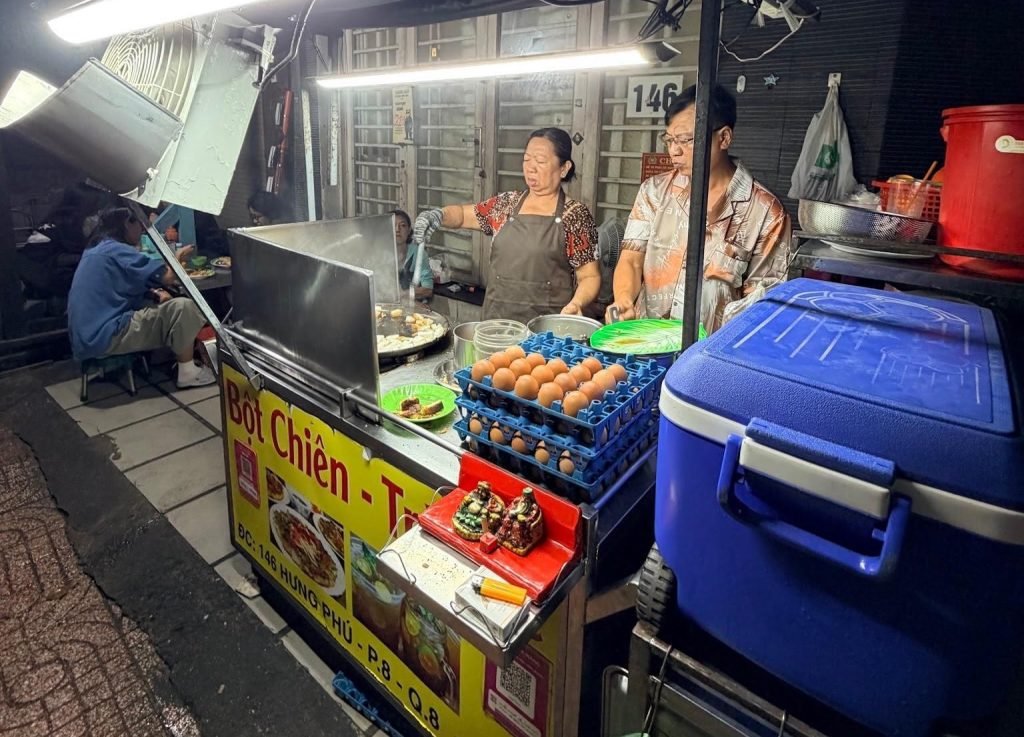
Mr. Tuấn’s fried rice cake cart in Hưng Phú Street in Ho Chi Minh City. (Trần Bảo Ngọc)
His initial capital was a modest 5 million Vietnamese dong (192.5 US dollar): 40% for building the cart, 17% goes to the plates, skillet and gas cylinder, while 20% of it are used for plastic tables and stools purchased at Chợ Lớn Market. The remaining capital was allocated to raw ingredients. His daily routine begins at 1 p.m. with ingredient delivery and preparation. At precisely 5 p.m., he pushes his cart to the designated spot and sets up the tables and stools. Operating late into the night, sometimes until 2 a.m., he sells over 200 portions of fried rice cakes (bột chiên) every night.
This low-barrier entry is intrinsically tied to legal precariousness. Periodic sidewalk clearance and “order enforcement” campaigns are conducted regularly across all three cities cited above. The Bangkok municipal authority’s 2016 campaign banning street vendors in famous street food zones serves as a widely documented international case in point. Consequently, food cart vendors exist in a state of institutional tolerance paired with perpetual vulnerability to eviction, which is a fundamental condition of their existence rather than an exceptional state.
The Low Plastic Stool: An Emblem of Egalitarianism
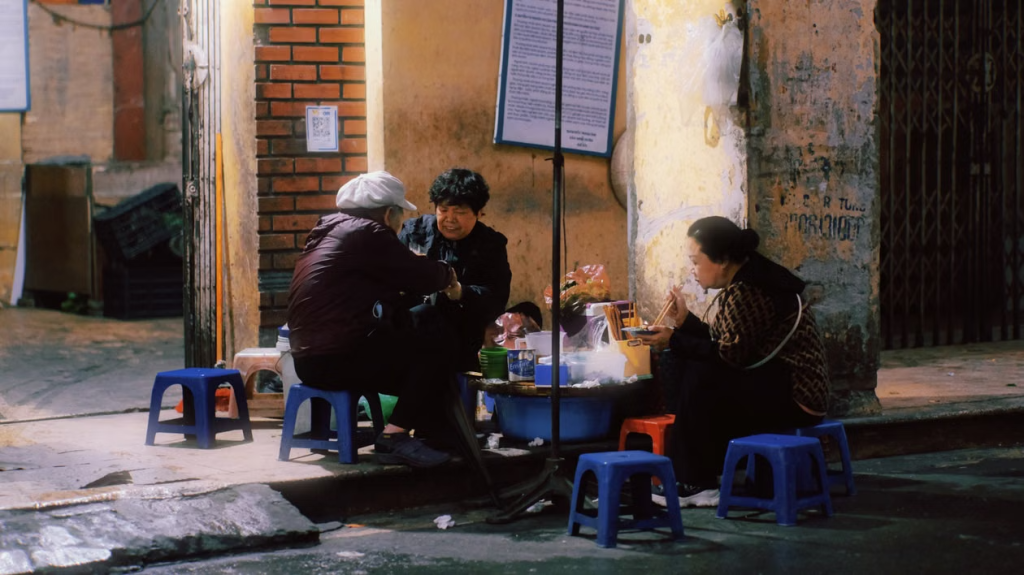
Locals enjoy street food in Hanoi’s night market on low plastic stools. (Pexels/Hòa Lê Đình)
The central thesis of this paper rests upon the stool itself. Monolithic, stackable low plastic stools with virtually identical designs are ubiquitous across all three countries, characterised by a uniform height of merely 25 to 30 centimetres. This low elevation eliminates any possibility of maintaining a formal posture. Every diner must bend their knees and stoop forward toward the food. The physical space surrounding the cart operates under an egalitarian logic; the sole governing principle is “first come, first served.”
Consequently, an urban social phenomenon emerges that other dining formats fail to replicate: direct contact between individuals from disparate social strata. A university student and a manual laborer sit at the same table, breathe the same humid night air, pay the identical price and are served according to the same sequence.
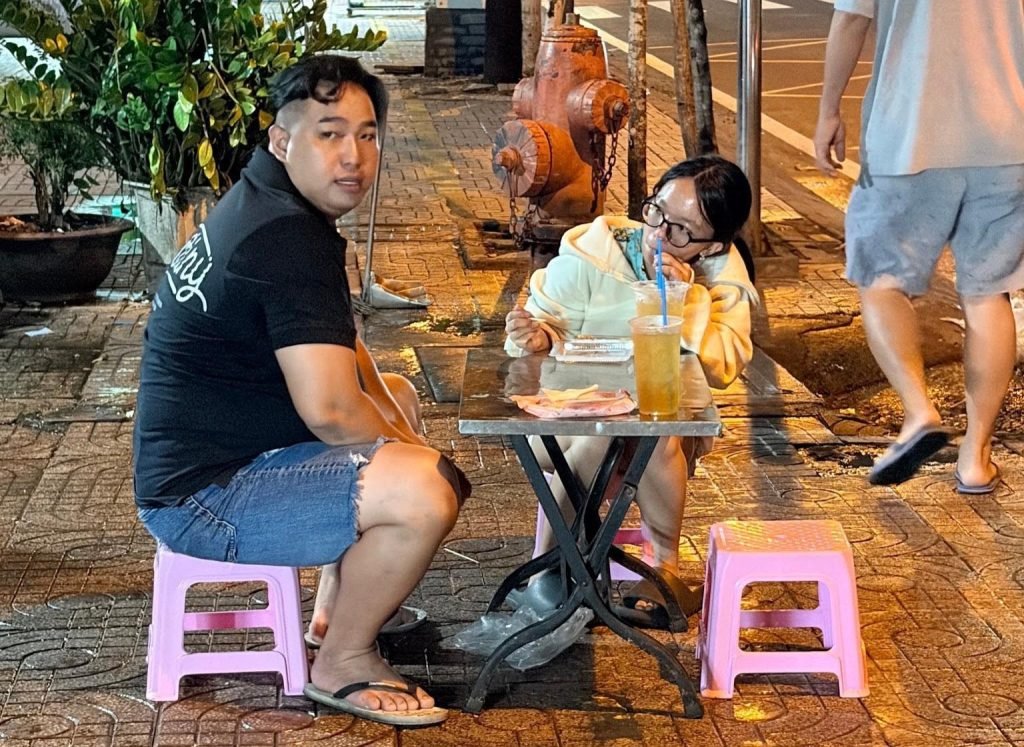
Patrons waiting for their food on Mr. Tuấn’s fried rice cake cart, still on low plastic stools. (Trần Bảo Ngọc)
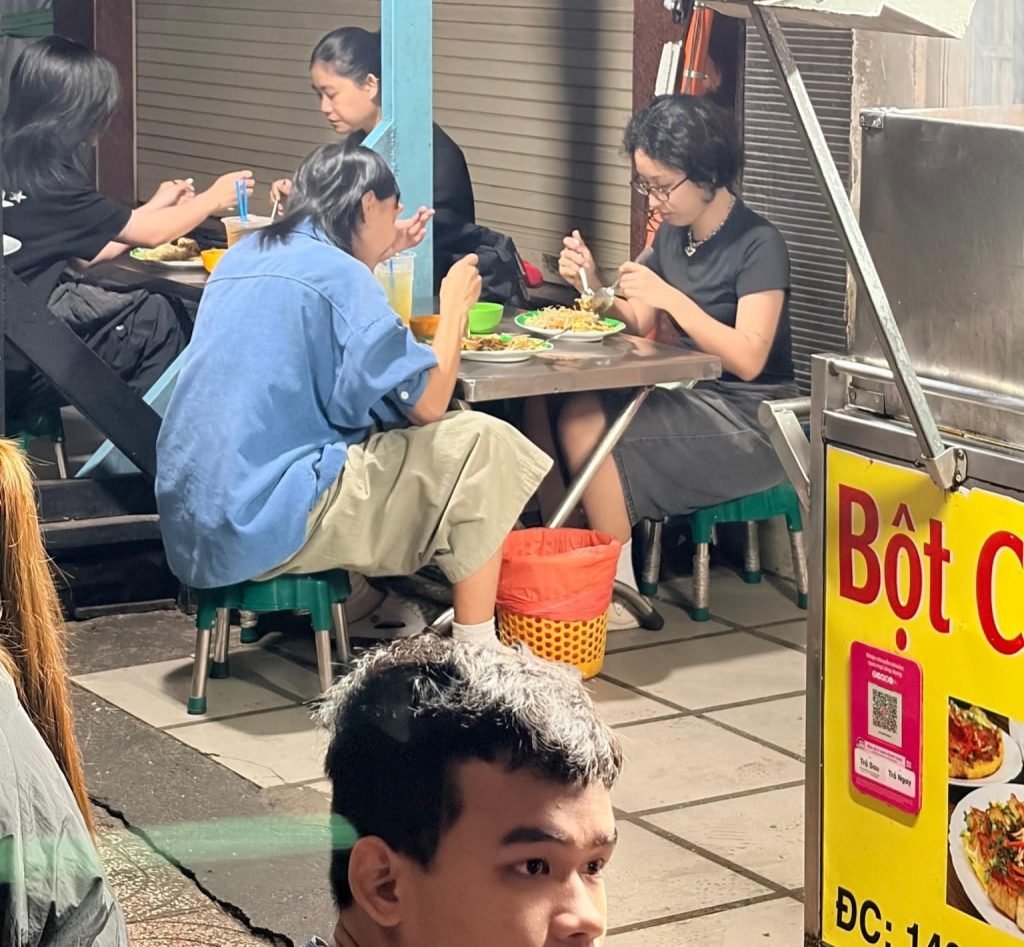
Patrons eating their food on Mr. Tuấn’s fried rice cake cart, still on low plastic stools. (Trần Bảo Ngọc)
These ephemeral material objects and intimate spatial interactions effectively level social class boundaries. The low plastic stool functions not merely as seating furniture, but as a unique social device: space where individuals discard status barriers, returning urban inhabitants to the most fundamental and genuine forms of social connectivity in the heart of the city.
The Encroachment of Air–Conditioned Urbanism
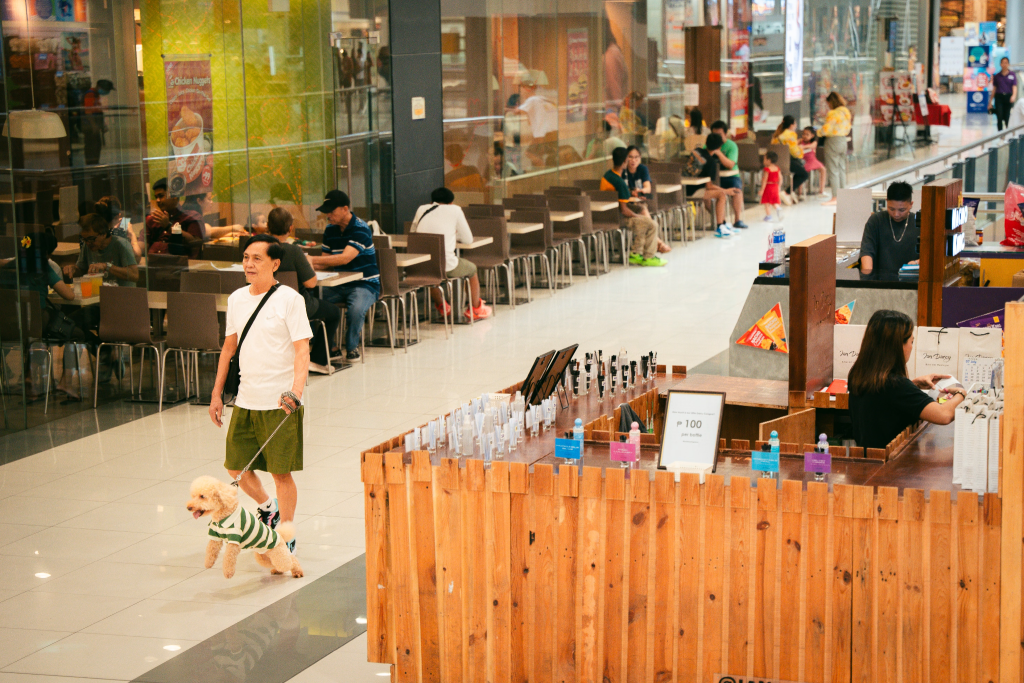
An indoor dining area in a mall in the Philippines. (Pexels/Kenneth Surillo)
From the preceding analyses, a broader conceptualisation of Southeast Asian urban identity can be synthesised. While regional identity is frequently sought in monumental markers like architectural heritage, official festivals or formal ASEAN charters, the genuine commonalities across regional societies reside within the realm of everyday practice: the habitus of utilising sidewalks as social living spaces, the routine of outdoor dining among strangers and the cultural acceptance that a meal may unfold wherever wheels can be parked. This represents an embodied, lived identity rather than a declared ideology, most vividly manifested around the food cart.
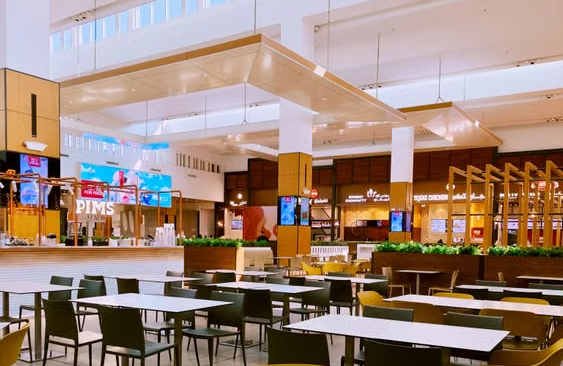
A food court area inside a mall in Indonesia. (Pexels/dwi endah kusumawati)
However, this lived identity is increasingly threatened by contemporary urban development trajectories. Air-conditioned shopping malls and corporate food courts represent the fastest-growing dining spaces in the region’s megacities; food delivery applications foster a generation accustomed to solitary dining; and municipal sidewalk regularisation campaigns continuously restrict street vending zones. While a mall food court may serve the exact same culinary dishes in a cleaner, cooler environment, its private tables and elevated chairs systematically eliminate the precise physical architecture that enables cross-class social encounter. What is lost is not the dish itself, but the twenty-centimeter physical proximity between the knees of two strangers.
The mobile food cart and its stack of low plastic stools constitute a shared material morphology across Southeast Asian metropolises, an entry point into the informal economy enabled by low capital thresholds, and, above all, an egalitarian social institution derived from its minimalist physical design. Accordingly, regional identity should be understood through everyday spatial practices and informal modes of sociability rather than through grand institutional symbols. As Southeast Asian urban landscapes become increasingly dominated by enclosed, air-conditioned and socially stratified environments, the humble food cart serves as a vital reminder that urban space must remain open, warm and accessible. Ultimately, the capacity to sit down alongside anyone remains the fundamental glue binding social life across the region.
About The Author