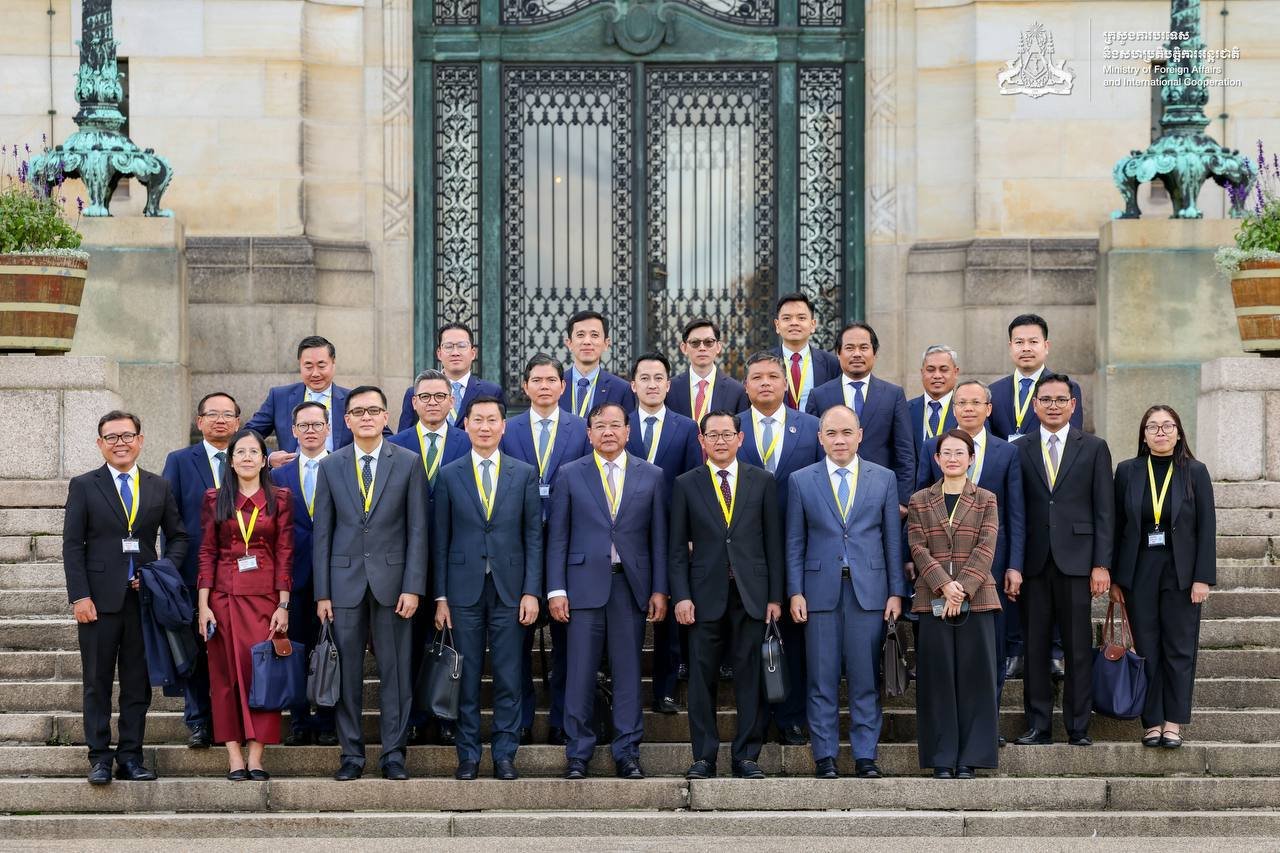
Cambodia’s delegation during the second meeting of the UNCLOS Conciliation Commission with Thailand. (Ministry of Foreign Affairs and International Cooperation)
Cambodia and Thailand have agreed on confidence-building measures during their latest round of UN-led conciliation talks, continuing efforts to resolve longstanding differences over their maritime boundary under international law.
The second meeting of the Conciliation Commission under the United Nations Convention on the Law of the Sea (UNCLOS) was held in The Hague, the Netherlands, from October 14 to 18. It followed the commission’s first meeting in Singapore, where both countries adopted the Terms of Appointment and finalised the Rules of Procedure governing the conciliation process.
The Cambodia’s Ministry of Foreign Affairs and International Cooperation (MFAIC) stated that the latest measures are intended to strengthen mutual trust and create conditions for constructive negotiations. Both countries retain the right to make statements to protect their legitimate interests or correct factual misinformation and disinformation.
The commission also noted that previously agreed measures between the two countries had not been fully implemented. It urged both sides to fulfil their existing commitments, saying their implementation was important to advancing the conciliation process.
Cambodia’s delegation was led by Deputy Prime Minister and Foreign Minister Prak Sokhonn, while Thailand’s delegation was led by Deputy Prime Minister and Foreign Minister Sihasak Phuangketkeow. The Permanent Court of Arbitration (PCA) served as the commission’s registry.
Cambodia has sought a comprehensive maritime boundary agreement with Thailand, while also proposing joint development and equitable resource-sharing as alternatives while a final settlement remains pending. Thailand has said its participation in the conciliation process is aimed at achieving an equitable maritime boundary in accordance with international law.
The latest meeting offers a diplomatic opening, but the failure to fully implement earlier commitments raises questions about whether conciliation can deliver lasting progress amid heightened regional tensions. If confidence-building measures remain unfulfilled, the maritime dispute could further strain bilateral relations, weaken trust between neighbouring states and complicate ASEAN’s efforts to maintain regional stability. The challenge is not only to secure a mutually acceptable maritime boundary, but to prevent unresolved claims from becoming a wider source of regional friction.
About The Author