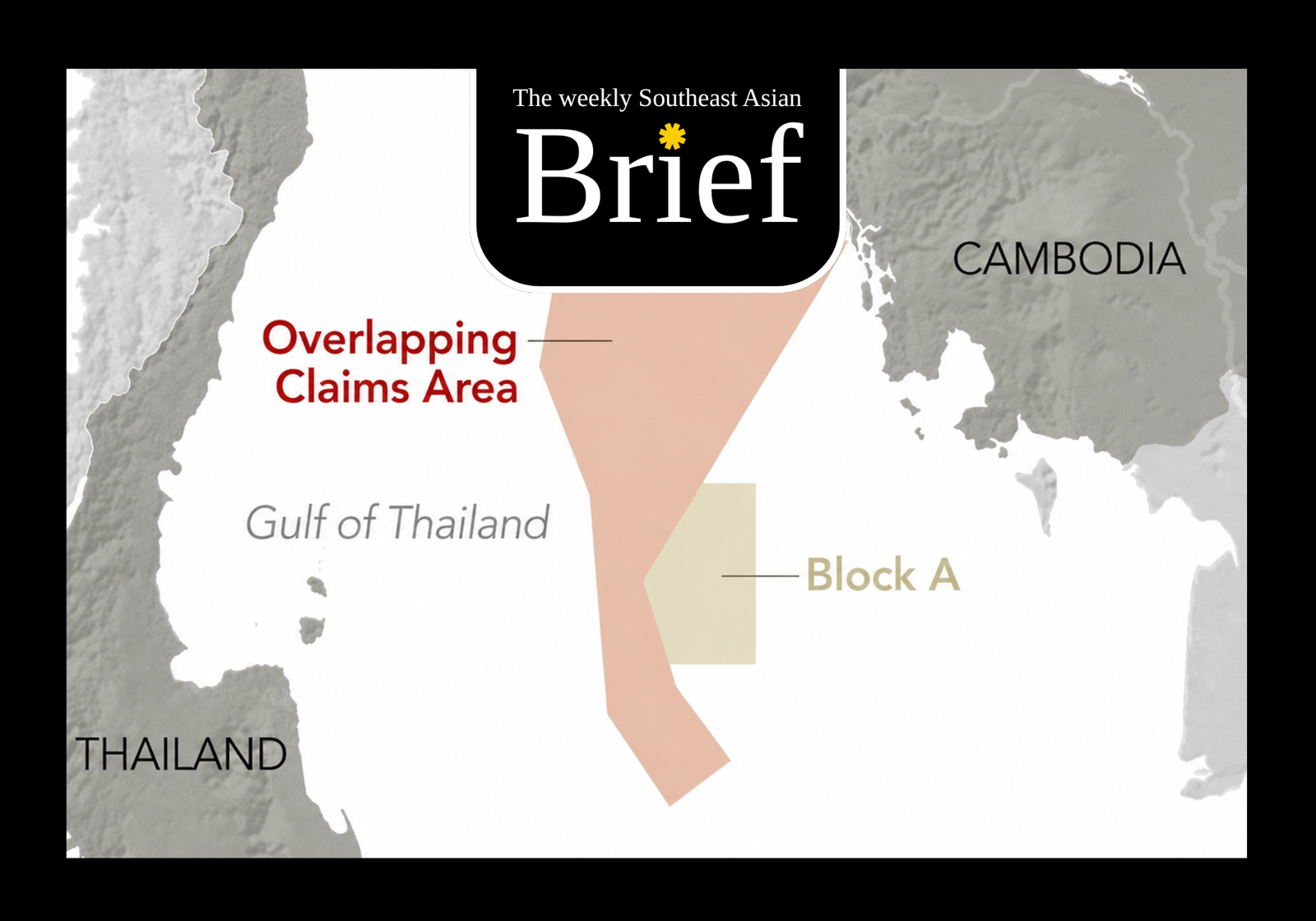
Overlapping maritime claims between Cambodia and Thailand around the Koh Kut island. (Thailand’s Department of Energy)
On July 19, Cambodia confirmed that it had reached an agreement with Thailand in regard to both countries’ maritime dispute around Koh Kut Island to allow additional time for the appointment of the Conciliation Commission under the United Nations Convention on the Law of the Sea (UNCLOS), describing the delay as “modest and entirely appropriate.” The extension followed a joint request by the four appointed conciliators and backed up by the Cambodian government that it will not affect any prescribed timeline or procedural step under the UN-backed process.
The announcement comes weeks after Phnom Penh formally initiated conciliation proceedings under UNCLOS to address its long-running maritime dispute with Bangkok in the Gulf of Thailand, following the latter’s withdrawal of the Memorandum of Understanding (MoU) 2001 on May 5. Cambodia has presented the mechanism as a peaceful, rules-based means of resolving overlapping maritime claims, while Thailand has agreed to the procedural extension without altering its own legal position on the dispute, reflecting longstanding differences over the issue.
The disagreement revolves around the waters surrounding Koh Kut (also known as Koh Kood in Thailand). While the island is recognised as Thai under the 1907 Franco-Siamese Treaty, Cambodia’s 1972 maritime baseline claim cuts through the waters to the south of and around the island, creating an area of overlapping claims over a maritime area estimated at around 26,000 square kilometres.
Cambodia argues that historical agreements dating to the French colonial period support its claims, while Thailand maintains that the maritime boundary should primarily follow the equidistance principle under UNCLOS. Beyond questions of sovereignty, control over maritime areas carries implications for long-term energy security, economic development and access to commercially valuable resources, especially as the area potentially has offshore oil and natural gas resources..
One of the most significant attempts to address the issue came in 2001, when Cambodia and Thailand signed a MoU 2001 establishing a framework for negotiating maritime boundaries and exploring the joint development of offshore hydrocarbon resources. However, the initiative became politically contentious in Thailand, where concerns over sovereignty generated strong domestic opposition. Subsequent political instability in Thailand meant that negotiations made little substantive progress, leaving the overlapping claims unresolved.
Unlike the two countries’ land border dispute around the Preah Vihear Temple, which resulted in military clashes between 2008 and 2011, the Gulf of Thailand dispute has remained comparatively stable. Although both countries have periodically increased naval patrols during
offshore exploration activities, neither has pursued sustained military escalation at sea. Instead, successive governments have largely relied on diplomatic engagement while continuing to defend their respective legal positions.
Phnom Penh’s decision to initiate the UNCLOS conciliation process represents a novel legal avenue. Unlike proceedings before an arbitral tribunal or the International Court of Justice, conciliation does not produce a legally binding decision. Instead, a five-member Conciliation Commission independently examines the legal and factual issues, hears submissions from both parties and produces recommendations intended to facilitate a negotiated settlement.
Cambodia’s decision to pursue conciliation is consistent with Prime Minister (PM) Hun Manet administration’s stated emphasis on resolving disputes through international law and multilateral diplomacy. This preference also reflects a harder calculation that Cambodia’s military remains weaker than Thailand’s, a gap shown during the 2025 Preah Vihear clashes. Pursuing conciliation lets Phnom Penh press its case on courts and commissions rather than the battlefield. By placing the dispute within the UNCLOS framework, Cambodia has underlined its preference for legal and diplomatic mechanisms while maintaining its claim over the disputed maritime area. The process also allows Cambodia to pursue negotiations without seeking an immediately binding legal determination of the maritime boundary.
Thailand’s calculations are more nuanced. Maritime sovereignty has long been politically sensitive, particularly following the controversy surrounding the MoU 2001 and previous border disputes with Cambodia. Domestic pressure forces any sitting government to avoid the perception of compromising territorial claims. Participating in conciliation, while maintaining its legal position, allows Thailand to demonstrate support for peaceful dispute resolution without committing itself to a binding legal outcome.
The tension also carries economic risks, particularly for offshore energy development, which requires significant financial commitments and regulatory certainty.A prolonged dispute could also affect economic confidence, particularly for cross-border trade, tourism and investment. While the maritime dispute has not directly disrupted economic activity, continued tensions could increase uncertainty for businesses.
Whether the proceedings ultimately lead to a negotiated outcome will depend largely on the willingness of both governments to engage with the Commission’s recommendations. If the process contributes to greater political confidence, it could create opportunities for renewed negotiations on maritime delimitation or for discussions on the joint development of offshore energy resources without requiring either side to resolve the sovereignty question immediately. Similar arrangements have been adopted elsewhere, notably to sooth the dispute between Indonesia and Malaysia in the oil rich maritime area of Ambalat, allowing states to cooperate economically while setting aside unresolved boundary issues.
Conversely, if wider bilateral tensions reduce the scope for compromise, the non-binding nature of conciliation means that the Commission’s recommendations may not lead to substantive progress. Nevertheless, the continued participation of both Cambodia and Thailand in the UNCLOS process demonstrates a shared preference for managing the dispute through recognised legal mechanisms rather than confrontation. Failure to reach a compromise could prolong uncertainty over offshore resources, reinforce security concerns and deepen political mistrust between the two countries, while projecting the degradation of the international framework as a mechanism for dispute resolution.
About The Author