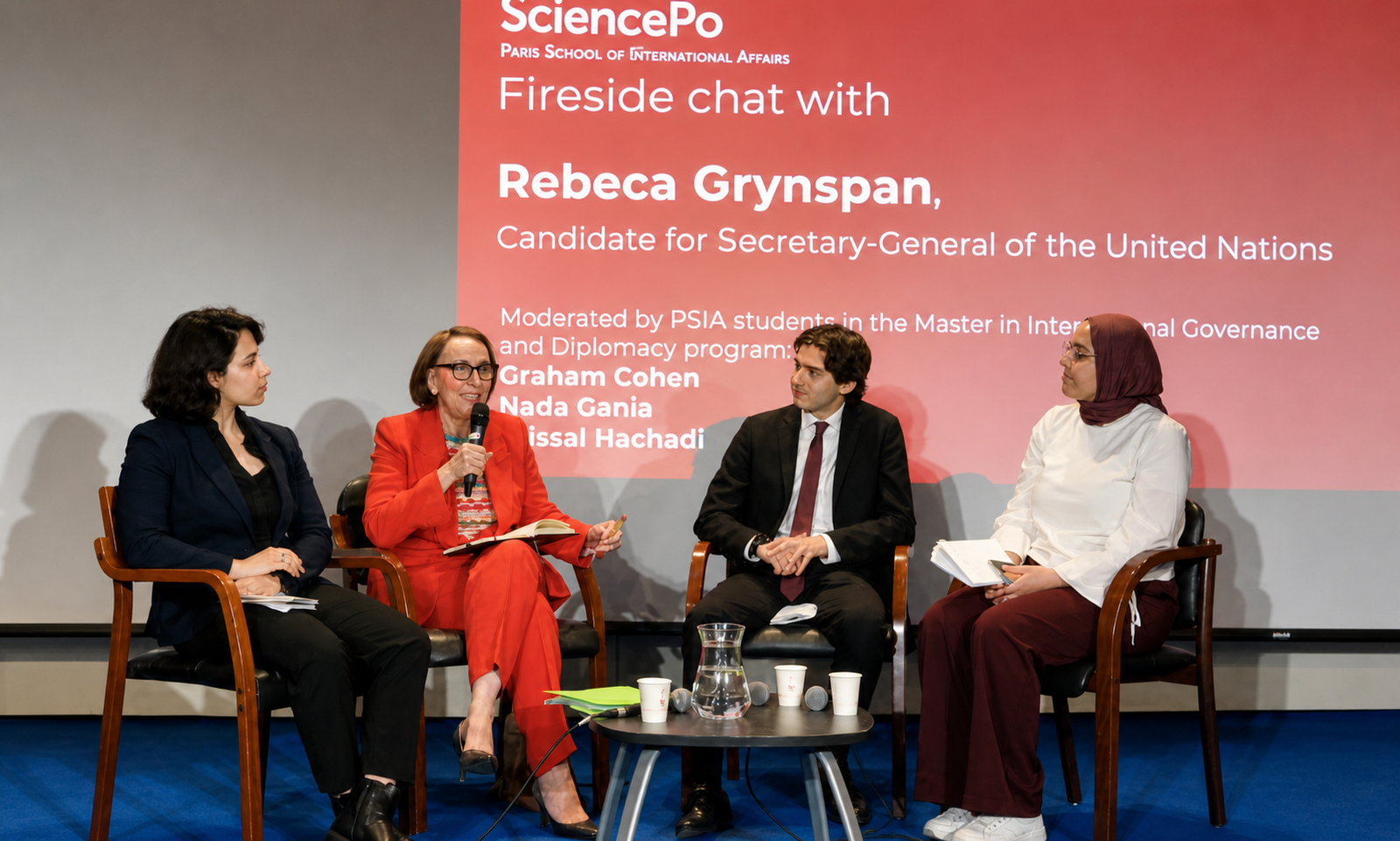
Rebeca Grynspan, Costa Rican candidate for UN Secretary-General and head of UNCTAD, speaks at a fireside chat at Sciences Po Paris on April 28, 2026. (SEA Daily/Protasius Isyudanto)
Former Costa Rican Vice President Rebeca Grynspan, a contender to succeed António Guterres as United Nations Secretary-General (UN SG) in 2027, framed Southeast Asia as a natural anchor of the multilateral system during a fireside chat at Sciences Po Paris on April 28, where she laid out a managerial pitch for the UN’s top job.
Asked about the region’s place in a reformed UN, Grynspan described the present moment as “the Asian century,” noting that all recent graduations from least developed country (LDC) status have come from Asia. She voiced hope that Southeast Asia—populated largely by middle powers traditionally invested in rules-based cooperation—would consolidate its economic gains and grow into a more decisive voice in shaping the emerging multipolar order.
Grynspan, currently Secretary-General of the UN Conference on Trade and Development (UNCTAD), is positioning herself as a managerial reformer rather than a purely political figurehead. She argued that the UN’s credibility has been eroded by its absence from the world’s main negotiating tables, despite the highest number of active conflicts since 1945. “The UN is not at the negotiation table,” she said, calling a return to mediation her foremost priority. She cited her own role in brokering the Black Sea Grain Initiative between Russia and Ukraine as a model of fast, flexible diplomacy, and argued that effective mediation requires the institutional courage to absorb repeated rejection from member states.
On reform, Grynspan described “unhealthy competition” and duplication between UN agencies, and warned that capacities once concentrated in New York and Geneva now sit with states, the private sector and civil society. The UN, she suggested, must partner and convene rather than attempt to do everything itself, defending the organisation’s irreplaceable role in delivering large-scale, non-discriminatory humanitarian assistance.
She also took aim at the UN’s communication culture, which she described as so saturated with jargon that it had become disconnected from the publics it claims to serve. Grynspan acknowledged the UN’s deepening financial squeeze, insisting that member states must honour their assessed contributions and that greater cost transparency is needed before serious reprioritisation can occur. Pressed for specifics on how she would reallocate scarce resources, however, she declined to be drawn, saying such decisions should not be announced publicly.
Grynspan currently trails Argentina’s Rafael Grossi, Director General of the International Atomic Energy Agency, in early market-based indicators. Polymarket places Grossi’s odds at around 63% against Grynspan’s 14%, with the UN Security Council expected to begin its formal winnowing of candidates later this year.
About The Author