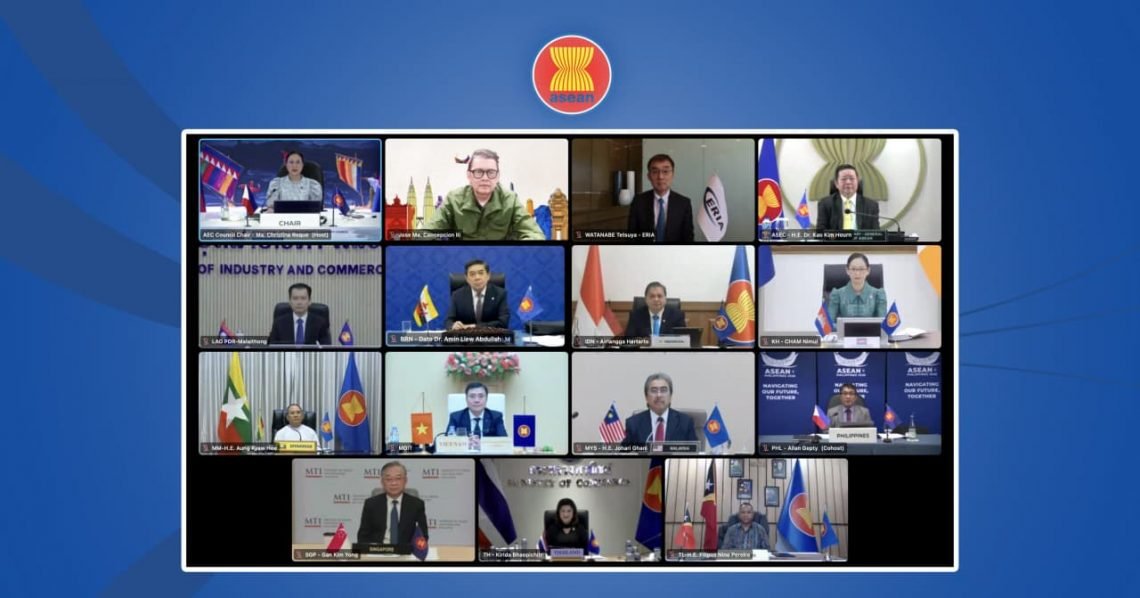
ASEAN Economic Community Council (AECC) holds a special meeting to discuss energy and food security threats amid escalating Middle East tensions on April 30. (ASEAN)
Presiding over the ad hoc video conference, Cristina convened AECC ministers to assess the significant economic ramifications stemming from the Middle East conflict.
Central to the discussion was a coordinated response to safeguard energy and food supply chains, which face cascading disruptions from rising tensions in the Strait of Hormuz. As Cristina noted, “we notice that geopolitical tensions are already affecting economic stability in ASEAN. These include pressures on energy supply, rising transport and logistics costs, and the risk to food security.”
On the following day, a joint statement was published elaborating the meeting’s key outcomes. These included support for initiatives from relevant ministries—namely, efforts by ASEAN energy ministers to maintain regional energy supply chains, and work by ASEAN agriculture ministers to safeguard regional food security.
In addition, responding to the disproportionate impact on lower-income households and smaller economies, AECC ministers also mandated Senior Economic Officials to fast-track the formulation and monitoring of a regional strategy, to be completed within the year. Ministers advised that this process draw on insights from relevant think tanks, including the Economic Research Institute for ASEAN and East Asia (ERIA).
All outcomes from the meeting will be brought to the 48th ASEAN Summit, scheduled for May 6 to 8.
What does this mean for businesses?
Southeast Asia’s trade-dependent economies are acutely exposed to global supply chain shocks. A key vulnerability is energy: the region relies heavily on fossil fuels transiting the Strait of Hormuz, and any disruption at this chokepoint ripples swiftly through regional markets—driving up transport costs and fuelling broader cost-of-living pressures felt most sharply by vulnerable households and small businesses.
Micro, Small and Medium Enterprises (MSMEs), the backbone of most ASEAN economies, are particularly at risk, as rising input costs can be existential for smaller players. The AECC’s mandate to fast-track an inclusive regional strategy—informed by bodies such as ERIA—is therefore a critical step.
The 48th ASEAN Summit is the moment to turn these commitments into concrete action. How member states prioritise MSME resilience and energy supply diversification will signal how prepared the bloc truly is.
About The Author