
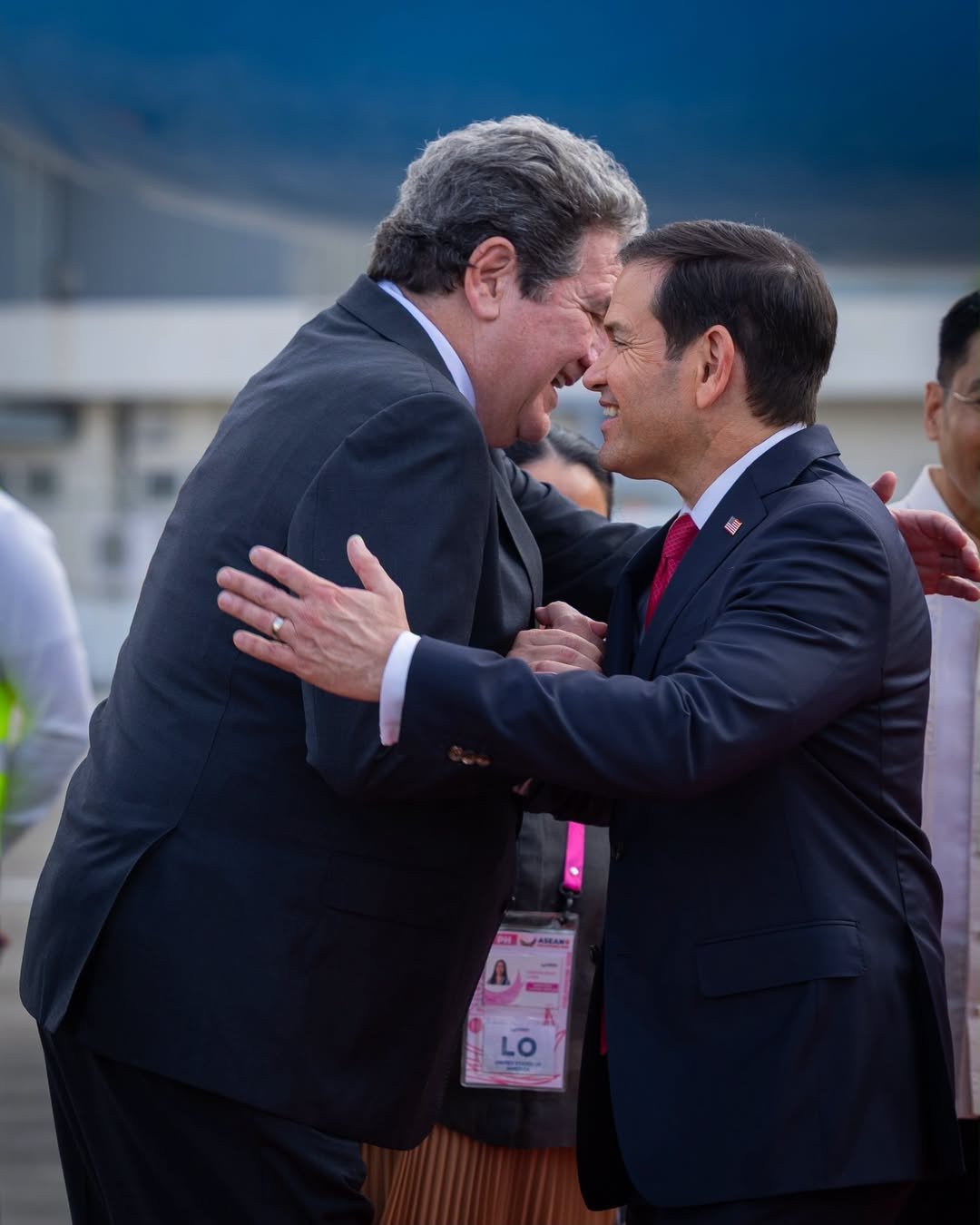
US Ambassador to the Philippines Lee Lipton welcomes US Secretary of State Marco Rubio upon his arrival in Manila on July 21, ahead of ASEAN-related meetings and bilateral talks. (US Embassy of the Philippines)
US Secretary of State Marco Rubio visited Manila from July 19 to 23 to participate in the ASEAN Foreign Ministerial Meetings (FMM) and related meetings, as well as to pay a courtesy call on the Philippine President and ASEAN Chair, Ferdinand Marcos Jr.
Secretary Rubio was welcomed at the Ninoy Aquino International Airport (NAIA) by US Ambassador to the Philippines Lee Lipton and US Ambassador to ASEAN Kevin Kim. During his visit, he is expected to attend the ASEAN FMM, the East Asia Summit (EAS) FMM and other ASEAN-led ministerial engagements in Manila.
Ahead of the meetings, Secretary Rubio said the US would be open to holding bilateral discussions with Chinese Foreign Minister Wang Yi and Russian Foreign Minister Sergei Lavrov if the opportunity arose. He also said a meeting involving the Quad comprising Australia, India, Japan and the United States could take place on the sidelines of the ASEAN meetings.
A critical event occurred during Secretary Rubio’s visit, when a confrontation between the Philippine Coast Guard (PCG) and the China Coast Guard (CCG) near Second Thomas Shoal (also known as Ayungin Shoal) left a Filipino sailor injured. Following the incident, the US condemned what it described as China’s “dangerous and aggressive” actions, placing maritime security at the forefront of regional attention ahead of the ASEAN meetings.
The visit further follows a telephone conversation between Secretary Rubio and Philippine President Marcos last month, during which the two discussed regional developments, economic priorities and bilateral trade. The Philippines and the US remain treaty allies under the 1951 Mutual Defence Treaty and continue to cooperate on regional security and economic initiatives, including the Luzon Economic Corridor.
Secretary Rubio’s visit underscored the role of the ASEAN ministerial meetings as a platform for dialogue between Southeast Asian countries and major powers on regional and international issues. The gathering provided an opportunity for the US to engage ASEAN member states and dialogue partners on maritime security alongside broader discussions on economic cooperation and developments in the Indo-Pacific.
More broadly, the meetings were expected to address a range of regional and international issues, including developments in the South China Sea, the ongoing situation in Myanmar and the implications of recent tensions between the US and Iran. These issues highlight ASEAN’s continuing role as a forum for managing regional challenges through dialogue and diplomacy while balancing the interests of major powers in an increasingly complex strategic environment.
About The Author



One thought on “US’ Secretary of State Arrives in Manila for ASEAN Foreign Ministers’ Meetings”