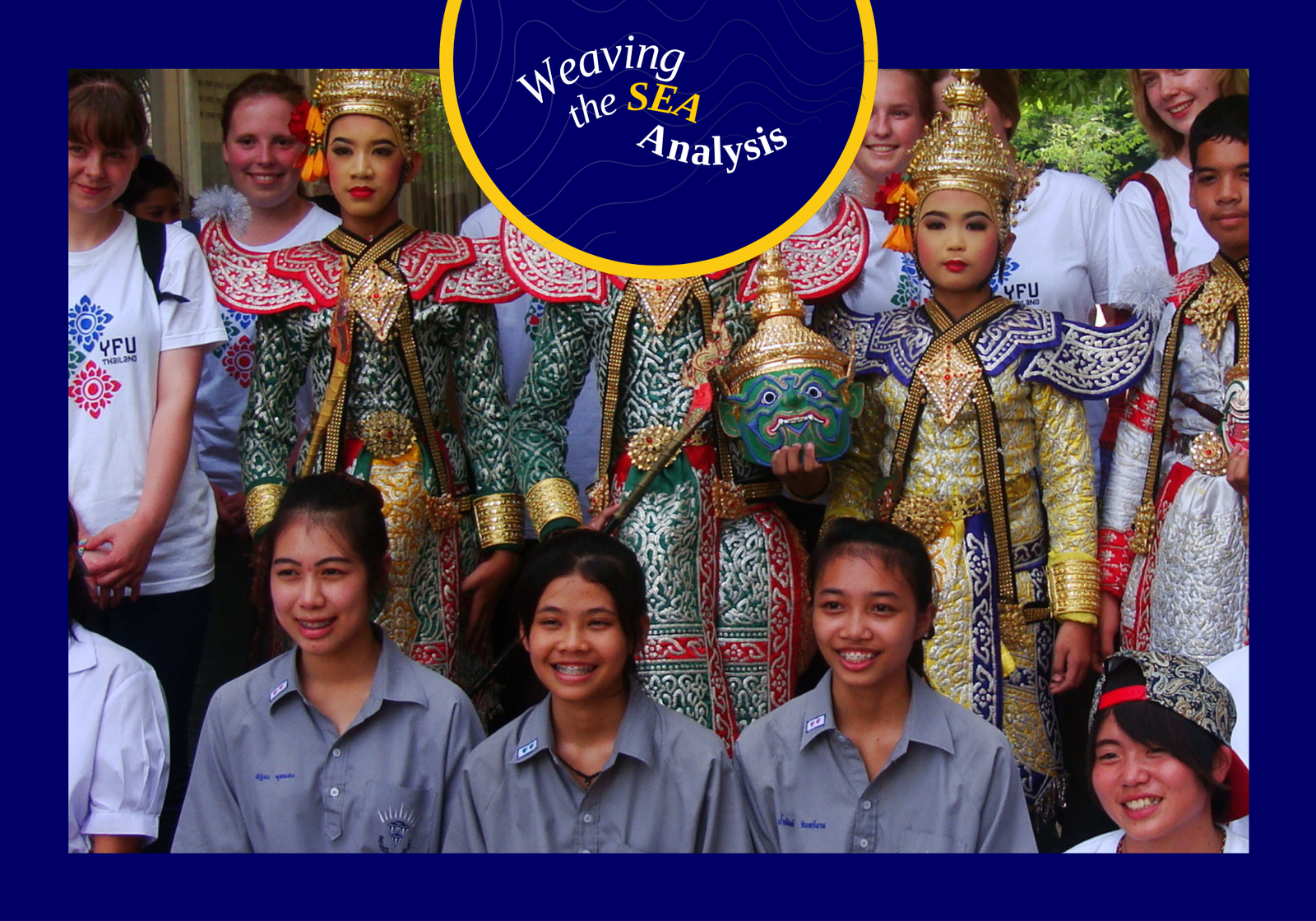
Exchange students participating in a Youth For Understanding (YFU) intercultural exchange programme pose with Thai students wearing traditional Thai costumes during an arrival orientation in Thailand in 2024. (Youth for Understanding)
A Rising Region, Invisible Languages
The past few decades has seen the surge of fame of several Asian languages, particularly Korean, Chinese and Japanese. Once largely confined only to their respective borders and mainly used as a tool of nation-building, they are now studied all around the globe in schools and universities as well as language institutions. This trend can be attributed to the shifting of the world’s economic and geopolitics hotspot to the Indo-Pacific region, as well as the growing global appeal of East Asian cultural exports ranging from K-Pop to anime.
Southeast Asia sits at the heart of the booming region and should naturally gain some visibility from this phenomenon. After all, it is home to more than 680 million people, is now the fourth largest economic bloc and is becoming an increasingly important arena for trade, investment and geopolitical competition. Southeast Asia hosts more than 1,300 languages, making it one of the most linguistically diverse regions in the world. Yet, despite these facts, few Southeast Asian languages have achieved significant international visibility compared to their East Asian counterparts.
The contrast is striking. There are currently 80 countries in the world with thousands of universities and schools that offer Chinese language study programmes, while there are nearly 20,000 institutions around the world that teach Japanese. In general, the numbers of enrollment for East Asian languages study programmes far surpass their Southeast Asian counterparts. Even Indonesian, the most spoken language in Southeast Asia, is only taught in 770 institutions outside of Indonesia.
Nevertheless, the story is beginning to change. As governments across Southeast Asia increasingly view language as a form of soft power, resources are being poured to bring their respective national languages abroad. Indonesia and Thailand come as the front-runners of these examples albeit with different approaches. Indonesia’s promotion of its national language has mainly relied on formal language diplomacy through government-led language courses, Darmasiswa scholarship and a push to make it a UNESCO official language. Meanwhile, Thailand’s success in generating interest in the Thai language comes through popular culture, tourism and entertainment exports. Together, these cases demonstrate that language promotion is no longer merely a matter of preserving national identity. Instead, languages are increasingly being leveraged as strategic assets to enhance cultural visibility, strengthen international engagement and project influence, a phenomenon that becomes increasingly common in Southeast Asia.
Two Different Paths, One Goal in Mind
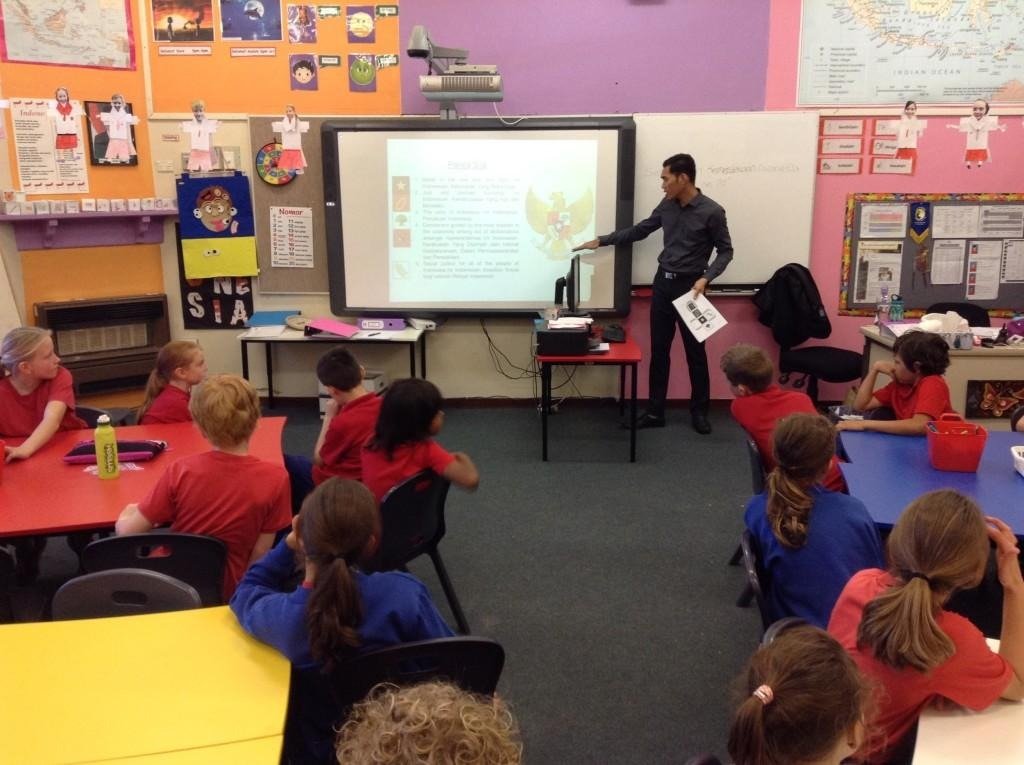
Among Southeast Asian languages, Indonesian possesses the unique advantage of being the region’s strongest candidate for internationalisation. Spoken by over 300 million speakers worldwide, it is the region’s most spoken language. The language is also taught in more than 61 countries in the world and benefits from the country’s rapid economic growth and increased political influence, with Indonesia’s gross domestic product (GDP) growing by 5% in 2025 and the government pushing for membership in more international organisations, including BRICS+ and OECD.
Unlike its regional counterparts that rely on an organic process of language propagation, Indonesia has pursued a deliberate state-led approach. This ambition is reflected in government regulations expressly meant to support the language’s internationalisation through the Ministry of Education, Research, Culture and Technology.
Indonesian Language for Foreign Learner (ILFL) or BIPA (as it is abbreviated in Indonesian) is the product of this initiative, framed as a way to accommodate and provide the learning guidance for foreign speakers and can be found in 61 countries. BIPA is a nondegree course and can be taken in many Indonesian embassies as well as universities around the world. In addition to that, the Ministry of Education also offers Darmasiswa Scholarship for foreign students interested in learning the country’s language, culture and arts at various Indonesian universities. The programme now counts over 4.000 alumni across 135 countries.
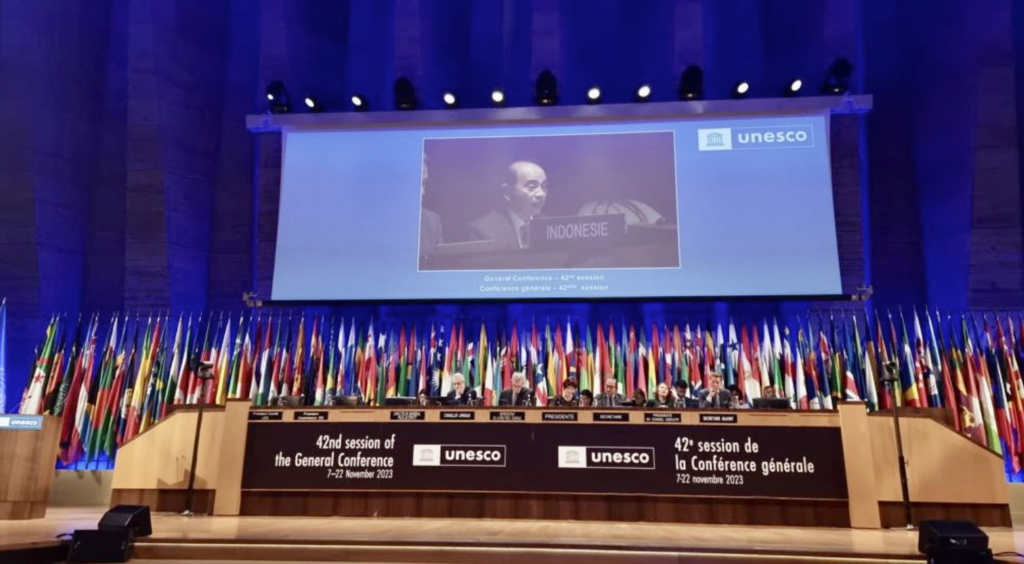
42nd Session of the General Conference of UNESCO, where the Indonesian language was recognised as the organisation’s tenth official language. (Indonesian Ministry of Foreign Affairs)
Furthermore, during the 42nd UNESCO General Conference in 2023, Indonesian language was designated as the tenth official language of UNESCO. The recognition serves as the clearest example of Indonesia’s institutional model of language internationalisation, in which state policies, educational programmes and diplomatic initiatives work together to expand the language’s global presence.
Thailand presents a markedly different approach to language internationalisation, relying more on its popular culture instead. Over the past decade, Thai television dramas, music, cuisine and tourism have gained a significant global following, particularly across Asia. As audiences worldwide consume Thai cultural products, many are exposed to the language and become interested in learning it.

A scene from How to Make Millions Before Grandma Dies, one of Thailand’s most popular and acclaimed films. (Salt&Light)
The creation of the National Soft Power Strategy Committee (NSPSC) in 2023 initiated by then-Prime Minister Srettha Thavisin indicated the country’s recognition that global interest is often generated through cultural consumption rather than formal diplomatic initiatives. Rather than treating culture, entertainment, tourism and cuisine as separate sectors, the Thai government began framing them as strategic resources capable of enhancing the country’s international influence and economic competitiveness. This resulted in the international success of Thai produced films such as How to Make Millions Before Grandma Dies (2024) and Hunger (2023), which attracted global audiences through streaming platforms and international film festivals.

A scene from the Thai film I Told Sunset About You, one of the ‘boy-love’ series that has attracted a large following across Asia. (Nadao Bangkok)
One of the most radical ways Thailand uses to boost its culture through movies is the utilisation of the BL (Boy’s Love) genre which is supported by the likes of GMMTV, the country’s largest entertainment industry and also the key player behind the success of the genre. The move has led to the increased interest in the Thai language with the BL entertainment as proxy.
From the screen to the beautiful beaches and vibrant nightlife of Thailand, the tourism sector also plays an important role in the promotion of Thai language. In 2025, Thailand welcomed over 32.9 million tourists making it the second most visited country in Southeast Asia just below Malaysia and generating 2.70 trillion Thai baht (81 billion US dollar) of total revenue. Tourism exposes millions of travelers to the Thai language through everyday interactions, public signage, local markets and cultural experiences that often sparks a deeper interest in Thai culture and encourages further engagement with the language. In this sense, tourism functions not only as an economic asset but also as a form of informal cultural diplomacy, extending the reach of the Thai language far beyond the country’s borders.
Towards a Hybrid Model
The experiences of Indonesia and Thailand suggest that there is no single path toward linguistic globalisation. On one hand, Indonesia pursues a state-led model built on education programmes, diplomatic initiatives and institutional recognition, while Thailand on the other hand relies heavily on the global appeal of its cultural industries. Both approaches have produced tangible results, but they also reveal the limitations of relying solely on either of the approaches.
Indonesia’s success in securing UNESCO recognition for Indonesian language presents the value of long-term institutional commitment, while Thailand’s growing linguistic visibility in recent years shows how international interest can be generated organically through culture, entertainment and tourism. Rather than opting one approach over the other exclusively, Southeast Asian countries should see them as complementary because governments can only go as far as providing the infrastructure for language learning, but it requires cultural industries to create the demand in the first place.
As Southeast Asia’s economic and geopolitical importance continues to rise, the region’s languages are likely to gain wider international recognition. The future of language diplomacy will depend not only on how languages are taught, but also on how effectively they are embedded within culture, media and everyday global interactions.
In the end, a language travels best when it is heard rather than read about. The two videos below give a short sense of how that sounds in practice. The first features a Thai speaker and the second an Indonesian speaker, a reminder that behind the policies, scholarships and box office hits are two living languages now finding new audiences far beyond their borders.
An Indonesian native speaking the Indonesian language, also known as Bahasa Indonesia in the country. (Wikimedia/Wikitongues)
A Thai native speaking the Thai language, also known as ภาษาไทย in the country. (Wikimedia/Wikitongues)
About The Author