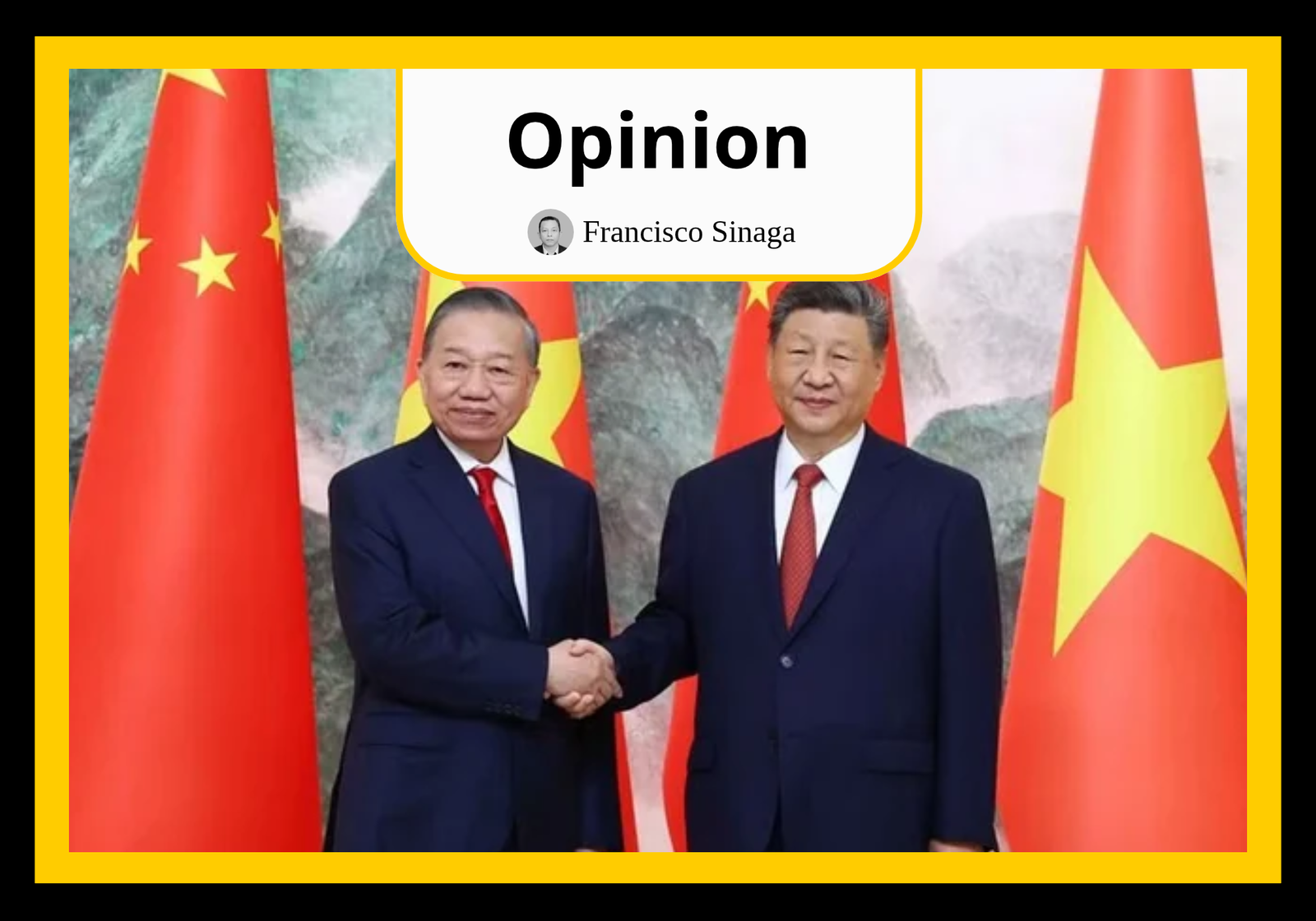
Vietnamese Communist Party General Secretary and President Tô Lâm shakes hands with his Chinese counterpart Xi Jinping in Shenzhen, China, November 17. (VNA)
Francisco Sinaga is an independent analyst in international relations, defense diplomacy and public ethics based in Jakarta, and was a panel speaker at Lomonosov Moscow State University. The views expressed are the author’s own and do not represent SEA Daily or that of another organisation.
A Bloc Pulled Apart
Great-power competition across the Indo-Pacific arguably has pushed ASEAN into a state of quiet paralysis. As it is no secret, decades of regional peace was preserved through passive consensus and institutional “neutrality”. Today, that traditional framework is being severely tested by geopolitical pressures.
ASEAN member states are drawn toward opposing orbits. While some governments seek closer security arrangements with Washington, others rely heavily on Beijing for trade and infrastructure. As internal divisions widen, ASEAN centrality is steadily eroded, leaving the bloc reactive when handling crisis after crisis. Thus, without a clearer and more adaptable posture, ASEAN risks losing its voice in regional governance.
Amid these growing fractures, however, Vietnam’s manoeuvre might serve as an exemplar to be emulated. Hanoi has built a foreign policy that handles global rivalries with remarkable flexibility. Over recent years, Vietnamese diplomats have achieved a major milestone by securing Vietnam’s strategic rapprochement with the US, marked by the establishment of a Comprehensive Strategic Partnership (CSP). Yet at the same time, strong diplomatic momentum was maintained through a deepened CSP with China.
International observers often treat this dual engagement with suspicion. Many Western commentators label hedging as a temporary strategy, assuming that middle powers will eventually be forced to choose a side when tension rises.
That perspective misses what makes Hanoi’s approach work in practice. Domestic leaders describe their foreign policy as bamboo diplomacy, pointing to its sturdy roots and flexible branches. Rather than showing weakness or hesitation, this posture reflects a pragmatic calculation. National sovereignty is protected while a working model is provided for ASEAN to rebuild its unity and maintain real strategic autonomy.
Bamboo in Practice

Philippine Coast Guard personnel wave Vietnamese and Filipino flags to welcome the Vietnam Coast Guard (VCG) ship, CSB 8002, in Manila, Philippines in August 2024. (VOA)
The strength of bamboo diplomacy is demonstrated by concrete economic figures and clear policy decisions. Following Hanoi’s “diplomatic upgrades,” registered foreign direct investment reached 36.6 billion US dollar in 2023, with substantial capital expansion recorded across semiconductor and high-tech manufacturing sectors. Global technology companies relocated major assembly lines to domestic industrial parks, including Apple’s expansion of iPad production and Nvidia’s agreement to establish a design centre. Through global supply chain diversification, Western investment was successfully attracted without disrupting vital commercial ties with Beijing. China remains Vietnam’s largest trading partner, supplying over 100 billion US dollar annually in intermediate components and industrial machinery.
Energy governance reveals the same practical focus. Under Decree 135 and national grid management frameworks, ambitious decarbonisation targets under the Just Energy Transition Partnership (JETP) were set to secure 15.5 billion US dollar in international public and private financing. Instead of accepting rigid external terms, state oversight is maintained through Electricity Vietnam (EVN) to protect grid stability while green transition projects are expanded.
At home, these international moves are supported by stronger legal enforcement efforts. High-level financial fraud and administrative graft have been targeted under the national anti-corruption campaign, known locally as Đốt Lò or the blazing furnace. While leadership changes initially raised questions among foreign observers, regulatory enforcement has seen to be anchored, which ultimately strengthened market transparency and contractual predictability for international investors.
While skeptics argue that relying on US consumer markets while depending on Chinese industrial inputs creates a dangerous trap during a major security crisis, Hanoi’s defence posture directly addresses that concern. Guided by the “Four No’s” defence policy set out in its 2019 National Defense White Paper, foreign military bases and formal military alliances are strictly avoided. Vietnam’s defence cooperation is broadened with diverse partners, including Japan, India and European Union member states. By spreading security links across multiple capitals, strategic leverage is kept out of the hands of any single power.
Growing Bamboo Across the Bloc
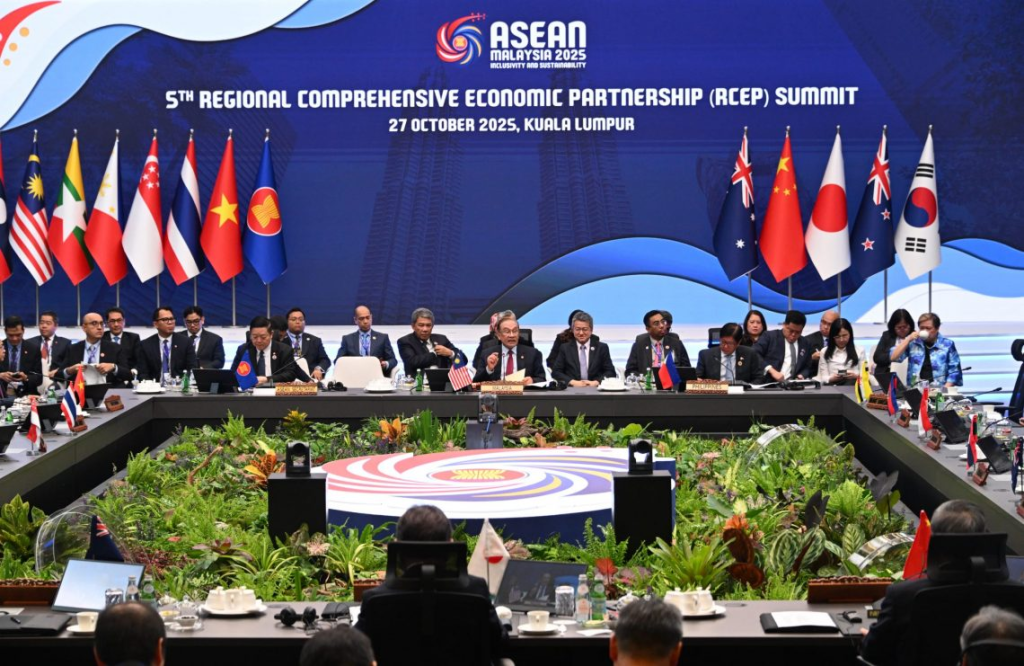
Regional Comprehensive Economic Partnership (RCEP) Summit in Kuala Lumpur, Malaysia in 2025, which gathers ASEAN member states and Australia, New Zealand, China, Japan and South Korea. (ASEAN Secretariat)
ASEAN’s current vulnerabilities show why Vietnam’s experience matters to the wider region. As maritime disputes and supply chain competition intensify, passive “neutrality” leaves the bloc vulnerable to external pressure. If individual member states continue to form separate security arrangements without a shared regional logic, ASEAN’s strategic autonomy will be steadily undermined.
To reverse this trend, ASEAN can adapt core principles of Vietnam’s bamboo diplomacy. Firm foundational principles must be combined with flexible regional engagement. Sub-regional economic links and maritime confidence-building measures can be strengthened to form unified positions under international law and UNCLOS 1982, while working channels are kept open with major powers, including both Washington and Beijing.
Ultimately, Vietnam shows that regional security is not built by taking sides in major-power rivalries. By keeping national interests clear and remaining flexible in a changing multipolar world, ASEAN can turn its present difficulties into a stable and independent future.
About The Author