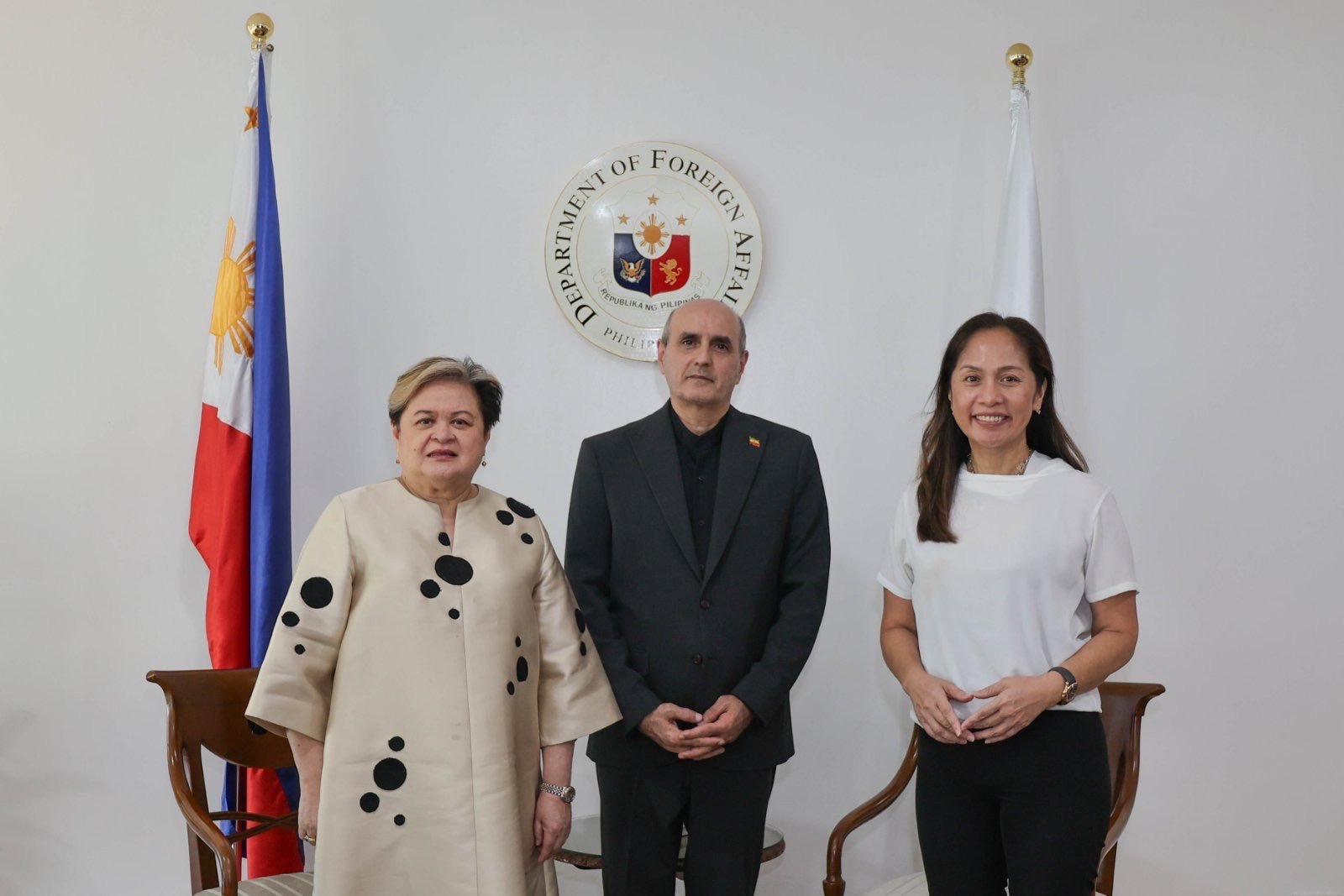
North Korea’s Foreign Minister Choe Son Hui meets with Singapore Foreign Minister Vivian Balakrishnan in Pyongyang on May 26, 2026. (Singaporean Ministry of Foreign Affairs)
This article is the third and final issue of a three-part series on North Korea-Southeast Asia ties.
Part 1—Signals of a Quiet Reconnection—maps Pyongyang’s phased re-engagement with Southeast Asia since 2023, showing how three distinct national logics exploit ASEAN’s gap between collective denuclearisation rhetoric and individual bilateral engagement.
Part 2—Charm Offensive, Shadow Network—examines the sanction evasion infrastructure: how it works, which states it runs through, and why the diplomatic opening and the evasion network are not two separate stories, but one.
On 8 June 2026, Chinese President Xi Jinping arrived in Pyongyang for a two-day state visit, his first trip to North Korea in seven years and his first overseas engagement of 2026. The choice of destination was itself a statement. Just two weeks earlier, on 26 May, Singapore’s Foreign Minister Vivian Balakrishnan had made his own rare visit to Pyongyang as part of a five-day tour that also included Beijing and Seoul. Minister Balakrishnan’s sequence of visits, China first, then North Korea, then South Korea, “was not accidental.” Two major powers engaging the same capital within a fortnight, through channels of very different character, with very different intentions and arriving at very different conclusions about what engagement means. That convergence is the subject of this final article in the series.
A Crowded Week Above the 38th Parallel
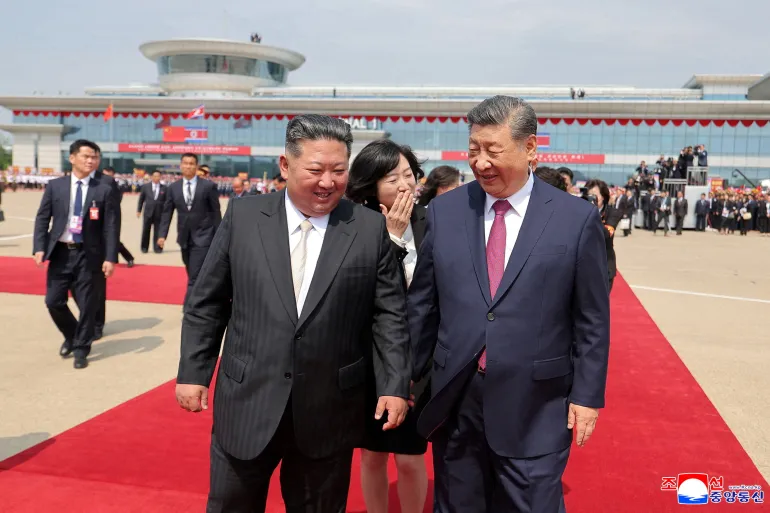
North Korean leader Kim Jong Un, left, walks with Chinese leader Xi Jinping during Xi’s state visit to Pyongyang, North Korea, on June 9, 2026. (KCNA)
Unlike Vietnam and Laos, Indonesia and Singapore fit neither the ideological-continuity model with the North Korean regime nor the North Korea’s sanctions-evasion groups of countries. Indonesia’s engagement with Pyongyang is grounded in its bebas aktif doctrine, a principle of free and active non-alignment that predates the sanctions regime and one that President Prabowo Subianto has operationalised more assertively than any of his predecessors. Bebas aktif is not a tactical posture but a “philosophical belief” embedded in how successive Indonesian administrations understand the country’s global role. In practice, this has meant reopening the Pyongyang embassy in July 2025, hosting Foreign Minister Sugiono’s first senior Indonesian visit to the Democratic People’s Republic of Korea (DPRK) in 12 years that October and signing a memorandum of understanding while simultaneously managing an active KF-21 joint fighter jet programme with South Korea.
Singapore’s position is different in logic if not in outcome. It is not non-aligned by doctrine; it is strategically small and strategically indispensable. North Korea dispatched a vice-ministerial-rank ambassador to Singapore in 2024, an unusually senior appointment that signals Pyongyang’s own valuation of the relationship. Singapore will assume the ASEAN chairmanship in 2027, which further underlines its importance in regional politics. And as the host of the 2018 Trump-Kim summit, it carries a credential that no other Southeast Asian state possesses. The Singapore Ministry of Foreign Affairs’ own statement from Balakrishnan’s May visit noted that both sides “recalled the historic visit by Kim Jong Un to Singapore for the first US-DPRK Summit in 2018.”
What’s at Stake
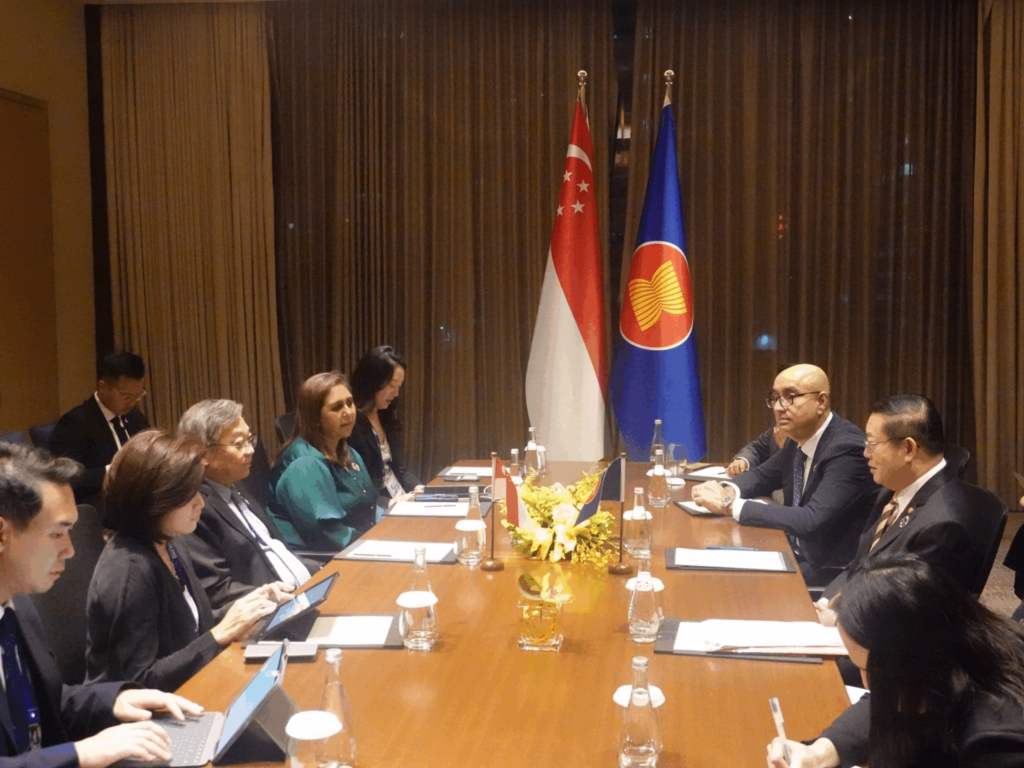
The Secretary-General of ASEAN, Kao Kim Hourn, met with Gan Kim Yong, Deputy Prime Minister and Minister for Trade and Industry of Singapore, on the sidelines of the 32nd ASEAN Economic Ministers (AEM) Retreat in Taguig, Philippines. Singapore is set to be the ASEAN Chair for 2027. (ASEAN Secretariat)
Singapore: Channels That Are Not Mediation
The most important clarification to emerge from the May 2026 Balakrishnan visit to Pyongyang is what Singapore explicitly said it was not doing. It was reported that Balakrishnan “dismissed the speculation that Singapore would mediate a potential US-North Korea dialogue” and told Singaporean media that North Korea “seemed more focused on strengthening military deterrence than external engagements.” This is a significant distinction. Singapore is keeping channels open, not positioning itself as a deal-maker. The invitation to North Korean Foreign Minister Choe Son Hui to attend the ASEAN Regional Forum (ARF) scheduled for July 2026 in the Philippines reflects the same logic: presence in multilateral frameworks, not bilateral facilitation. This distinction illustrates that Singapore is not building toward a 2018 reprise. It is rather maintaining a relationship whose value is precisely its ambiguity. Balakrishnan’s core message in Pyongyang was to “keep channels open.” That is the entirety of the strategy: not mediation, not facilitation, but the preservation of access in a landscape where access is increasingly scarce.
Indonesia: The Three-Axis Tension
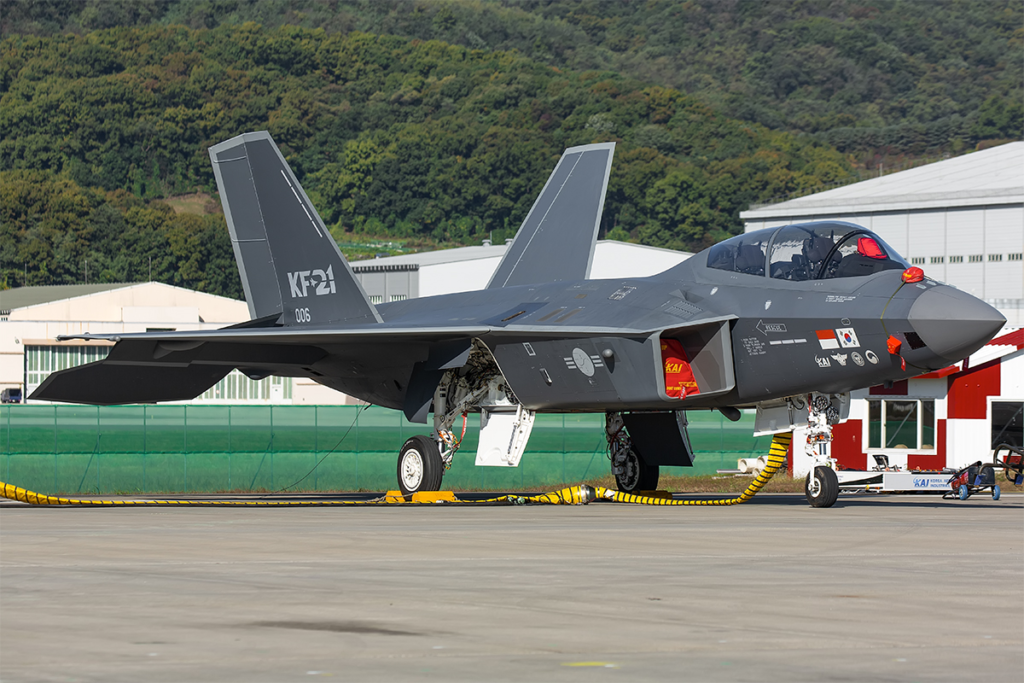
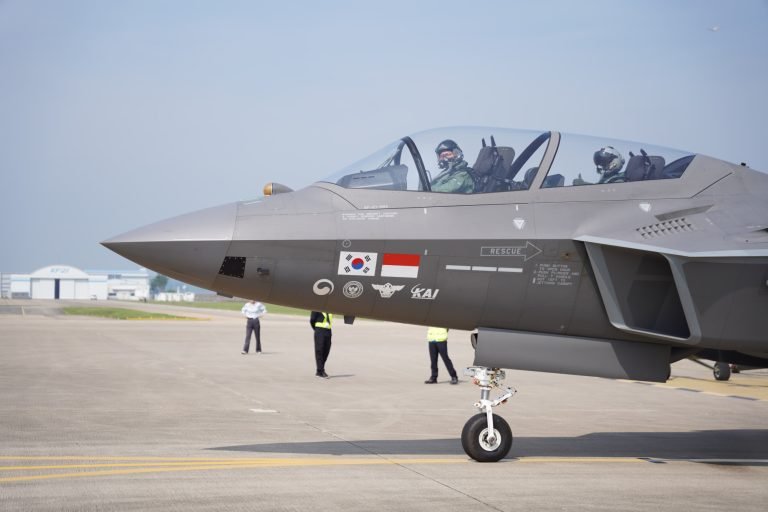
KF-21 Boramae displayed at Seoul ADEX 2023. The jet is jointly developed by South Korea and Indonesia, creating security concerns from Seoul given Indonesia’s continuing engagement with North Korea. (Wikimedia/AnShmat)
Indonesia’s engagement with North Korea sits within a broader pattern described as Jakarta’s “Russia card”. The same strategic impulse that led Prabowo to pursue cheap Russian energy and join BRICS+ for favourable economic positioning also drives its Pyongyang opening. Hedging is not merely ideological for Jakarta here, it also leads to financial gains. The tension this creates is threefold. First, the KF-21 dimension: Seoul’s concern that Indonesia’s Pyongyang engagement could complicate technology-security protocols within the joint fighter jet programme surfaced immediately after Sugiono’s October 2025 visit. Secondly, in terms of cyber dimension, North Korea has already distributed malware and backdoors into the digital infrastructure of countries including Indonesia, establishing long-term footholds for future operations. Indonesia is deepening diplomatic ties with a state that is documented targeting its own infrastructure. Thirdly, regarding ASEAN dimension, full-spectrum engagement complicates each state’s ability to perform the role of neutral convener within ASEAN. For Indonesia, which positions itself as a natural leader of the Global South and a prospective ASEAN voice on Korean Peninsula affairs, this is not a trivial cost.
ASEAN’s Structural Contradiction: The “Xi Moment”
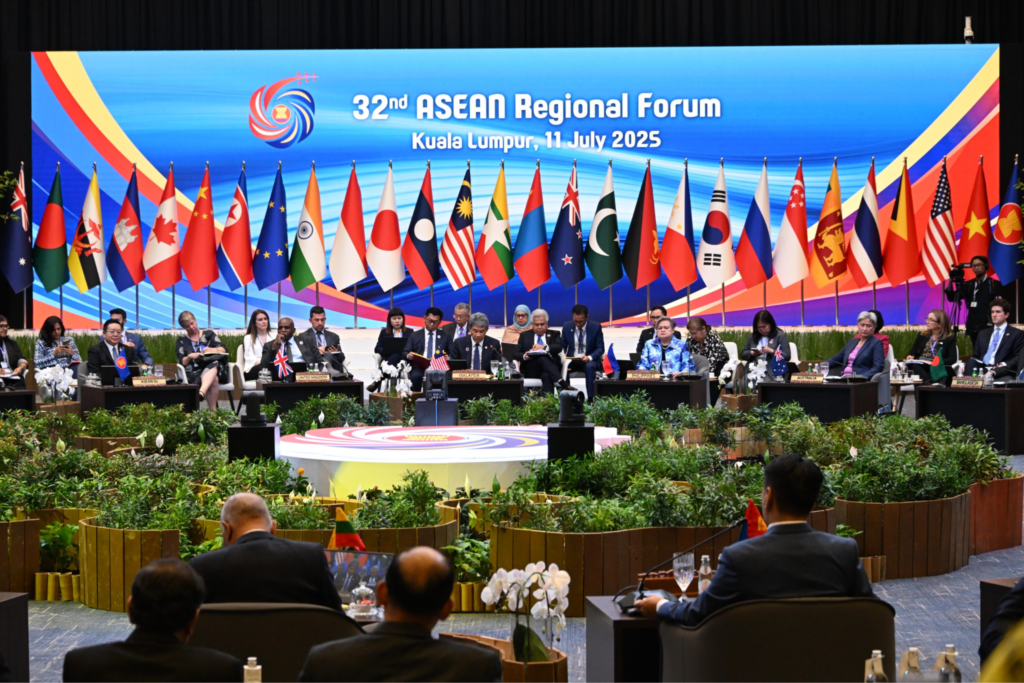
The 32nd ASEAN Regional Forum (ARF) in Kuala Lumpur, Malaysia, which gathers a diverse set of Indo-Pacific countries, including North and South Korea. (ASEAN Secretariat)
The Xi-Kim summit of 8-9 June 2026 crystallised the structural problem facing ASEAN’s collective position on North Korea. The official Chinese readout of the summit contained no mention of denuclearisation. Xi pledged “unwavering support” for Kim and called for “powerful momentum” in bilateral ties. Given this framing, it was unlikely that highly sensitive issues, such as denuclearisation or even relations with the US, would have been on the agenda. Beijing is not abandoning denuclearisation as an official position; it is simply stopping to emphasise it, because doing so serves no practical purpose and risks alienating Pyongyang at a moment when China is already competing with Russia for influence over Kim. For ASEAN, this opens further complex games. The ASEAN-Republic of Korea (ROK) Comprehensive Strategic Partnership, signed in October 2024, formally commits the bloc to supporting “a denuclearised, peaceful, and prosperous Korean Peninsula.” Yet, the bloc’ s most consequential external partner on Korean affairs, China, has effectively suspended that commitment in practice. Individual ASEAN members are deepening bilateral ties with Pyongyang. North Korea may seek to use the ARF itself to “challenge nonproliferation norms by countering denuclearisation calls and furthering efforts to portray North Korea as a legitimate socialist state.” The non-interference principle structurally prevents ASEAN from holding individual members accountable to the bloc’s stated positions. The result is an institution that endorses denuclearisation collectively and enables normalisation individually, a gap that widens with every ambassador appointment and every MOU signing.
The Final Question
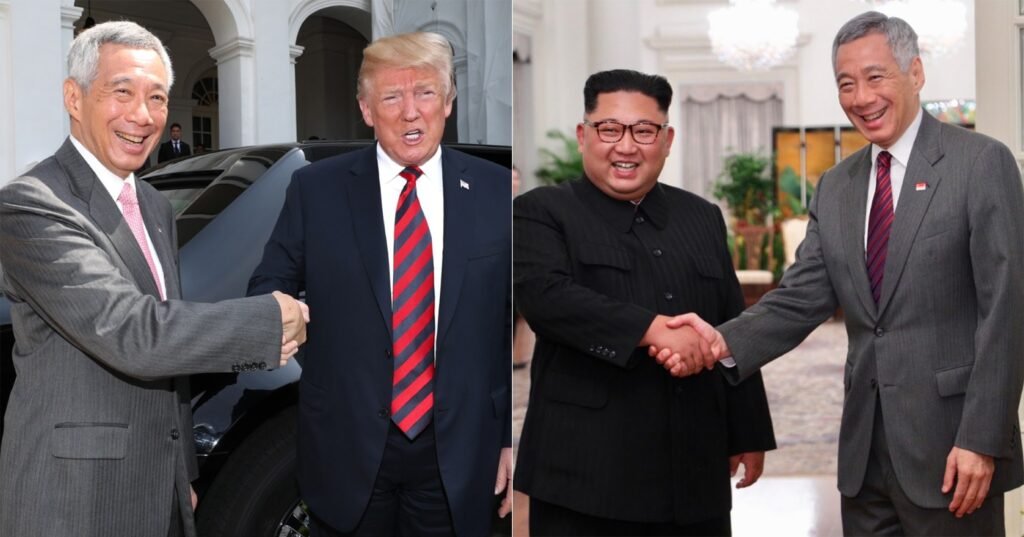
A collage of former Singaporean Prime Minister Lee Hsien Loong with US President Donald Trump and DPRK Leader Kim Jong-un during the 2018 US-DPRK Summit in Singapore. The summit shows how maintaining good relations with all parties can put Southeast Asia in the position of peacemaker, a role Singapore is eyeing in the unlikely event of another US-DPRK Summit in the near future. (Ministry of Communications and Information Singapore)
The prospect of a Trump-Kim summit in 2026 remains “a flickering ember.” The likelihood of talks between Washington and Pyongyang are significantly lower than during the first Trump administration. During Trump’s Beijing visit, preparations for a US-North Korea summit were almost nonexistent. Moreover, China has “generally shown limited interest in serving as an intermediary between Washington and Pyongyang,” adding that whether Xi briefed Kim on Trump discussions during their June summit remains unclear.
For South Korea’s Lee Jae-myung government, which has championed the END (Exchange, Normalisation, Denuclearisation) initiative as a pathway to revitalised inter-Korean dialogue, ASEAN represents a potential indirect channel. The request conveyed to Balakrishnan in Seoul, that Singapore and ASEAN help “create conditions for dialogue with North Korea,” reflects a strategy of multilateral facilitation in the absence of direct bilateral progress. The strategy is not unreasonable, but it carries a structural condition: the ASEAN states being cultivated as dialogue channels are the same states whose regulatory gaps and diplomatic ambiguity have enabled the parallel networks. And even if Trump and Kim eventually sit down, the fundamental question remains whether Washington is prepared to accept North Korea’s peaceful coexistence framing, which Kim has made an explicit precondition for any engagement. Without clarity on that precondition, no ASEAN channel can substitute for the policy decision that Washington has yet to make.
Taken together, the three Southeast Asia and North Korea articles in this series reveal a single, coherent structure. Pyongyang’s post-COVID re-engagement with Southeast Asia is not a diplomatic opening in the conventional sense. It is a dual-track operation running through the same states, the same institutional channels, and often the same bilateral relationships simultaneously. Vietnam and Laos provide ideological cover and regulatory grey zones. Cambodia offered formal compliance while hosting a multi-billion-dollar laundering node. Indonesia’s full-spectrum hedging opens a relationship whose strategic and cyber implications Jakarta has not yet fully accounted for. Singapore maintains access while disclaiming facilitation, a distinction that is real but whose durability depends on a diplomatic environment that remains highly volatile.
The closing question is the same one its opening posed, now with more evidence behind it. When Vietnam appoints a new ambassador to Pyongyang, when Singapore’s Foreign Minister recalls the 2018 summit in a Pyongyang press statement, when Xi Jinping makes North Korea the first stop of his year: are these signals of genuine diplomatic normalisation? Or are they the ongoing construction of a legitimising facade over a structure that operates, earns, and adapts regardless of what any diplomatic communication says? The answer, as this series has documented, is that the question itself may be the wrong one. Normalisation and evasion are not alternatives between which Pyongyang chooses. They are complements, designed to reinforce each other and Southeast Asia is the chessboard in which that design is most clearly visible.
About The Author