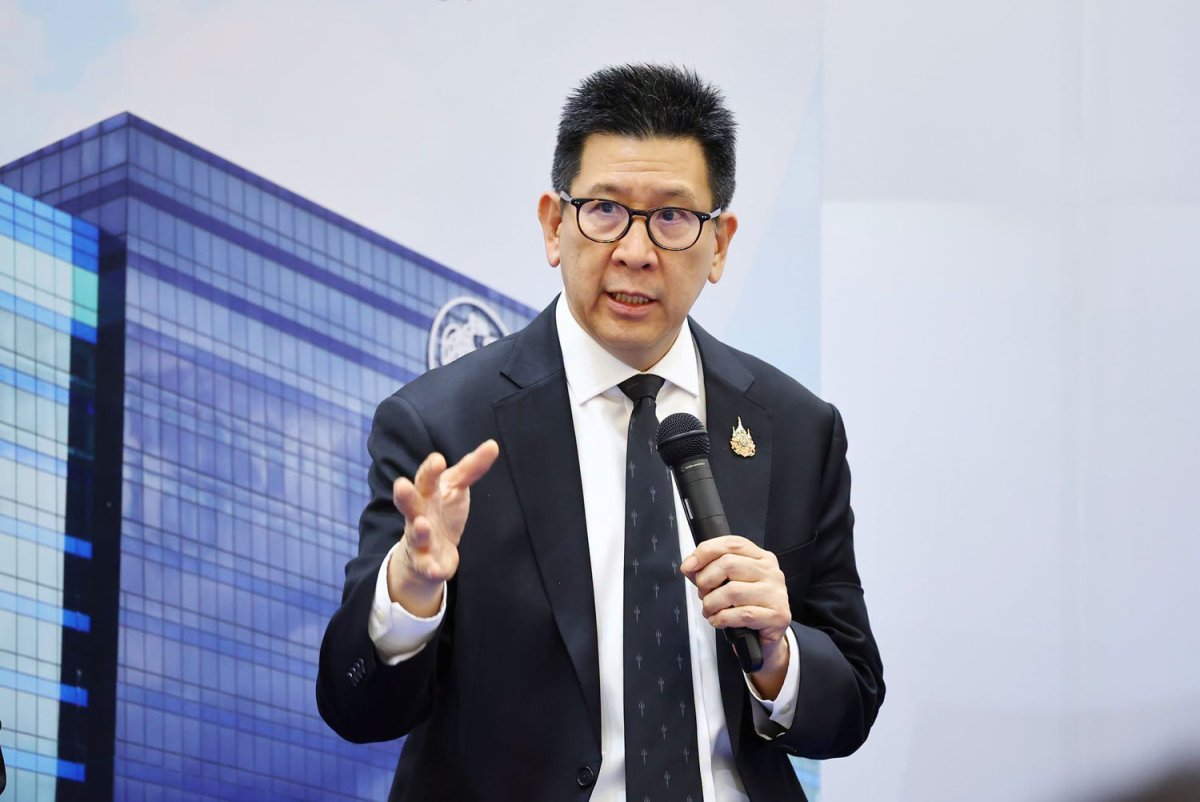
Thai Finance Minister Ekniti Nitithanprapas speaks at a meeting of the Subcommittee on New Investment Development in Bangkok, on August 1. (Thai Ministry of Finance)
Two decades from now, Thailand envisions attaining a high-income status, eyeing a leading role as a regional investment hub.
To accomplish the ambition, the Thai government unveiled a major economic growth framework on July 31, during an official high-level meeting convened by the newly established Subcommittee on New Investment Development.
The meeting was led by the subcommittee’s Chairman, who serves concurrently as Thailand’s Deputy Prime Minister and Finance Minister, Ekniti Nitithanprapas. In his remarks, he outlined strategic roadmaps for Thailand to escape the middle-income trap, with a core emphasis on increasing total investment to contribute 30% of the country’s gross domestic product (GDP).
“To become a high-income country within the timeframe we have set, Thailand must increase combined public and private investment to 30% of GDP from the current 23%,” he said, noting that the government has also set a medium-term goal for its GDP growth to exceed 3% by 2029.
The minister further explained that the subcommittee has advanced operational strategies, established through specialised task forces mandated to drive substantial development across five sectors: artificial intelligence (AI) and high-tech, industrial transformation, the green economy, financial services and medical investment.
Reportedly, these working groups have a tailored, time-specific objective: “early results” within six months, tangible progress in the next two years and ultimately infrastructure outcomes in four years.
Minister Ekniti added that the government has committed to “deploy all available policy tools,” including tax incentives, targeted budget spending, as well as public-private partnerships (PPP) and the Thailand Future Fund.
“Countries around the world are competing to attract investment and reorganise global supply chains,” he concluded.
For context, the Subcommittee on New Investment Development was recently formed under Thailand’s Joint Public-Private Sector Committee for Solving Economic Problems (JPC), and made its official public debut through the recent July 31 meeting. The newly launched body is designed to fast-track Thailand’s structural economic reforms, consisting of representatives from the Board of Investment (BOI), the Office of the National Economic and Social Development Council (NESDC), the Thai Chamber of Commerce, the Federation of Thai Industries and the Thai Bankers’ Association.
What does this mean for businesses?
Thailand is currently ranked 26th in the International Institute for Management Development (IMD) World Competitiveness Ranking, which measures and benchmarks how effectively nations create and maintain an economic environment that allows enterprises to compete and grow. According to Minister Ekniti, Thailand aims to tap into the global top 20 and achieve high-income status by 2038. If properly executed, the BOI is expected to streamline investment policies and remove bureaucratic bottlenecks to successfully draw foreign capital. This regulatory groundwork remains the vital first step to ensure a robust environment for enterprises. Such measures are critical, given Bangkok’s immediate target to secure massive injections of capital, including 100 billion Thai baht specifically directed toward AI and semiconductor investments by 2027.
Kala Advisory helps investors transform such new high-tech frameworks and structural reforms into targeted, country-by-country market entry plans across Southeast Asia. Visit kala-advisory.com.
About The Author