

Vietnam’s U-23 men’s football team celebrating their win against Thailand in the 2022 ASEAN U-23 Championship in Cambodia. (VTV)
Flint Fernando Tendy is an International Relations graduate from Universitas Katolik Parahyangan with expertise in research, stakeholder engagement and cross-cultural communication. The views expressed are his own and do not represent SEA Daily or that of another organisation.
A Region in Love With Football, Yet Absent From Its Biggest Stage
As the world’s attention is currently fixed to the largest ever FIFA World Cup tournament in history where 48 national teams are competing, Southeast Asia is also watching closely. The region is home to one of the biggest fanbases in the world, hosting about 300 million people or roughly 10% of the world’s football supporters. For many of them football is not merely a sport or a form of entertainment but also woven into their national identities and communities. In the region’s largest football markets, namely Indonesia, Thailand, Vietnam, Malaysia, and the Philippines, more than 50% of their respective populations consider themselves as football fans. Few regions can match Southeast Asia’s emotional investment in football where it unites the diverse and complex socio-political landscape of the regions with a deep and shared passion for the beautiful game.
Yet despite this burning passion, the region’s national teams remain largely absent from football’s biggest stage except for maybe Indonesia with their participation in the 1938 FIFA World Cup as the first ever Asian team to qualify in the tournament albeit under the name of Dutch East Indies. Nearly nine decades later, no Southeast Asian teams have broken this curse, with all campaigns only falling short in the qualification round. Thailand was the first ever Southeast Asian country in modern history to have reached the third qualifying round in 2018. Four years later, this achievement was matched by Vietnam who also held the regional benchmark by earning four total points in the group against some of Asia’s fiercest opponents.
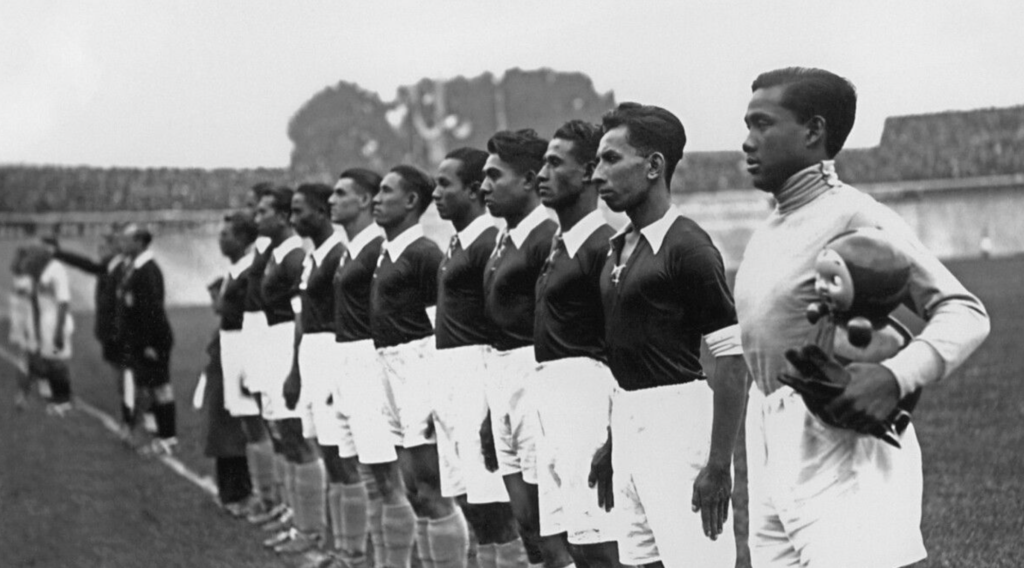
The Dutch East Indies men’s football team in the 1938 FIFA World Cup, the first Asian team to qualify for the cup. (AFC)
History was almost made for Southeast Asia when Indonesia, against all odds beat Saudi Arabia, China and Bahrain and earned itself a spot to fight in the fourth round of 2026 World Cup Qualifiers. This marked the furthest progression by a Southeast Asian team in the modern qualification era and gave hopes that the region might finally be on the verge of a breakthrough. Unfortunately, this fairy-tale-like campaign ended where so many others before it had: short of qualification.
Indonesia’s historic qualification campaign may eventually have ended in disappointment, but to consider it as only an anti-climax would be to miss its broader significance. Beyond reigniting the hopes of millions of football supporters across Southeast Asia, the journey offered valuable insights into what the region has long lacked in its pursuit of a World Cup dream. More importantly, it highlighted a path forward. The answer may lie not solely in the quality of players, but in the quality of the institutions that develop them. A comparison of Indonesia, Vietnam and Thailand suggests that football success is shaped less by talent than by the long-term governance decisions made far from the spotlight of match day.
What Indonesia, Vietnam, and Thailand Can Teach Southeast Asia

For the last two decades, Thailand has often been regarded as Southeast Asia’s football standard-bearer or the king of ASEAN as it is often called on social media. It is largely due to its professionalisation of Thai league that has transformed the country’s football landscape ever since 2007 by attracting greater private investment which as a result improves the country’s clubs infrastructure, and creating the region’s most competitive domestic league. As a result, Thai clubs, in particular Buriram United, have consistently been the participants in Asia’s most elite club football competitions, while the national team remains the region’s most decorated and successful.
The Football Association of Thailand (FA Thailand) has also strengthened the country’s football pyramid by expanding lower-tier competitions and youth leagues, demonstrating a commitment to long-term football development. Yet, Thailand’s progress also illustrates the limits of league-centred reform. A well-governed domestic league can raise the overall standard of football, but it does not automatically produce a World Cup team. League development must be complemented by equally sustained investment in youth development, elite coaching and long-term national team planning which is lacking in Thailand’s national football team at the moment.
Unlike Thailand, Vietnam’s recent rise has been driven less by the strength of its domestic league than by sustained investment in youth development. Since the late 2000s, the Vietnam Football Federation (VFF), alongside partnerships with private initiatives such as the Hoang Anh Gia Lai–Arsenal JMG Academy, has invested heavily on elite academies, age-group competitions and a clearer pathway from youth football to the senior national team. This translates to some of the successes achieved by all levels and groups of Vietnam’s national football team in recent years most notably earning 4 points in the third round of Asian World Cup Qualifying stage in 2022, reaching the final of 2018 AFC U-23 Championship, and qualifying for 2023 Women’s World Cup.
Vietnam’s U-23 men’s football team reached the Final of 2018 AFC U-23 Championship (AFC Hub)
What makes these achievements even more amazing is the fact that they were built largely on the development of domestic players rather than an extensive naturalisation programme like what its neighbours are doing. Vietnam’s experience demonstrates that sustained investment in youth development can elevate a country’s competitiveness. Nevertheless, in recent years the problems of financial stability, league quality and long-term governance start to hinder the progress of Vietnam’s national football team as the cracks are starting to be evident. This highlights that producing talented generations is only one step towards becoming a consistent World Cup contender, maintaining that progress ultimately depends on broader institutional support.
The recent rise of Indonesia in world football has sent shockwaves especially to other Southeast Asian countries. Following years of administrative instability that culminated in the suspension of Indonesia from FIFA in 2015, the Football Association of Indonesia (PSSI) has since embarked on a series of reforms aimed at modernising and developing the country’s football ecosystem. These included restructuring football governance, strengthening youth competitions, upgrading infrastructure, improving collaboration withFIFA through the FIFA Forward programme and accelerating the naturalisation of eligible overseas players to raise the national team’s quality. These actions have helped restore confidence in a football system that had long been affiliated with administrative instability and tragedy following the 2022 Kanjuruhan disaster, which was a crowd crush in Kanjuruhan Stadium, Malang, that killed 135.
The impact has been swift and immediate as Indonesia is slowly but surely emerging as a new force to be reckoned with in Southeast Asian football which has been dominated by Thailand and Vietnam for decades. Indonesia managed to reach the third and subsequently the fourth round of AFC qualification for the 2026 FIFA World Cup which was the furthest any Southeast Asian nation has progressed in the modern qualifying era. The country’s youth teams have also become increasingly competitive, while Indonesian clubs have begun investing more seriously in long-term player development.
Despite all these success stories, Indonesia should not be blinded by the lights as the greatest test still lies ahead. Naturalisation and administrative reform can accelerate progress, but they cannot replace the institutions needed to sustain it. If recent achievements are to become the foundation of a genuine footballing renaissance rather than a single remarkable campaign, Indonesia must ensure that today’s reforms evolve into a system capable of producing future generations of players, coaches, and administrators. Only then can its World Cup ambitions become a lasting reality rather than a once in a blue moon moment.
Building a World Cup Nation
Although Thailand, Vietnam and Indonesia have pursued different ways towards the World Cup and each with its respective success as the result, their experiences merge on the same lesson that football success is built by institutions, not by chance. Thailand demonstrated how a professional domestic league can raise the standard of competition and the national team’s class eventually. Vietnam showed that sustained investment in youth development can produce a generation capable of competing with Asia’s best. Indonesia, meanwhile, has illustrated how success can be achieved in a relatively short period with governance reforms and strategic planning.
Each case also presents the reality that only relying on a single approach will not lead the success far away. A strong league alone does not guarantee World Cup qualification and neither does an outstanding youth academy system or an ambitious naturalisation programme. Sustainable success requires these elements to complement one another in a coherent football ecosystem.
As Southeast Asia continues its fight to compete in the global stage and ultimately qualify for the first modern World Cup appearance, the region should resist the temptation of instant success that plagues the mentality and hinders a lasting process. Instead, football associations must commit to long-term planning that extends beyond election cycles, coaching appointments, and individual generations of players.
The recent campaign by Indonesia has reignited the belief that Southeast Asia can one day compete on football’s biggest stage. Turning that belief into reality, however, will depend not on discovering extraordinary talent, but on building extraordinary institutions.
About The Author




3 thoughts on “Southeast Asia Is Not In The World Cup, But It’s Not A Talent Problem”