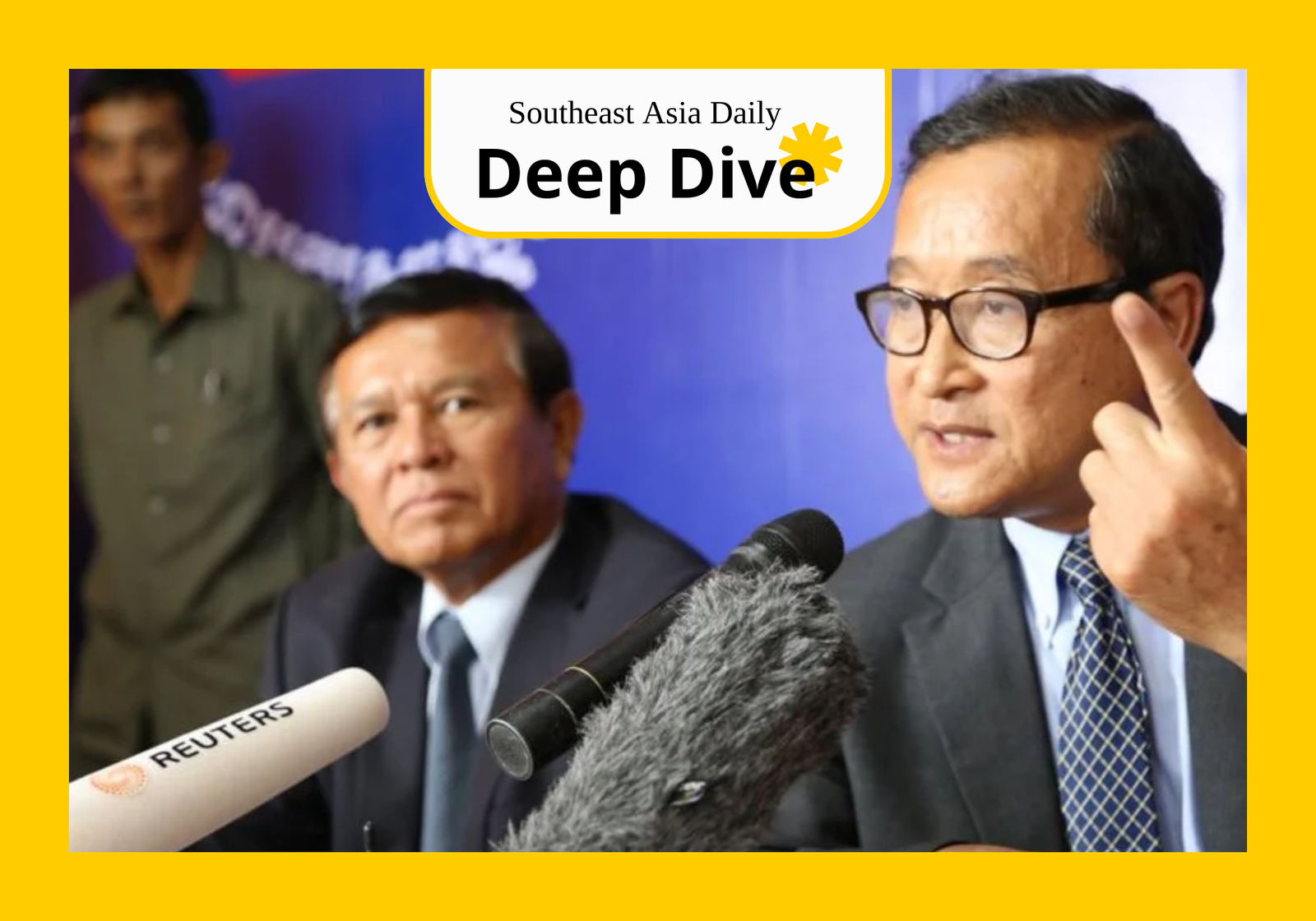
Cambodia National Rescue Party leaders Sam Rainsy and Kem Sokha at a press conference. (VOA Khmer)
The Gesture and the Gap
On May 25, 2026, Hun Sen, Cambodia’s Senate President and prominent political figure, signed a royal pardon on behalf of King Norodom Sihamoni, lifted opposition leader Kem Sokha’s 27-year house arrest sentence for the treason accusation.
Kem Sokha, co-founder of the Cambodia National Rescue Party (CNRP), which was dissolved by court order in November 2017 following his arrest, has drawn close attention from Western governments for his pro-democracy stance and political alignment. His presence in Cambodia’s politics was favourable as he marked a new period for Cambodia’s democratic transition and led to a more even balance of power in domestic politics.
Kem Sokha’s release therefore carries weight within Cambodia’s borders as it would help define future cooperation with the West and whether human rights and democratic principles will remain the basis of that relationship. The royal pardon was a change of message toward what the Cambodian government had long framed as foreign intervention in its internal affairs. When Kem Sokha stepped outside of his house for the first time in years, the US, the UK, Australia and Canada all issued statements welcoming his release while calling for the restoration of full political rights and an open civic space.
The European Union (EU), which has been at odds with Cambodia over democratic backsliding for more than a decade, also responded approvingly. On May 27 through its Ambassador to Cambodia, Igor Driesmans, the bloc described the move as a positive step, while underlining that future actions by Phnom Penh would be the true measure of political reform. The latter phrasing was deliberate. Brussels framed the release not as a political turning point, but also making sure that it was not directly criticising Phnom Penh to maintain their improving economic ties.
Looking back, Cambodia-EU cooperation began almost 30 years ago in 1997 and was initially focused on human rights promotion before gradually expanding into a broader relationship covering economic development, trade and political partnership. As a Least Developed Country, Cambodia benefited from duty-free and quota-free access to the EU market under the Everything But Arms scheme and the Generalised Scheme of Preferences (GSP) which covered the country’s key sectors, including garments and footwear. This arrangement provided a significant boost to the country’s job market and economic growth. However, in 2020 the EU suspended a part of Cambodia’s tariff preferences out of deep concern over what it identified as serious violations of the International Covenant on Civil and Political Rights including human rights, labour rights and fundamental freedoms.
The EU has since been focusing on strengthening Cambodia’s regional integration, civil democracy, human rights, inclusive governance and sustainable development as mentioned in the EU Action Plan on Human Rights and Democracy (HR&D) 2020-2024. This shows that the concern is more inclined toward humanities as granting of EU trade preferences is directly tied to the respect of human rights and fundamental freedoms as a crucial part of EU trade policy.
There are thus two hypotheses regarding this royal pardon in shaping this current cooperation. Does the release of Sokha represent a subtle way of Cambodia reforming into a more democratic state or simply a white flag toward the EU?
Who Needs This More?
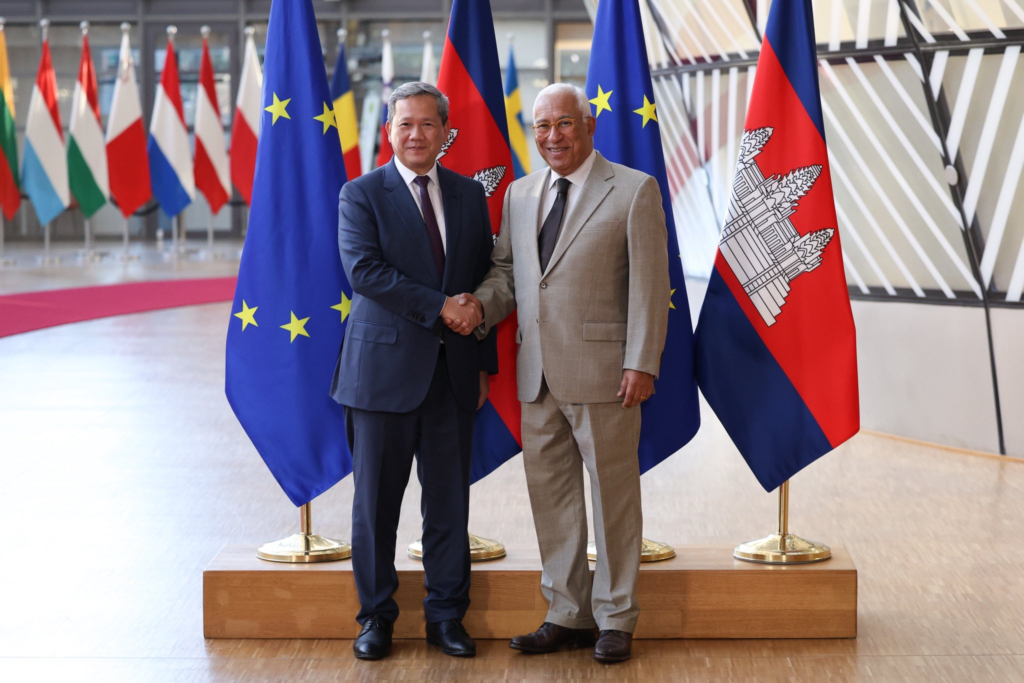
Meeting between Cambodian Prime Minister Hun Manet and President of the European Council António Costa. (X/António Costa)
In a transactional lens, the pardon can be understood as a trade. The partial withdrawal of EU trade preferences in 2020 hit Phnom Penh’s key export sectors hard, including garments, footwear and travel goods, which together employ hundreds of thousands of Cambodian workers.
The EU has promised to review the suspension on three conditions: the release of Kem Sokha, the reinstatement of his CNRP and the restoration of civil and political rights. With the royal pardon, one of the requirements has been addressed. Nevertheless, despite his release, Kem Sokha’s lifetime ban on political activity remains in force and his five-year travel ban is still in place. For analysts and opposition voices inside Cambodia, the signal is unambiguous. Cambodian Political Scientist Sophal Ear has described the move as symbolic rather than transformative, while underlining one point that genuine reconciliation cannot happen while political inclusion remains structurally blocked.
The irony is that the EU’s cautious welcome says as much about Brussels’ limits as it does about Phnom Penh’s intentions. Having spent six years applying trade-based pressure, Brussels could not afford to dismiss a gesture it had spent years demanding. However, accepting the pardon, which was not a structural change, would validate a pattern in which minimum concessions buy maximum diplomatic relief.
What makes this paradigm more difficult to break is the presence of a third actor. China has spent years embedding itself into Cambodia’s economy and security architecture in ways that fundamentally reduce Phnom Penh’s dependence on Western resources. In April 2026, Chinese Foreign Minister Wang Yi met with Hun Sen in Phnom Penh to inaugurate the first China-Cambodia 2+2 strategic dialogue involving both foreign and defence ministers where the two sides pledged to oppose any forces seeking to undermine their “ironclad friendship”. The dialogue also reaffirmed acceleration of the Belt and Road projects including the 1.7 billion US dollar Funan Techo Canal which Beijing frames as a symbol of Cambodia’s economic sovereignty and its own tool of regional influence. The significance of this relationship for the EU’s leverage is at risk, as China provides infrastructure investment, security cooperation and unconditional diplomatic support that are not conditional on any democratic standard.
The Test Ahead
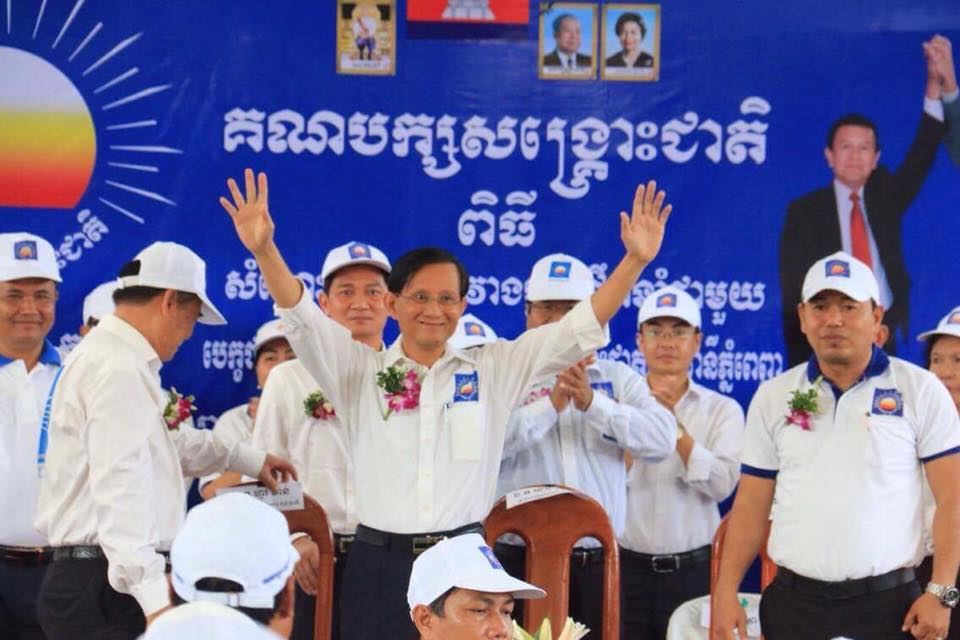
CNRP’s Yim Sovann campaigning ahead of the Cambodian communal elections in 2017 before the party was dissolved. (Wikimedia/Zenonja)
Cambodia is approaching its next electoral cycle in 2027-2028. If political opposition remains legally suppressed, exiled or restricted, the CNRP would stay dissolved, while Kem Sokha remains barred from political participation. Furthermore, if activists and journalists continue to face intimidation and arrest, then the pardon will be remembered as a calculated minimum, timed to ease international scrutiny ahead of elections rather than to change the conditions that make scrutiny necessary.
For the EU, the question is whether the pardon becomes a floor or a ceiling. Ambassador Driesmans’ statement suggests Brussels intends to keep the pressure on. But the pattern of the past six years: concessions offered in response to pressure, cautious welcoming, and lack of structural change suggests that good intentions on both sides have not been enough to alter the underlying political economy of the relationship. Another challenge for Brussels is that its primary tool is slowly falling into danger while China’s presence is hardening.
The real test of whether the Kem Sokha pardon means anything will come not in the statements issued in its wake, but in whether the next Cambodian election has a genuine opposition to contest it.
About The Author