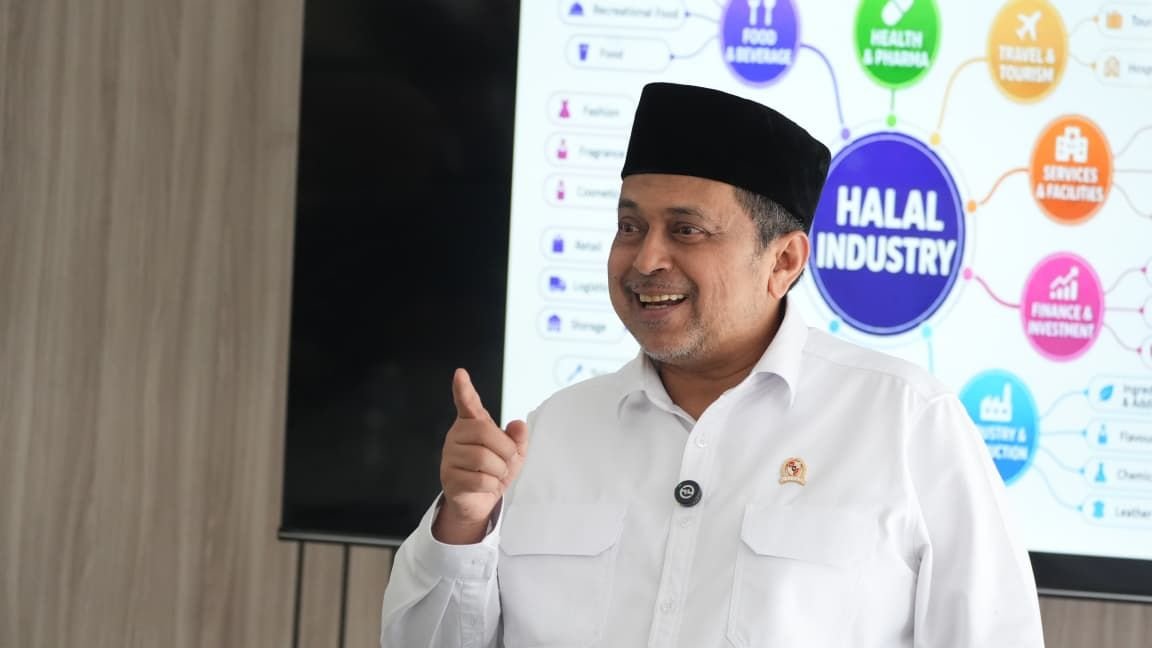
Head of Indonesia’s Halal Product Assurance Agency (BPJPH) Ahmad Haikal Hasan speaks at a public discussion on the halal industry on August 24. (BPJPH)
Value chain optimisation is the key to tapping into the halal industry’s potential, Head of the Halal Product Assurance Organising Agency (BPJPH) Ahmad Haikal Hasan affirmed during a public forum themed “Halal Industry: The Future of Indonesia’s Industry and Economy” on August 24.
Haikal emphasised that the halal industry must transition from being treated as a merely religious certification exercise into a major driver of the national economy, noting that Indonesia’s halal value chain already contributes approximately 27% to the country’s gross domestic product (GDP).
Haikal pointed to the growing global demand for halal-compliant products and services, and how it offers immense opportunities for Indonesia, which boasts a large domestic market, thriving businesses, alongside a vast Muslim population.
Nevertheless, Haikal argued that “that halal is not only about certification, but also makes a significant contribution to the national economy,” he claimed. Accordingly, he highlighted that strengthening the halal industry must be assessed beyond the mere growth in the number of halal-certified products, but also by viewing enhancement of production capacity, trade, investment and job creation.
“Indonesia must not only become a market. We must become producers. We must use our potential to build industries, create jobs, increase trade and drive economic growth,” he said.
He further noted that a whole-of-nation collaboration among the government, enterprises, education and financial institutions, as well as civil society, is required. This is crucial, as he mentioned, to establish a productive and sustainable ecosystem linking halal potential with economic activity.
What does this mean for businesses?
Indeed, the halal market is growing globally, and Southeast Asian nations are actively striving to tap into the projected growth opportunities it presents. Notably, even non-Muslim majority nations such as Vietnam are striving to carve out a niche in the global supply chain. For Indonesia, which possesses a commanding strategic advantage as home to the world’s primary Muslim population, this massive domestic base can be leveraged by businesses to scale operations efficiently before expanding internationally.
As Indonesia scales its halal production ecosystem, Kala Advisory helps investors turn openings like these into targeted, country-by-country entry plans across Southeast Asia. Visit kala-advisory.com.
About The Author