
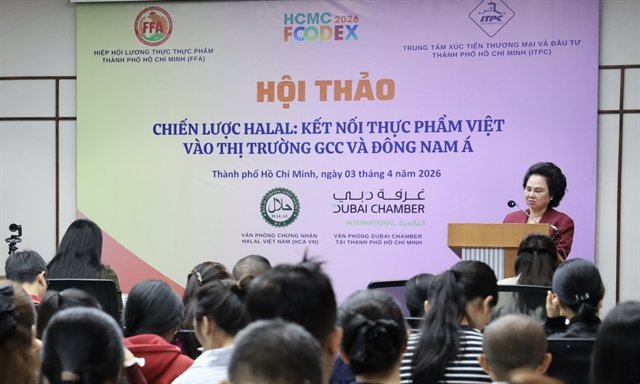
Halal market seminar in Ho Chi Minh City on April 3, 2026. (Vietnam News Agency)
Vietnam is set to debut the HalalViet Promotion and Experience Centre on May 15 in Hanoi. Organised by the Vietnam Institute of Strategy and Policy for Industry and Trade (VIOIT) under the Ministry of Industry and Trade, the launch will serve as a platform for business networking and Halal cultural experiences.
The event is expected to see high-ranking officials from national and regional ministries, diplomatic representatives from Islamic countries and global halal authorities. Experts, business executives and media practitioners will also be present to cover the proceedings.
In collaboration with Hanoi Xanh Cooperative (a Vietnamese enterprise specialising in producing and exporting high-quality agricultural products), the HalalViet Centre will offer consultancy on standards, certification and competitiveness improvement for enterprises.
Held alongside is an international seminar titled “Halal Market: A Growth Driver for Vietnamese Enterprises,” which is set to examine global Halal market trends and opportunities as well as assess solutions to technical barriers and promote product innovation.
The initiative is expected to help Hanoi tap into the supply chain of the expanding global Halal market. For context, the global Halal market is a worldwide trade ecosystem encompassing goods and services that comply with Islamic dietary and lifestyle laws (Sharia).
Looking ahead, the centre plans to develop the HalalViet.com e-commerce platform to connect businesses with international partners and consumers through both business-to-business (B2B) and business-to-consumer (B2C) models.
What does this mean for businesses?
Although Muslims account for less than 0.1% of Vietnam’s population, Hanoi is positioning the halal industry as a new economic pillar to drive exports. This is a strategically sound move, given that the global halal market is expanding well beyond food into sectors such as cosmetics, pharmaceuticals, tourism, logistics and e-commerce.
Vietnam already holds a degree of competitive advantage in the agricultural sector, at least within ASEAN, giving it a credible foundation from which to integrate into the global halal supply chain. The more pressing challenge, however, is domestic readiness as only around 0.2% of businesses in Vietnam currently hold halal certification. Bridging that gap will be the critical first step before any broader ambitions can be realised.
About The Author

2 thoughts on “Hanoi to launch HalalViet Centre, eyeing global halal supply chain”