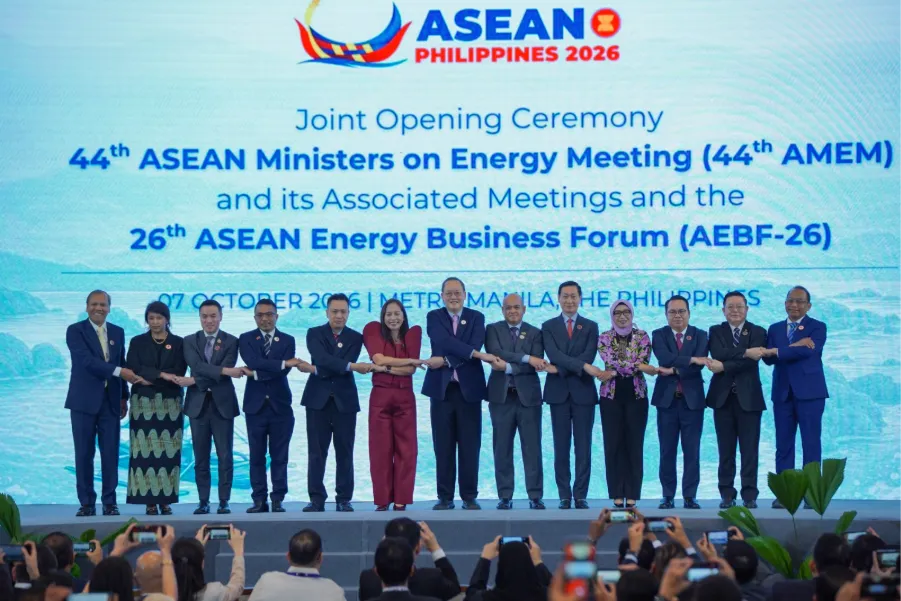
The Joint Opening Ceremony of the 44th ASEAN Ministers on Energy Meeting (AMEM) and 26th ASEAN Energy Business Forum (AEBF-26) at the Philippine International Convention Center in Manila, on October 7. (ACE)
The proposed regional hub for fuel stockpiling became a central focus of discussion among leaders and energy executives during the 44th ASEAN Ministers on Energy Meeting (AMEM) in Manila from October 5 to 9.
The initiative was first tabled at the 48th ASEAN Summit in Cebu, Philippines, in May this year. The envisioned joint fuel reserves aims to mitigate supply chain vulnerabilities as Southeast Asia was considerably the worst-impacted regions following the Hormuz disruptions, and continues to grapple with its “planted” consequences. Reportedly, it will operate on a commercial, producer-consumer coordination basis to ensure countries can rapidly pull oil reserves during a supply emergency
The ongoing discussions are currently focused on the feasibility study and framework development phase. The process will be assisted by technical experts from the e Japan International Cooperation Agency (JICA) and Japan’s Ministry of Economy, Trade and Industry. They will determine exactly where physical facilities can be built, how much they will cost and how the voluntary oil-sharing logistics will operate commercially.
Crucially, this year’s ASEAN Chair, the Philippines, will establish a national energy reserve by the end of 2027, which could potentially be integrated or converted to support a broader regional network.
Notably, under such a plan, Philippine Energy Secretary Sharon Garin clarified that the Philippines wants a built-in priority clause. If the country serves as a storage host, it must be granted first priority to draw from those reserves during a domestic emergency.
“What we want is if there’s any country that wants to store the crude or their petroleum products here. In case of any emergency the country gets priority on this on the stocks,” she noted.
Additionally, Southeast Asia has also taken a major step forward on the long-delayed regional power grid through a fresh preliminary deal.
What does this mean for business?
For enterprises, this regional energy pivot promises greater operational predictability. Establishing robust fuel buffers and interconnected power grids will better insulate businesses from the volatile transport fuel hikes and power outages triggered by global shipping bottlenecks. Furthermore, the commercial, producer-consumer structure of the reserves opens up lucrative long-term investment avenues for logistics, infrastructure development and energy trading firms looking to anchor themselves in Southeast Asia.
About The Author