A woman working in a factory producing Vietnamese flags, an illustration of “Made in Vietnam” products. (Pexels/Hong Son)
Dyana Yuri Aurora is a Trade Analyst at the Ministry of Trade Indonesia. The views expressed are the author’s own and do not represent SEA Daily or that of another organisation.
An Open Market
In 2025, Vietnam was the world’s 17th-largest exporter, with total exports reaching 473 billion US dollars. Hanoi’s success in boosting its national economy and reposition is due partly to the fact that it aligned with the World Trade Organisation (WTO) Trade-Related Investment Measures (TRIMs) principle, which allowed trade-related investment to flow freely. However, its rapid growth is not without challenges as it faces transhipment issues, leaving it labelled as a screwdriver industry in the global market.
In August 2025, Vietnam was hit with 40% ad valorem duty by the US, with the latter citing transhipment as the tariff’s main reasoning. It caused Hanoi a headache as Washington is its biggest export market. The transshipment rate is no longer effective, but Vietnamese products now have to pass through the US Customs’ substantial transformation test (19 C.F.R. § 134.1(b)) to be able to claim the tariff privileges. Even further, through White House Publications, “The Great Transhipment Scam” in August 2026, the US has put Vietnam on Tier 2 of Shadow Transhipment Network with deeper integration into China-linked supply chains.
Alongside incentives and competitiveness, Vietnam has a vast trade architecture that accommodates GVC integration, which became a catalyst for the flow of foreign direct investment (FDI). At the same time, because domestic industries are not fully integrated into the value chain, local content and value-added processing remain noticeably low. In 2025, the FDI sector accounted for 77.3% of total Vietnamese exports. Domestic industries accounted for only 22.7% of exports in the same year, with their total value decreasing by 6.1% compared to the same period in the previous year.
Double-Edged Sword
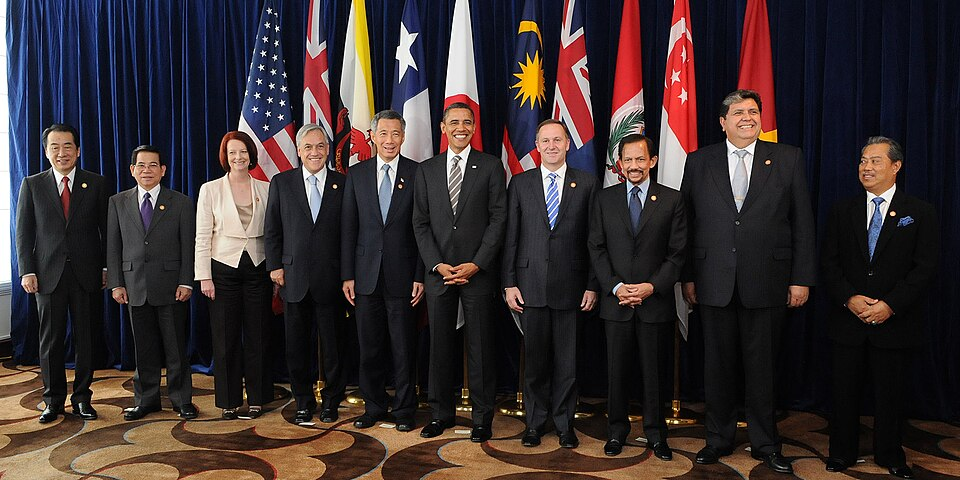
Summit with leaders of the negotiating states of the Trans-Pacific Strategic Economic Partnership Agreement (TPP). Vietnam represented by Mr. Nguyễn Minh Triết (number two from the left). (Wikimedia)
For global manufacturers, the existence of Rules of Origin (RoO) is highly favourable. RoO determine the nationality of products or services required to qualify for preferential treatment in global markets. That is why countries claiming to operate open markets compete fiercely to secure favourable trade agreements covering major export destinations. This is precisely what Vietnam has done. With 18 trade agreements covering 90% of the global market, Vietnam is notably one of the few countries to successfully boost its gross domestic product (GDP) through exports driven by FDI. Vietnam’s RoO network allows products and services to enter more markets, rendering them highly competitive in destination countries.
However, challenges arise from this very mechanism. With numerous FDI investors eager to establish manufacturing operations in Vietnam, the open market structure enables manufacturers to connect directly with GVCs for raw materials. Some producers even bring their own Tier 1 and Tier 2 suppliers—referring to those who supply their direct parts, sub assemblies, and materials with them—severely limiting integration with domestic industries. Under previous RoO regimes that set no explicit local content thresholds, manufacturers were left to self-determine the origin of their products or services. Consequently, goods undergoing minimal processing in Vietnam could still satisfy origin criteria. This is how Vietnam earned the label of a ‘screwdriver industry’—where simple assembly or repackaging processes were sufficient to claim a ‘Made in Vietnam’ designation.
As a result, the RoO sword cuts both ways. Foreign companies utilise these rules far more effectively than domestic producers, while lenient RoO regulations slow the integration of local industries into global supply chains and leave the country burdened with an undesirable reputation.
Trade Wars and Viet Nam RoO Reformation
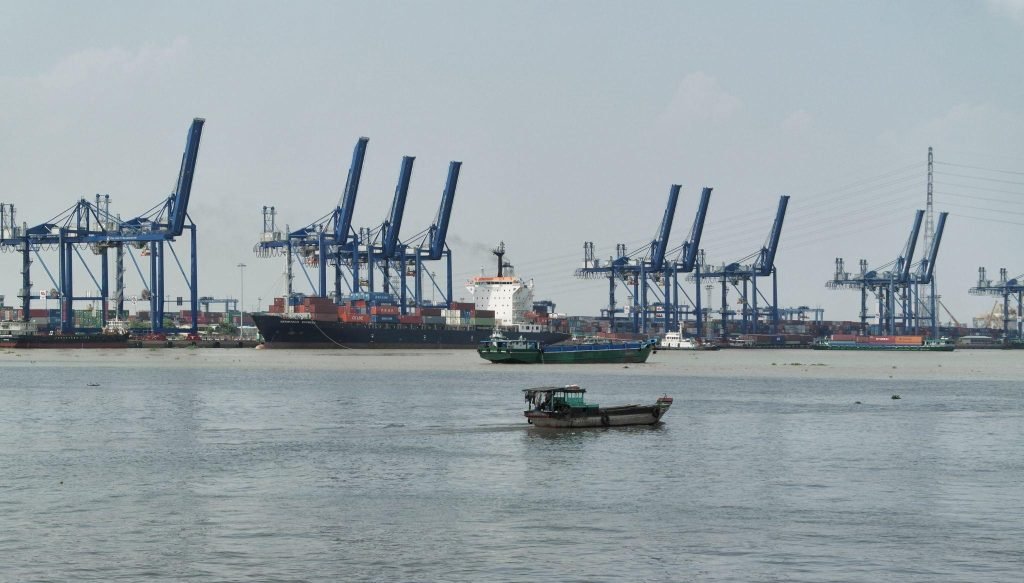
Cát Lái Port, Viet Nam Largest Port (Wikimedia)
On the surface, the solution to this headache appears straightforward: the government should build Tier 1 and Tier 2 supporting industries for global manufacturers in Vietnam, encourage domestic integration into GVCs and raise local value content requirements for issuing RoO certificates. In reality, however, the process is far more complex. Local industries must first be rendered ready for integration into both domestic and international value chains. Currently, most domestic firms are not yet equipped to participate. Limited technology transfer, restricted access to capital and inadequate incentive packages must all be tackled alongside policy adjustments. However, efforts in this direction are actively ongoing.
In October 2026, the Vietnamese government issued Decree 384/2026, regulating the determination of Vietnamese origin for goods produced and circulated domestically. This Decree addressed key regulatory loopholes by stipulating that products made with imported materials must contain at least 30% Vietnamese Value Content (VVC), while explicitly excluding simple assembly or packaging operations from obtaining Vietnamese RoO. As these regulations enter into force early next year, the prevalence of screwdriver industries will hopefully diminish as value-added processing expands along the supply chain.
The next homework is driving domestic industry participation in export-led supply chains. As an initial step, the government could collaborate with relevant trade associations to assess the readiness level of companies across each sector. For higher-tier firms, business-matching events and trade exhibitions between Original Equipment Manufacturers (OEMs) and supplier industries could be organised to facilitate integration. For lower-tier firms, support could take the form of technical assistance, supplier mentoring programmes involving global manufacturers, quality certifications or targeted interventions aligned with national priorities.
Concurrently, an export credit scheme should be established on both incentive and non-incentive bases. When domestic firms produce critical components required by the market, they could earn credit points. Higher credit scores would grant improved access to finance, fast-track customs clearance and tax restitution. Additionally, public-private partnerships could cross-share financial incentives, encouraging market-ready domestic firms to join global and local export chains. Under this approach, global manufacturers secure reliable local suppliers and policy compliance, domestic firms gain commercial clients and capital injections, and the government acts as an active facilitator rather than merely an enforcer.
While Vietnam’s economic reforms are commendable, the focus must now shift to executing the next phase of structural integration.
About The Author