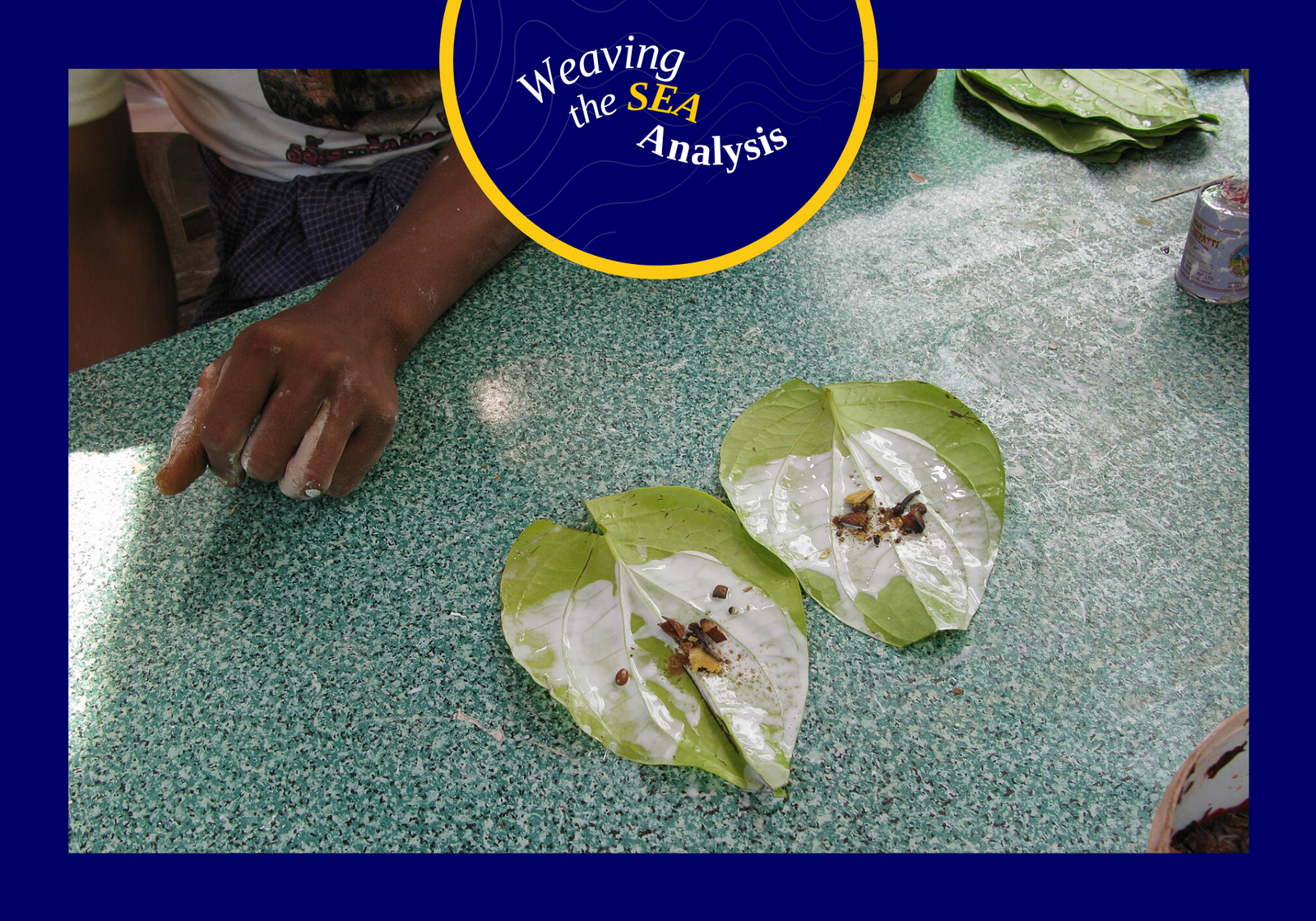
Paan, the betel leaf and areca nut preparation for chewing in Mandalay, Myanmar, in 2008.(Wikimedia/Vyacheslav Argenberg)
Red Spittle at the Market’s Edge
In a covered market on the edge of a village in the Shan hills, Myanmar, an elderly woman sits behind a low tray of green leaves, pale nut slices and a small tin of white paste. With practised hands, she smears slaked lime along a betel leaf, folds a sliver of areca nut and a pinch of gambier inside it, and tucks the parcel into her cheek. Within minutes her mouth fills with a deep crimson fluid, part of which she spits neatly onto the packed earth beside her stool, leaving a dark stain that dries almost black. When she laughs at a customer’s joke, her teeth show the same blackened patina, built up over decades of chewing. A stranger passing through is handed a quid before being asked his business, an old gesture of welcome rather than suspicion.
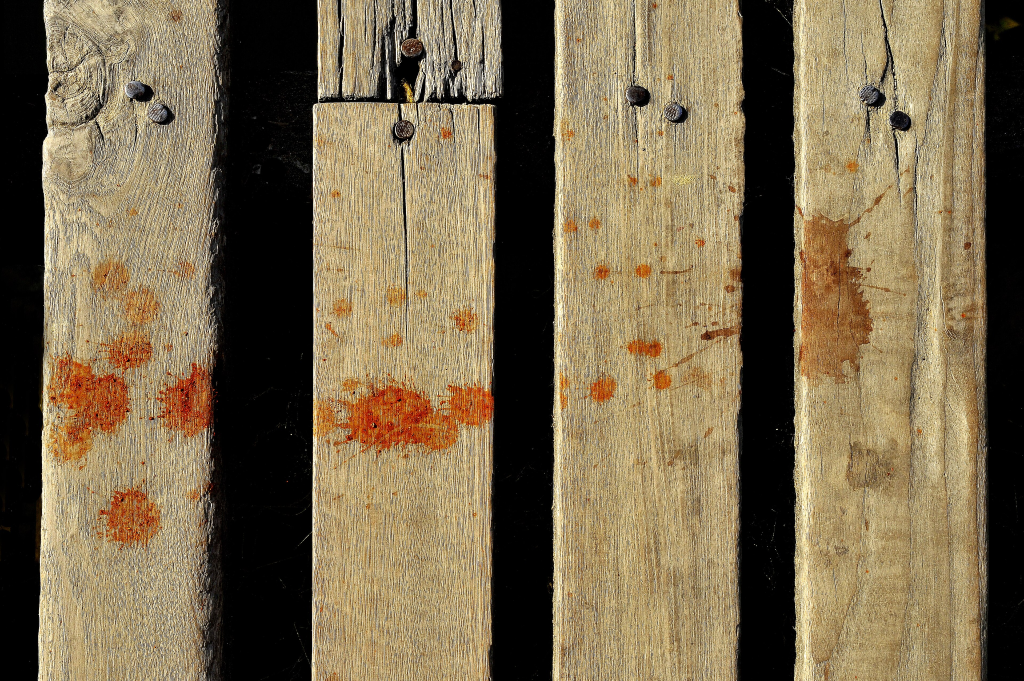
Red betel quid spit on a bridge in Mandalay, Myanmar. (Wikimedia/LBM1948)
Travel a little and the same choreography repeats, in different costumes. In the highlands of Vietnam, elderly women still fold identical parcels for guests who step through the door. In the limestone hills of Nusa Tenggara Timur and scattered pockets further into Indonesia’s eastern islands, betel chewing has become a habit of the old and the rural rather than the young and the urban, though its trace is stubborn enough that physical anthropologists have been able to read it straight off the teeth, in the living and the long dead alike. In the Malay world the same complex has hardened into an object you can hold in your hands: the tepak sirih or cerana, an ornate compartmentalised box of areca nut, betel leaf, lime, gambier and sometimes tobacco. Carried by a bride’s family, it is, as custom has it, the one object without which the conversation about marriage cannot even begin. What looks, at first glance, like a fading rural habit turns out to be the visible remainder of one of the oldest shared bodily practices in maritime and mainland Southeast Asia, written not only into oral tradition but into the mineralised plaque still clinging to teeth pulled from graves several thousand years old.
From Neolithic Quid to Colonial Contraband

A map showing the migration and expansion of the Austronesians (5,500 to 800 BP), which roughly corresponds to the prehistoric distribution of betel chewing (Wikimedia/Pavljenko)
In 2025, a team working on six Bronze Age burials at Nong Ratchawat in central Thailand ran the dental calculus through biomolecular analysis and pulled out arecoline and arecaidine, the diagnostic alkaloids of Areca catechu, locked inside a burial some four thousand years old. It is, by their own account, the earliest direct biochemical confirmation of betel chewing anywhere in the region. The same chemical fingerprint had already turned up two decades earlier in the teeth of a Bronze Age community at Nui Nap in northern Vietnam, where gas chromatography lifted areca-derived tannins straight out of ancient dental staining.
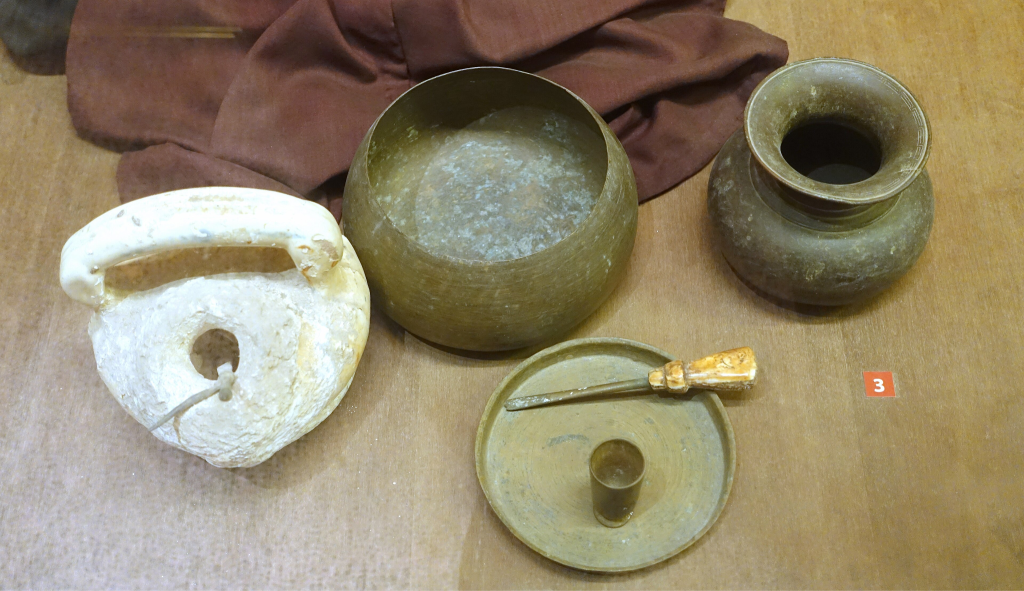
Vietnamese betel nut kit from the Vietnam Museum of Ethnology. (Wikimedia/Daderot)
Follow the trail further south and east and it surfaces again in the dental pathology of prehistoric islanders at Lewoleba and Liang Bua in Nusa Tenggara Timur, read directly off the bone by researchers working on the archipelago’s own skeletal record. Lay these three sites side by side on a map, central Thailand, coastal Vietnam, the eastern Indonesian islands and a single chewing complex comes into focus, one that predates every national border since drawn across it. A wide-ranging synthesis of the evidence situates this complex within an even older diffusion of Areca catechu and Piper betle across South Asia, Southeast Asia and the Pacific.
The chemistry explains why the habit left such a stubborn mark. Chewing brings the areca nut’s alkaloids into contact with the calcium hydroxide of slaked lime and the phenolic compounds of the betel leaf and the reaction produces both the mild lift chewers prize and the blood-red saliva that stains lips, packed earth and eventually enamel. Repeated across a lifetime, sometimes deliberately intensified with additional dyeing agents, that same chemistry produced the blackened teeth once read across much of the betel-chewing world as a mark of a mature, marriageable adult rather than a blemish to hide.
A shared chemistry supported a shared grammar of gesture. Offering a quid could open anything from hospitality to a passing stranger to formal negotiation between kin groups. In Malay, the association runs into the language itself: meminang, the verb for proposing marriage, descends directly from pinang, the areca nut. Comparable ritual uses, courtship, hospitality, offering, recur across the mainland and the archipelago, less a set of coincidentally similar local customs than a single regional vocabulary of obligation, built around one chewed substance.
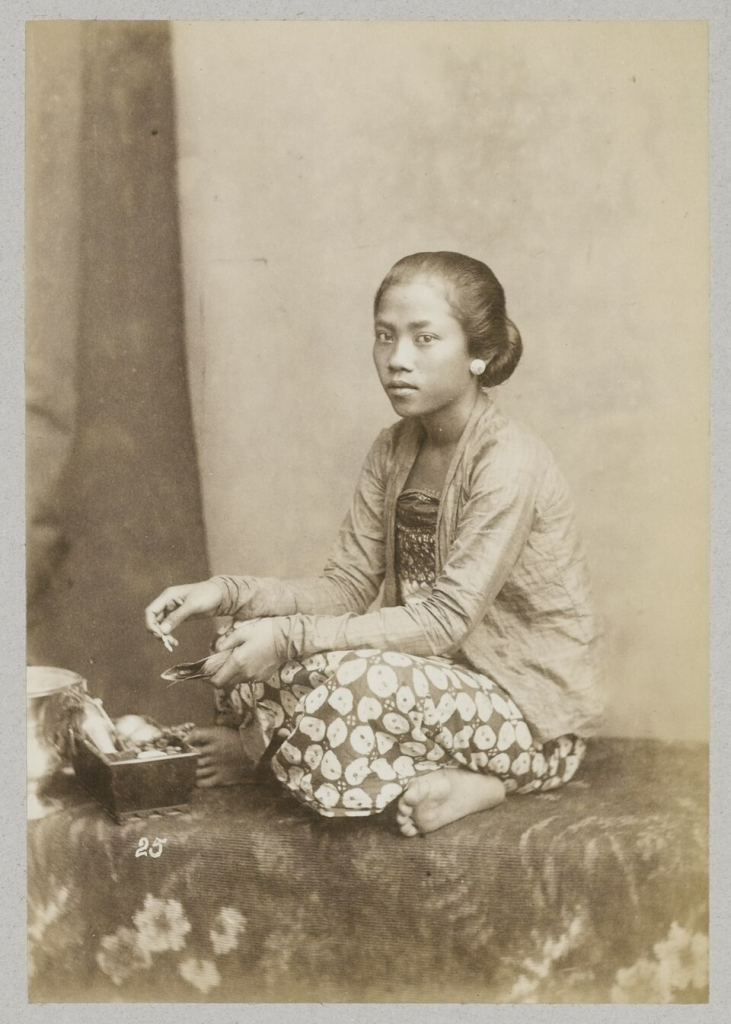
A Javanese woman preparing betel leaf in the 19th century. (Wikimedia/KITLV)
That vocabulary was deliberately overwritten in the twentieth century. In Indonesia, historian Anthony Reid has traced the slow eclipse of betel chewing by cigarette smoking to the changing commodity economies and prestige structures colonial rule introduced, cigarettes, not the quid, came to mark a modern kind of sociability. In Thailand the shift was made explicit as policy: the cultural mandates of the 1930s and 1940s, part of a wider modernisation drive that also pushed Western dress and hygiene, suppressed public betel chewing as a sign of backwardness incompatible with a modern national image. More recently the practice has picked up a further, biomedical layer of stigma. In 2004, the World Health Organization’s cancer research arm concluded that areca nut, with or without tobacco, belongs in Group 1, the same category as tobacco itself, on the strength of its link to oral submucous fibrosis and oral cancer. Where colonial and nationalist modernisation once framed the quid as unhygienic, public health now frames it as carcinogenic, and the two framings have worked together to push a once-central social practice toward the margins of rural and elderly life.
A Somatic Archive of Belonging
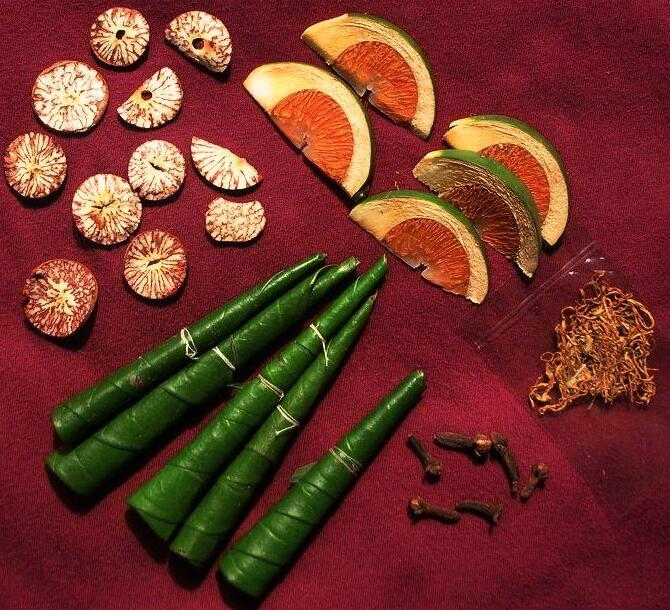
The items used in a chewing session. The betel leaves are folded. Slices of the dry areca nut are on the upper left. Slices of the tender areca nut are on the upper right. The pouch on the right has tobacco, an optional element. On the lower right, there are dried cloves. (Wikimedia/Mohonu)
Put together, this archaeology, this linguistics, this political history, add up to something larger than a shared taste for a mild stimulant. Before the modern nation-state drew its borders across the mainland and the archipelago, populations from the Shan hills to the eastern islands of Indonesia were bound by a common sensory and chemical habit, one that produced the same reddened mouths and blackened teeth, moved through the same gestures of hospitality and courtship, and left the same biochemical fingerprint on human remains separated by thousands of kilometres and several thousand years. The stained tooth of a Bronze Age individual at Nong Ratchawat and the blackened smile of a present-day market vendor in the Shan hills are, in a real biochemical sense, evidence of the same regional body.
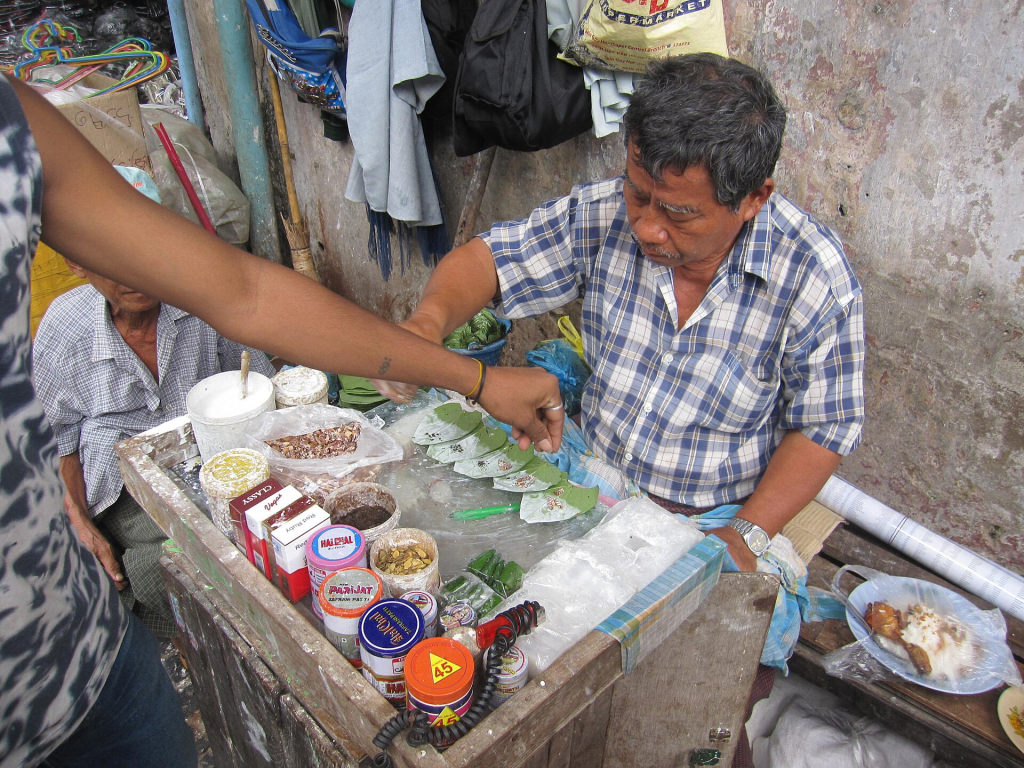
Betel quid vendor at Bogyoke Market in Yangon, Myanmar. (Wikimedia/Wagaung)
The retreat of this practice under colonial hygiene campaigns, nationalist modernisation, and contemporary oncology is not simply a story of one habit falling out of fashion. It is a case study in how the modern nation-state, colonial or postcolonial, tends to standardise the bodies of its citizens, replacing older transregional somatic ties with health regimes and aesthetic norms organised at the national scale. What survives, in rural markets, in minority communities, in ornate objects like the tepak sirih now more often found behind museum glass than in daily use, is a residue of that older collective body rather than its full continuation. Read together, biochemical, linguistic, material, these residues let the region’s deeper history be told not only through kingdoms, trade routes, and religions, but through the shared, chewed, spat and stained evidence of ordinary mouths.
About The Author