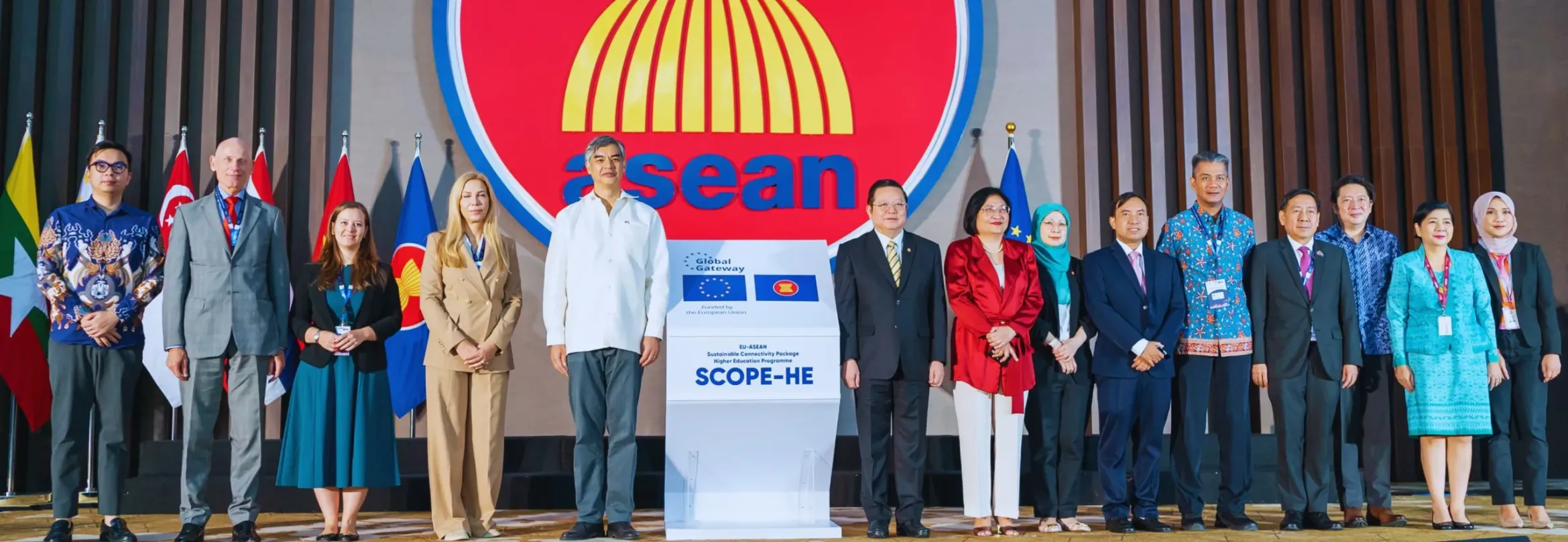
Global Town Hall 2026 on September 19. (FPCI)
With a genuine belief that civil society is central to determining the world’s development agenda, the seventh Global Town Hall convened on September 19, drawing over 8,000 people from more than 120 countries and all walks of life.
Organised by the Foreign Policy Community of Indonesia (FPCI)—alongside a global consortium of think tanks, universities and international institutions—the virtual marathon dialogue focused on the theme, “Calling for a Global U-Turn: Recentering Development, Reclaiming Humanity, Restoring Justice in a Crazi(er) World”.
The founder and chairman of the independent foreign policy organisation—who was also Indonesia’s ambassador to the US and a former Vice Minister of Foreign Affairs—Dino Patti Djalal, delivered the opening remarks, setting a definitive tone for the conference. “The world is going in the wrong direction,” he insisted, for “force is increasingly used to determine outcomes”.
The imperative path forward is therefore a “U-Turn”, with Dino stating, “this is not the kind of world we want to live in,” and certainly “not the kind of world we want our children and future generations to live in”.
To represent benchmark actions for navigating times of turbulence and escalating tensions, FPCI invited Micheál Martin, the Taoiseach (Prime Minister) of Ireland, a nation the organisers noted as being a “staunch and fearless defender” of international law. The Taoiseach’s stance was clear, that “development succeeds not when it is done for people, but when it is shaped with people”.
The development agenda scrutinised most throughout this year’s Global Town Hall was, as obvious, technological advancement.
Casper Klynge, Denmark’s first Digital Ambassador to Silicon Valley (2017-2020), sternly emphasised that “those working in the field have a very big responsibility as they are developing a very powerful tool,” and are therefore bound to ensure this technology benefits people, inclusively.
When it comes to “recentering development”, experts made frequent reference to Southeast Asia; a region standing at a critical crossroad as it navigates the artificial intelligence (AI) boom. Of note, AI infrastructure establishment comprises—or, for some countries, is beginning to comprise—the bulk of overall foreign direct investment (FDI) that flows into the region. And in keeping that momentum, each Southeast Asian nation is attempting to leverage its respective factor endowments; such as robust law enforcement, cheap labour, vast land, or even (though farfetched) abundant electrical power capacity.
Yet, such developmental endeavours are fatally compromising humanity, threatening (if they have not already done so) to breach fundamental human rights and further marginalise already vulnerable communities. What must be grasped, by all stakeholders, as experts reminded, is that trading away humanity won’t catalyse growth; if anything, it does the opposite.
The discussion then shifted to admit that there is no sign of slowing, let alone stopping, the “AI Race”. Consequently, the non-negotiable move for governments (the pinnacle of what they can provide) is to establish a sufficient AI governance framework. Southeast Asia is woefully lacking it.
In taking a broader view, the Founder and President of the Observatory of the Social and Ethical Impact of AI (OdiseIA), Idoia Salazar, acknowledged that indeed “we need green lights and red lines [for AI development],” but “the reality is far more complex”. “Those colours are not universal,” she underscored, explaining that “what is considered a green light in one country, and/or culture, may be perceived as a red line in another”. She thus reminded that policymakers have to be “really careful when drawing the line”. “We must understand context,” she added.
Nevertheless, governments of developing, Global South nations, she argued, remain entitled to invest substantially in education, specifically to raise awareness and “nurture critical thinking”. This is the foundational footing, as she argued that “before we align machines with humanity, humanity needs some agreements”. Alignment is required between governments, companies, researchers and citizens on “what values we want to protect,” furthermore “what are we willing to delegate to AI,” and ultimately, “where and when human control remains essential”.
“Get down to individual level,” the Director of Lee Kuan Yew Centre for Innovative Cities at the Singapore University of Technology and Design (SUTD), King Wang Poon, insisted on alignment with Salazar. He highlighted targeted initiatives, such as technology workshops tailored for the elderly and career-stage training adjusted for the youth. His main argument centres on how to ensure that the people benefit.
“Focus on humans and we’ll be able to navigate this a bit better,” he concluded.
About The Author