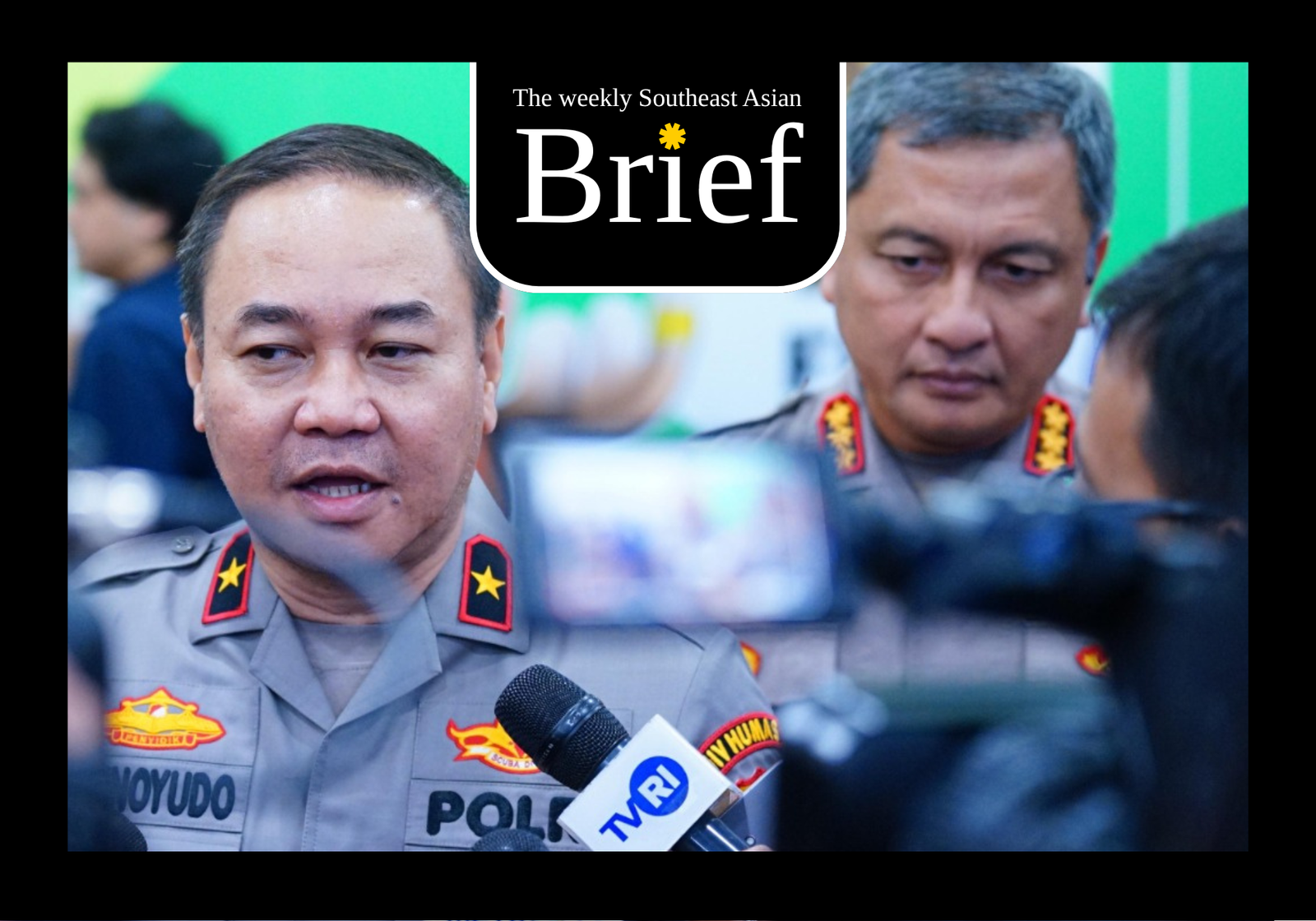
Jakarta is racing to sign spaceport deals with Russia and India on land whose ownership remains contested, and diplomacy isn’t waiting for that dispute to close.
Indonesian President Prabowo Subianto held a bilateral meeting with Russian President Vladimir Putin in Vladivostok, Russia, in September 2026. (Indonesian Secretarial Secretariat)
On September 3 this year,Vladimir Putin called Indonesia one of Moscow’s “trusted friends” in ASEAN, and Indonesian President Prabowo Subianto told the room in Vladivostok thatRussia and Indonesia “interact as equals.” The two leaders were discussing a joint spaceport on Biak, an island off Indonesia’s Papua coast. What went unsaid is that the land the spaceport needs still has no resolved owner. Three months earlier, on June 5, over 5,300 kilometres away, landowners from the Warbon Indigenous community drove a red cross (Owarak) into the ground in Indonesia’s Saukobye village, North Biak. This traditional marker signifies sasi adat, a customary law that officially closes the land to outsiders. “This is our ancestral land, not empty space for a state project,” one resident said. Six days later, officials from the National Research and Innovation Agency (BRIN) held a public consultation over the boycott of the Byak Customary Council. On June 13, BRIN’s head Arif Satria, the Papua provincial government and the Biak Numfor regency signed a memorandum of understanding to build a national spaceport on that ground.
The first line of Indonesia’s constitution does not talk about trade, nor borders, nor government. It talks about colonialism and even says it “must be abolished in the world, as it is not in conformity with humanity and justice.” That sentence is the reason the first Indonesian President Soekarno and Vice President Hatta built Indonesian foreign policy around bebas-aktif (independent and active). It is the reason Indonesia hosted the 1955 Bandung Conference, which brought together 29 newly-independent Asian and African states in Indonesia to promote economic and cultural cooperation, oppose colonialism and stake out a path independent of both Cold War blocs, laying the groundwork for the Non-Aligned Movement. And it is the reason Indonesian President Prabowo Subianto stood at this year’s BRICS summit and invoked “the spirit of Bandung.” Nations that fought colonialism, he said, now uniting as equals.
While Indonesia’s founding principle looks outward at the world with real conviction, Biak tests whether those same founding ideals apply to domestic policy.
Between Two Giants
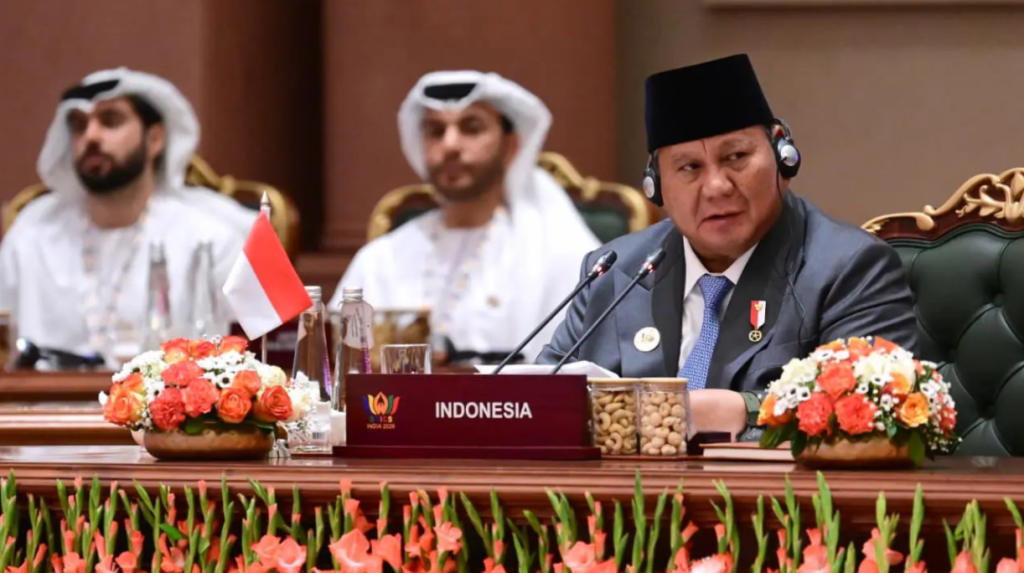
President Prabowo Subianto attended the 2026 BRICS Summit in New Delhi, September 2026. (Indonesian Presidential Secretariat)
The government moved rapidly to build the legal framework for spaceport operations. On May 12, President Prabowo signed Government Regulation 22/2026, which became Indonesia’s first law governing spaceport operations—licensing, sanctions, insurance, financing. It says nothing about customary land. The state wrote itself a complete legal architecture for launching rockets and left the question of whose ground they launch from, still, entirely unanswered. However, the same constitution that abolishes colonialism in its preamble also contains, in Article 33, the tool Jakarta actually uses to override customary land. Government Regulation 22/2026 didn’t need to mention customary land because the constitution already gives the state authority to proceed without resolving it.
As for foreign partners, Russia was the first mover. A 2023 memorandum was followed by a December 2024 meeting between BRIN and Roscosmos in Jakarta that named Glavkosmos as the implementing partner, then BRIN chief Arif Satria’s April 2026 visit to Moscow, then a July 1 working meeting aimed at a 2027 target for the spaceport. By the time Prabowo and Putin sat down in Vladivostok two months later, the technical groundwork was already largely in place. Even so, Russia’s own ambassador has struck a more cautious tone than his president: as late as August, Sergei Tolchenov called the relationship “just the first discussion, not even the first stage of cooperation.”
India arrived almost simultaneously. When Indian Prime Minister Narendra Modi visited Jakarta in July 2026, the two governments extended a BRIN–Indian Space Research Organisation (ISRO) framework agreement among sixteen strategic deals signed that day. BRIN said the two leaders had directly discussed Biak, adding that Indonesia was already in intensive talks with India over a launch site for the Indian firm Skyroot, paired with the Indonesian satellite operator PT Pasifik Satelit Nusantara (PSN). With Turkey now showing interest, Biak has become a battleground for competing foreign interests, all bidding for space on land whose legal ownership remains unresolved.
What makes this worth the courtship, officials say, is up to 200 million US dollar a year in potential revenue. This projection, however, carries an immediate conflict of interest. It comes from Adi Rahman Adiwoso, chairman of the Indonesian Space Association, who is also the CEO of PSN, the same company holding the commercial stake in the Indian deal. The underlying study, a 2025 Deloitte–Singapore Space & Technology report, projects 100 billion US dollar in regional gross domestic product (GDP) contribution from satellite data across all of Southeast Asia by 2030. While that figure is real, it doesn’t come from this spaceport alone and it’s worth noting it comes directly from a party with a stake in the project.
Jakarta’s Case for Biak
The land question did not begin this year. In 1980, Indonesian National Institute of Aeronautics and Space (LAPAN)—BRIN’s predecessor—surveyed 100 hectares near Saukobye’s coast and objectors were reportedly asked whether they were sympathisers of the Free Papua Movement (OPM). The Abrauw-Rumander clan did not discover the resulting release certificate until 2002, and dispute it to this day. BRIN reportedly sought to expand that claim to 500 hectares in late 2025. While advocacy groups report a planned expansion to 500 hectares, BRIN’s official public commitment remains at 100 hectares. Since November 2025, human rights monitors report between 1,200 and 1,750 military personnel deployed across Biak and Supiori, framed by the state as “territorial development.” As recently as November 2025, UN human rights experts publicly called on Indonesia to honour its 2007 vote, noting the country “continues to deny formal recognition to self-identifying Indigenous Peoples.”
A recent Papuan analysis piece compared Biak explicitly to Baikonur and French Guiana’s Kourou, other places where the world’s launch ambitions were built on indigenous ground. A recent paper argues that “the anticolonial spirit inherited from Sukarno has transformed into internal colonialism against West Papua.” A political scientist studying Bandung’s legacy calls it a “vexing contradiction” that the very conference committed to ending self-determination’s denial produced exactly that condition in West Papua.
BRIN’s own chairman has said publicly that customary figures have signed on, though even the government’s messaging is not consistent about how many:Kompas quotes him saying “the majority” have agreed, while Antara’s own report has him saying only “some” have. PSN puts the equatorial site’slaunch-efficiency gain at 15 to 20% over Cape Canaveral. That is plausible, even thoughindependent estimates for comparable equatorial sites elsewhere run closer to 5 to 10%. The local community isn’t united on this, either. Saukobye landowners aresplit between supporters and opponents, adding that no one has actually asked them for their free, prior and informed consent.
That last point is the one that survives every version of the government’s case. Whatever the actual split in Saukobye, whatever the true efficiency gain, whatever share of local elites has signed on, none of it substitutes for the consent process Indonesia’s own human-rights commitments require and none of it has happened.
It also isn’t the only place the government has known better and chosen Biak anyway. Indonesia’s own feasibility studies have compared Biak against Morotai, an island in North Maluku, for exactly this project. And on the safety criteria that matter most, population density and flight trajectory, Morotai scores better, helped by an existing air force base that could support launch operations. LAPAN’s own 2012 planning around Morotai cited its low population specifically because it meant little potential for social conflict with native inhabitants, and today the exact conflict playing out at Saukobye. Biak still wins the overall ranking, on infrastructure and economic grounds. But the state has known since at least 2012 that the alternative carried less risk to the people living on it and kept selling Biak regardless.
Malaysia offers a comparison that should make Jakarta uneasy. Pahang state is courting its own foreign spaceport partner, China’s Great Wall Industry Corporation signed a letter of intent in April 2025, while, in the same district, Jakun Orang Asli families had homes demolished in May 2026 for a palm-oil lease issued without consent.
The difference is what happened next. On June 16, Malaysia’s Federal Court reinstated 20,000 Malaysian ringgit (4,900 US dollar) in damages for seven Orang Asli villagers of Kampung Batu 20, Pekan, over the desecration of ancestral graves during development, a ruling Suhakam publicly welcomed in September. It is not a new legal frontier; it builds on the Sagong Tasi precedent Malaysian courts established in 2002 and affirmed in 2005. The ruling established a key principle that indigenous rights don’t just disappear without formal paper title. It was a modest case about grave sites, not sweeping land rights and Indonesian courts rarely enforce it consistently. Still, it proves the legal logic works in practice, a standard the government hasn’t even attempted to meet here.
The Test Bandung Never Faced
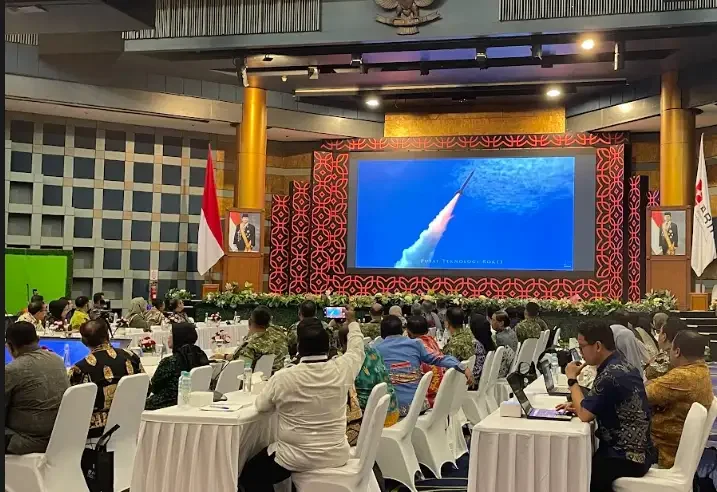
Indonesia’s National Research and Innovation Agency (BRIN) during an event held on space technology in 2025. (BRIN)
None of this proves Indonesia’s founding promise was always hollow. Prabowo’s Bandung rhetoric may be sincere; the diplomatic equality he claims with Moscow may be real; the economic case for Biak may be sound. The regulatory timeline points to a consistent outcome. On the one ground where that promise was actually tested against a competing interest, the state moved to override it because it always happened that way.
The next twelve months will show whether that changes. BRIN wants a foreign partner selected within 2026, implementation by 2027, a timeline that assumes the land question resolves itself, or doesn’t matter enough to hold up the schedule. It assumes away a second unresolved question, too: Biak sits inside a rainforest ecoregion rated critical and endangered, on a bay protected as a national marine park for one of the last pristine reef systems on the planet. A recent academic analysis of the community’s concerns points to deforestation, habitat loss for endemic species, and coastal pollution from rocket activity, and Indonesia’s own environmental group WALHI has spent years pushing for a completed Environmental Impact Analysis (AMDAL) that, as of the most recent reporting, still hasn’t caught up with the project’s own timeline. Papua Legal Aid Institute (LBH Papua) has demanded the Indonesian National Commission on Human Rights (Komnas HAM) investigate whether the June signing violated the community’s right to consent. Finalising these international partnerships before resolving local land title and environmental reviews would effectively bypass constitutional guarantees.
Whoever gazettes a working spaceport first, whether it is Jakarta or Kuala Lumpur, will not be the government that gazetted its own citizens’ land first. For a nation built on anti-colonial principles, the unresolved status of Biak remains a critical test of its founding ideals.
About The Author