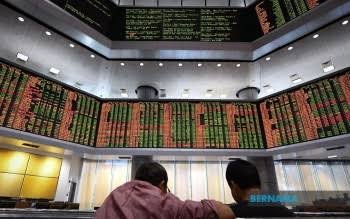
Traders monitor stock movements at Bursa Malaysia (Malaysia Stock Exchange) in Kuala Lumpur. (Bernama)
The Malaysian national news agency Bernama reported on August 8 that the FTSE Bursa Malaysia KLCI (FBM KLCI) is projected to trade with an upward trend bias leading into the week of August 8. This favourable momentum is estimated to oscillate within a narrow consolidation range of 1,720 to 1,750 points.
Mohd Sedek Jantan, Director of Investment Strategy at IPP Financial Advisers (IPPFA), attributed this positive trajectory to Malaysia’s robust domestic fundamentals and a stronger-than-expected 5.8% second-quarter gross domestic product (GDP) growth.
“Key catalysts to monitor include fluctuating oil prices, unfolding developments in the US-Iran conflict, and China’s July economic activity data,” he noted.
Echoing this sentiment, Rakuten Trade’s Vice-President of Equity Research, Thong Pak Leng, concurred that Malaysia’s domestic market will remain resilient despite ongoing geopolitical volatility. He maintained that “our stable interest rate environment, resilient domestic demand, and ongoing infrastructure spending will provide solid support for investor sentiment”.
Concurrently, during the week ending August 14, the FBM KLCI futures market experienced broad-based declines across all major delivery months on a Friday-to-Friday basis. This contraction was led by the August 2026 contract dropping 3.5 points to 1,726.0, whilst the September and December 2026 contracts fell by 2.5 points each to 1,705.0 and 1,706.5 respectively and March 2027 shed 5.0 points to settle at 1,689.0.
Reflecting this cautious derivative sentiment, the underlying physical benchmark FBM KLCI index similarly lost 8.36 points over the week, retreating from its previous Friday close of 1,735.75 to finish at 1,727.39.
What does this mean for businesses?
This positive economic baseline signals a highly predictable and secure operational environment for companies currently established or looking to expand in Malaysia. However, the substantial compression in market participation (evidenced by weekly turnover tumbling from 40,896 lots to 30,907 lots and open interest slipping from 49,170 to 41,862 contracts) indicates that institutional traders are actively liquidating short-term positions to wait on the sidelines. Consequently, rather than pursuing aggressive expansion, businesses should adapt by prioritising strict corporate profitability, shifting surplus treasury cash into defensive, highly liquid short-term instruments and focusing capital expenditure heavily towards internal technological optimisations.
Kala Advisory helps corporate treasurers and executives navigate localised volatility, optimise capital expenditures and turn macroeconomic openings like these into targeted, country-by-country entry plans across Southeast Asia. Visit kala-advisory.com.
About The Author