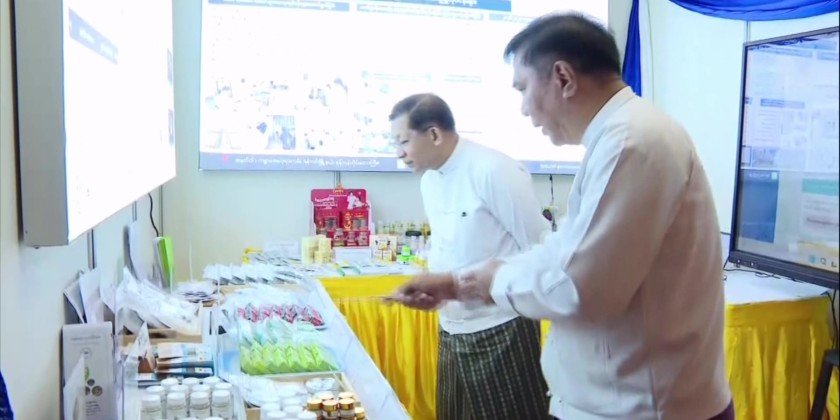
Myanmar’s President U Min Aung Hlaing attends the World MSME Day commemorative ceremony at the Myanmar International Convention Center-1 in Nay Pyi taw on June 27. (Myanmar International TV)
Aligning with the global theme “The Future Generation of MSMEs,” Myanmar’s two-day celebration pledged a heavy emphasis on transitioning businesses into an AI-driven, highly digitalised era. The event featured 149 exhibition booths showcasing regional garments, traditional Myanmar handicrafts, processed food, agricultural machinery as well as fertilizers produced by local small businesses.
The event was attended by Myanmar’s President Min Aung Hlaing, who delivered the opening address, affirming that MSMEs are key to the country’s economic growth.
The president highlighted the government’s efforts through the newly established Ministry of Industry and MSME Development. He elaborated that the body will provide financial assistance, technology facilitation and capacity building for businesses and the workforce. Reportedly, the ministry has already enforced some financial measures, including low-interest and collateral-free MSME loans through strategic alliances with domestic insurers. Therefore, the president urged MSMEs to modernise operations by adopting e-commerce and digital payment systems.
Notably, the Minister for Industry and MSME Development, Charlie Than, held an expert discussion regarding how MSMEs’ digital adoption will substantially contribute to Myanmar’s Digital Economy 2030-2031 target.
In his remarks, the minister underscored the critical importance of a digitalised MSME sector, outlining a six-stage pathway: visible, trusted, paid-, market-ready, delivered and growing.
Additionally, he called on MSMEs to participate in several upcoming events to, including an export workshop targeting Germany on July 8, as well as a China-ASEAN business benchmarking initiative scheduled for July 15 to 16.
What does this mean for business?
Because MSMEs constitute 90% of Myanmar’s businesses and drive 70% of domestic employment, the newly formed Ministry of Industry and MSME Development serves as a structural vehicle to accelerate digital adoption. Enterprises embracing these changes will capture priority state training, enhanced market visibility, and low-interest capital via domestic financial synergies. While critical primary sectors like agriculture, forestry, and livestock will gain massive boons from state loans and export tax breaks, enterprises anchored solely to importing finished foreign items will face stiffer regulations and elevated tariffs.
Ultimately, this digital infrastructure is designed to fortify local supply chains, sharpening Myanmar’s competitive edge within collaborative ASEAN economic frameworks.
Kala Advisory helps investors turn openings like these into targeted, country-by-country entry plans across Southeast Asia. Visit kala-advisory.com.
About The Author