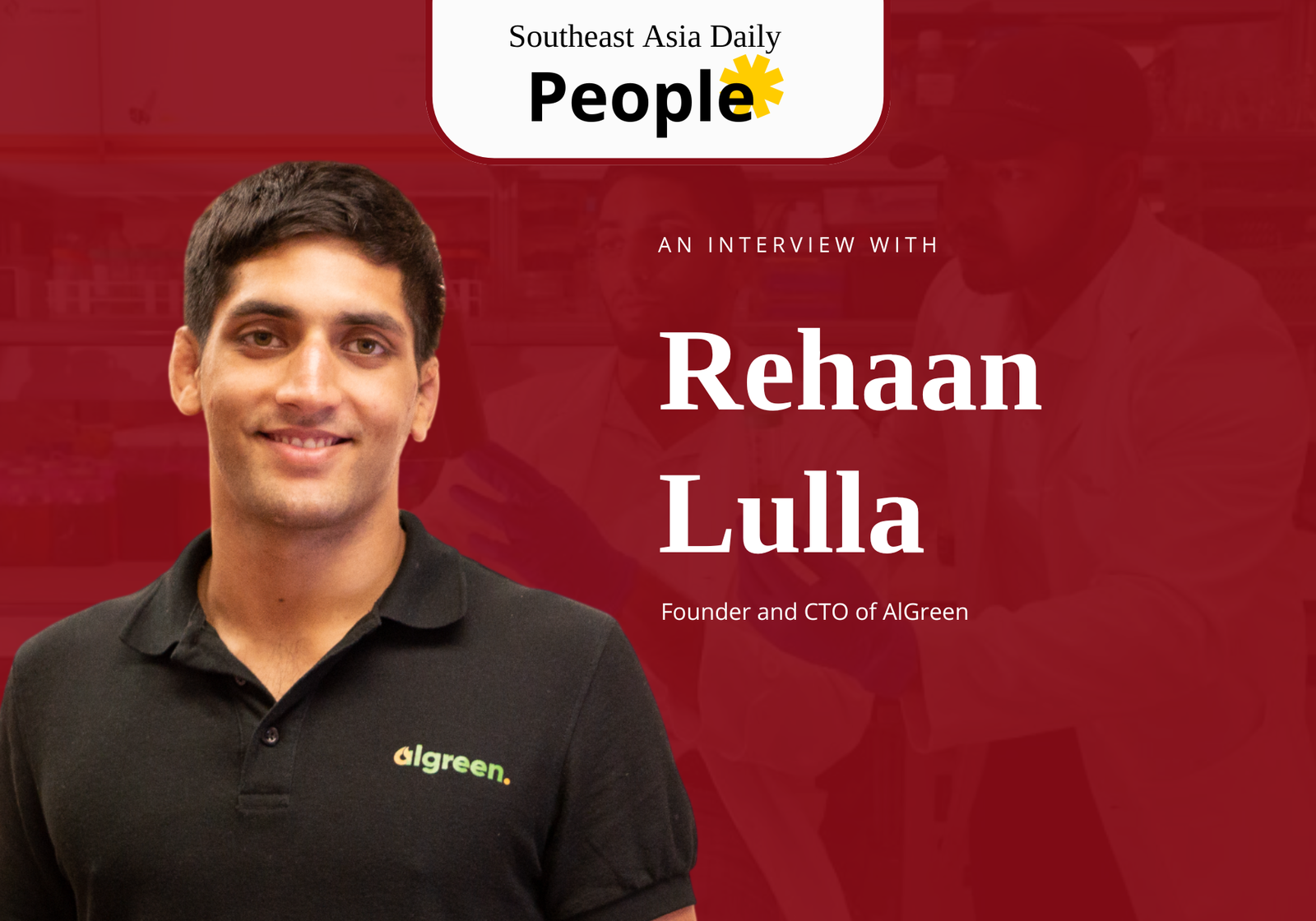
The device on Rehaan Lulla’s desk looks like a lava lamp. A tall glass column, a slow swirl of green and a soft glow. What it is invisibly doing is drawing carbon dioxide out of the room and releasing oxygen more efficiently than the pot plants most people keep for the same reason. The organism inside is microalgae, grown for decades as food and as a cosmetics ingredient, which Rehaan’s start-up AlGreen has repurposed to clean the air.
The reason behind the invention is air pollution, which is not a niche or a distant concern. It is now ranked among the leading causes of death worldwide. Southeast Asia, the region AlGreen is most interested in, lives with it more acutely than most. Seen that way, the green column is not a room decoration but one of the solutions to something very large.
An Invisible Killer
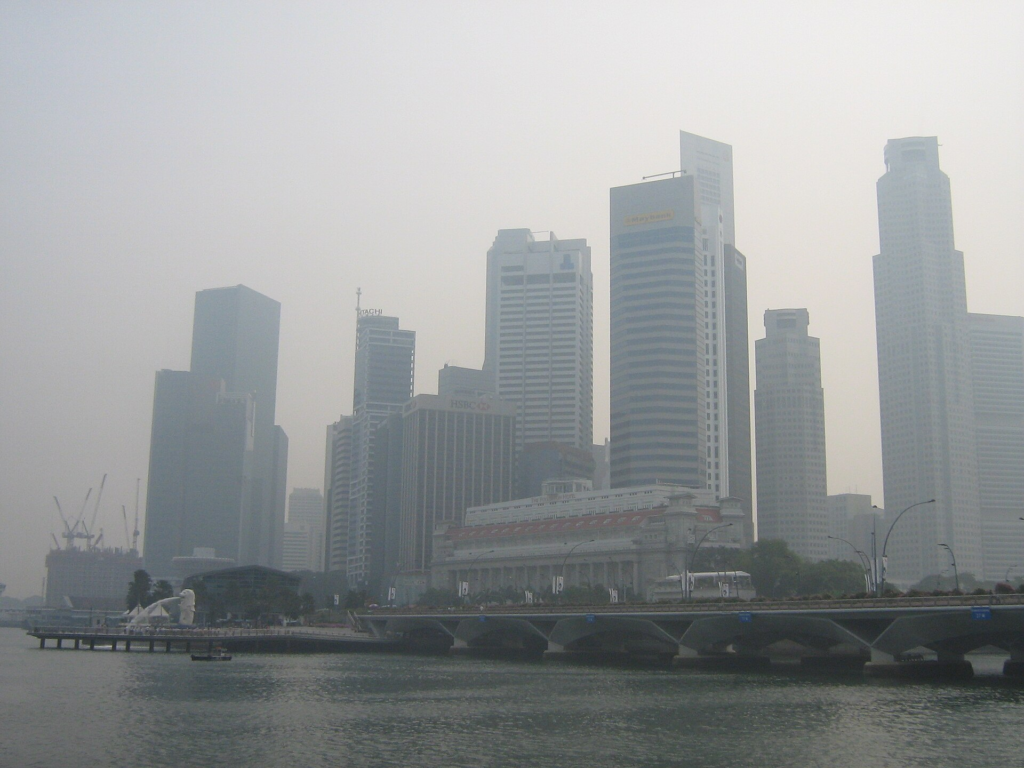
Haze over Singaporean skyline, partly attributed to the forest fires in neighbouring Indonesian island of Sumatra. (Wikimedia)
Air pollution has quietly become one of the largest threats to human health. In 2021, it was estimated to be linked to 8.1 million deaths worldwide, making it the second-leading risk factor for death after high blood pressure. It doesn’t only pose health risks in the outdoors. Around 40% of the world’s population still cooks and heats with wood, charcoal, dung or coal and the resulting household air pollution kills millions more each year. Because people spend most of their lives inside, either in homes, offices, classrooms or shops, the quality of indoor air matters as much as the haze outside.
The responses to all this vary and no single one is sufficient. Governments phase out coal and tighten emissions rules. Cities push public transport and electric vehicles. Households buy mechanical air purifiers that trap particles behind filters. Each helps but they have their own limits. Filters catch particles but do nothing for carbon dioxide, while the pot plants people keep for the same reason work slowly. It is in that gap that a certain biological approach starts to look interesting, one that led to the conception of Rehaan’s initiative.
The Case for Spirulina
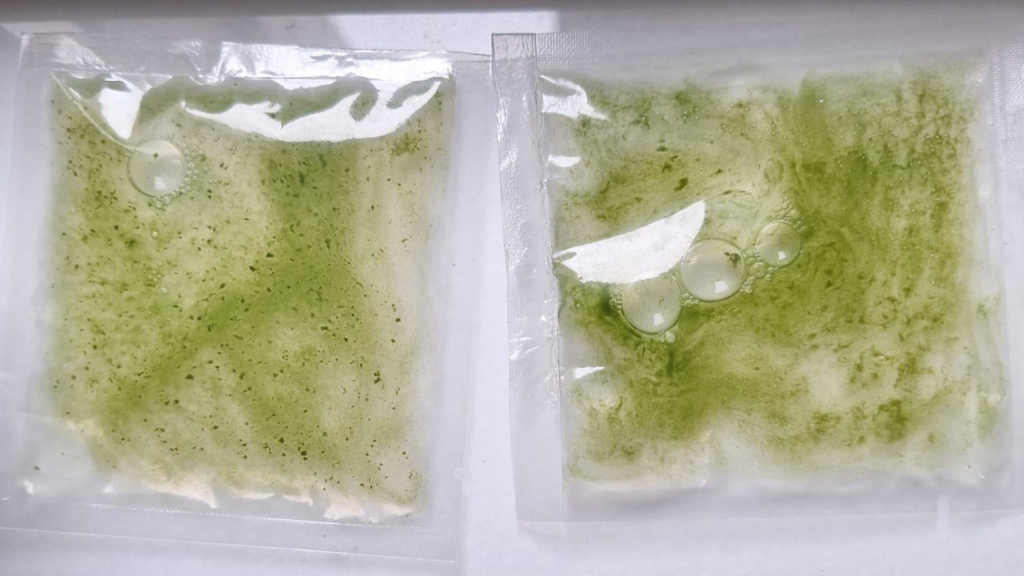
A spirulina culture. (AlGreen)
AlGreen began in a classroom. Rehaan was studying at the Hong Kong University of Science and Technology when he realised that biology, so central to medicine and food, was barely being applied to the environment. He and a few classmates dug deep, looking for something that is of value and they could actually build. They ended up in an organism most people only knew as a health supplement. That organism is spirulina, a spiral-shaped microalgae long grown for its protein and sold in tablets and face creams. When the project started, Rehaan noted that there were fewer than ten companies anywhere working on microalgae for carbon removal.
He calls it tiny but mighty and the reason is simple enough. A leafy plant pours most of its energy into roots, stems and bark, while spirulina constructs almost none of that, so nearly all of its biomass turns carbon dioxide into oxygen. It photosynthesises across its whole tiny body, far faster for its size than a pot plant can. By one estimate, a single gram of it can absorb close to two grams of carbon dioxide. It also grows in water that can rarely be used for other purposes, so it doesn’t need to compete with farmland.
From the Lab to the Living Room
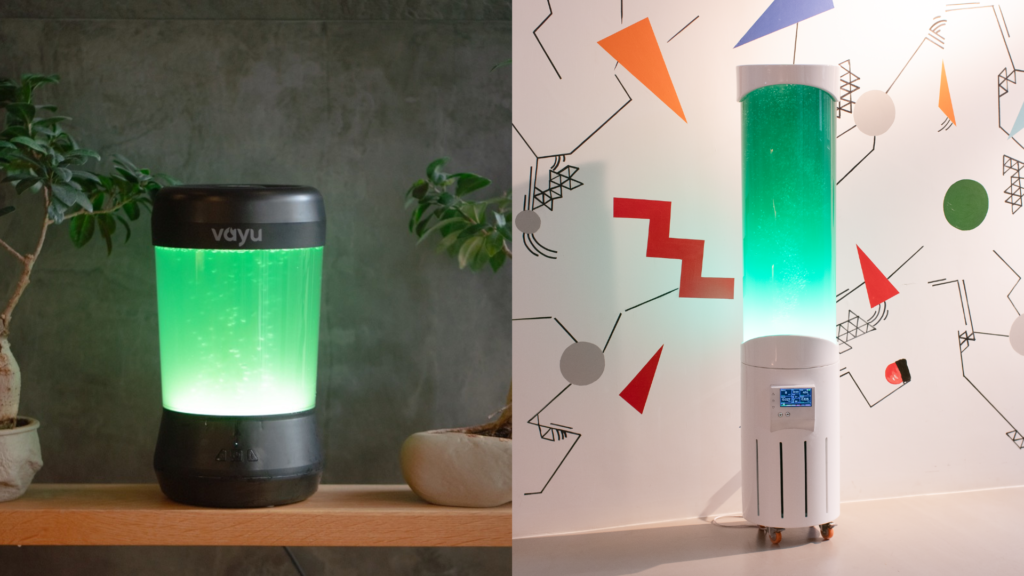
AlGreen’s two main products: the table-sized VAYU and human-sized OAK. (AlGreen)
AlGreen’s work has largely been to build the hardware that spirulina needs to do its job in ordinary places. In its case, the laboratory ends up being people’s homes and offices. On one hand, VAYU is destined for those who keep their windows shut but still want cleaner air. On the other hand is the OAK, an adult human-sized microalgae tank which includes a carbon capture device and serves larger places like schools and universities.
Because clean air is invisible, the project’s main challenge is proving the devices work. Rather than explaining the biology, AlGreen maintains that a single VAYU does the work of roughly 40 large house plants, a figure from its own tests backed by third-party testing. Meanwhile, its larger machines carry sensors that track how much carbon dioxide is absorbed and how much is produced, providing real-time performance data.
There is, however, an honest limit worth naming. AlGreen’s devices capture carbon by drawing it into algae biomass, but capture only becomes removal if that carbon is durably stored rather than allowed to escape. For the roughly 700 VAYU users, the company’s official guideline is to pour the spent algae down the sink or use it in the garden, where the captured carbon may return to the air. Nevertheless, its larger devices tell a different story. For the OAK tanks, AlGreen harvests the algae and converts it into biochar (which does not decompose and so locks the carbon away) or into storable bio-oil which Rehaan hopes one day to refine into aviation fuel.
Where the Air Is Worst and the Algae Grows Best
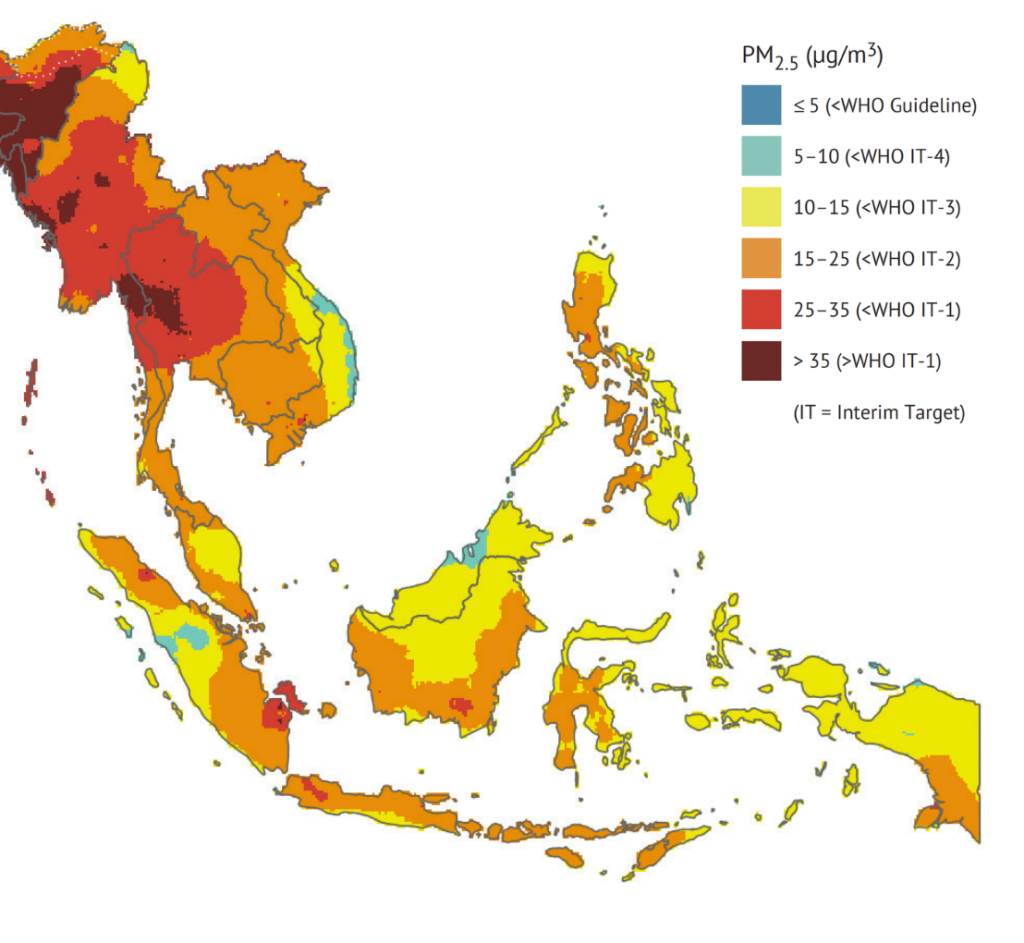
Annual average ambient PM2.5 exposure in 2019 in Southeast Asia, which has since evolved with Indonesia declared most polluted in 2025. (Health Effects Institute)
While air pollution is a global problem, Southeast Asia carries more than its share. In 2025, the most polluted country in the region, Indonesia, has an average PM2.5 level six times over the limit set by the World Health Organisation (WHO). To note, PM2.5 is potentially harmful airborne particles, which are small enough to slip past the body’s defences and remain deep in the lungs. In 2024, the worst-ranked city in Southeast Asia was South Tangerang, on the edge of the country’s capital Jakarta, where the annual average is roughly 12 times WHO’s guideline. One study attributed more than 10,000 deaths a year in Jakarta alone to polluted air, alongside an economic cost that reaches billions of dollars.
The causes are partly seasonal and partly structural. Each dry season, land-clearing fires on Indonesia’s islands of Sumatra and Kalimantan send haze across borders into Singapore and Malaysia, turning a national problem into a regional one, while coal plants around Jakarta and dense traffic keep the pollution reading high year-round. For such a region, any credible tool should be considered and here, AlGreen’s scheme has an additional advantage. Spirulina grows fastest in warm climates, so the closer it is to the equator, the faster it grows. Where cold winters can stall the organism’s growth in parts of East Asia, the tropical conditions across much of Southeast Asia are ideal for the species.
Rehaan lists India, Thailand, Malaysia and Indonesia as places where interest is building as the region already grows spirulina at scale for food and cosmetics. What’s new is the idea of mobilising it against air pollution in a place whose climate is very suitable to Spirulina’s growth.
The Green-Water Problem
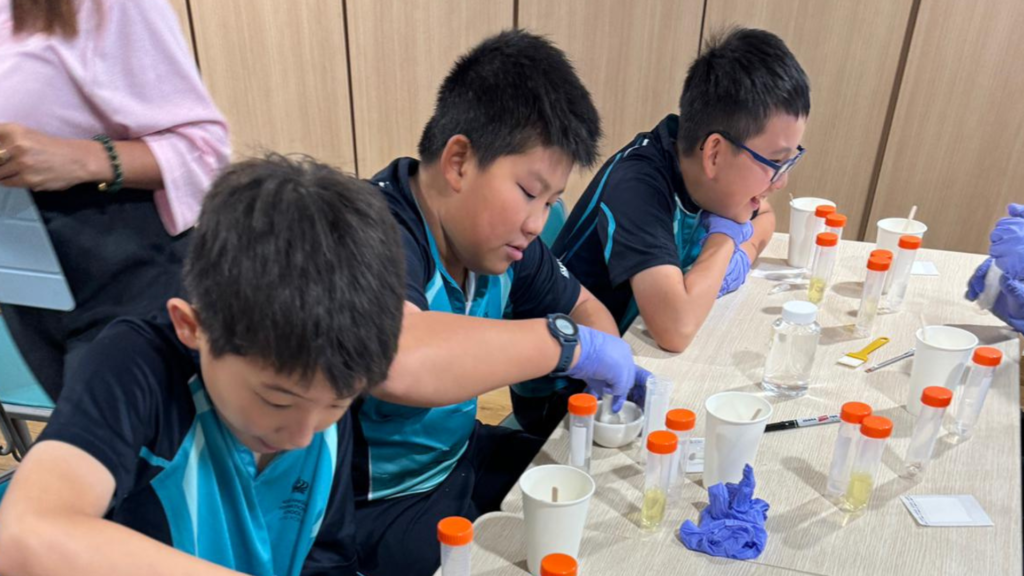
AlGreen leads a learning session on spirulina and its applications. Education is a key part of developing the potential of this microalga. (AlGreen)
The obstacles to a concept like this are rarely the technology itself, but rather the perception of its potential users. From the outside, AlGreen’s systems are a tank of green water, which is perceived as dirty water across much of the region, the kind found in a polluted river. It is, in fact, the other way around. Since the green is nutrient-dense water in which algae are thriving, the very thing that makes the device seem unhygienic is the sign the system is working.
A launch in the region could not simply be putting the product on a shelf. AlGreen would first have to explain what the machine is doing and actively shift the stigma. It is a branding and education cost rather than a flaw and it sits on top of a wider knowledge gap, since microalgae in the region is usually synonymous to nutrition and cosmetics, rather than clean air. A buyer has to be walked across two unfamiliar ideas at once, that algae can clean the air and that green does not mean dirty.
AlGreen’s answer for that problem is to teach from the ground up. The company already runs workshops in schools, showing students why microalgae outperforms ordinary plants at absorbing carbon dioxide through simple experiments. The same approach is presumably how it would tackle the green-water stigma in a new market like Southeast Asia.
Spirulina is not the whole answer to Southeast Asia’s air pollution problem and Rehaan would be the first to say there is no single answer. But the fit is real. In a region where the air is among the world’s worst and the climate is among the ideal to the organism, there is real reason for optimism. Once the hurdle of perception is cleared, Rehaan’s larger aim is to bring the living, breathing air purifier in the cities that need it most.
About The Author