
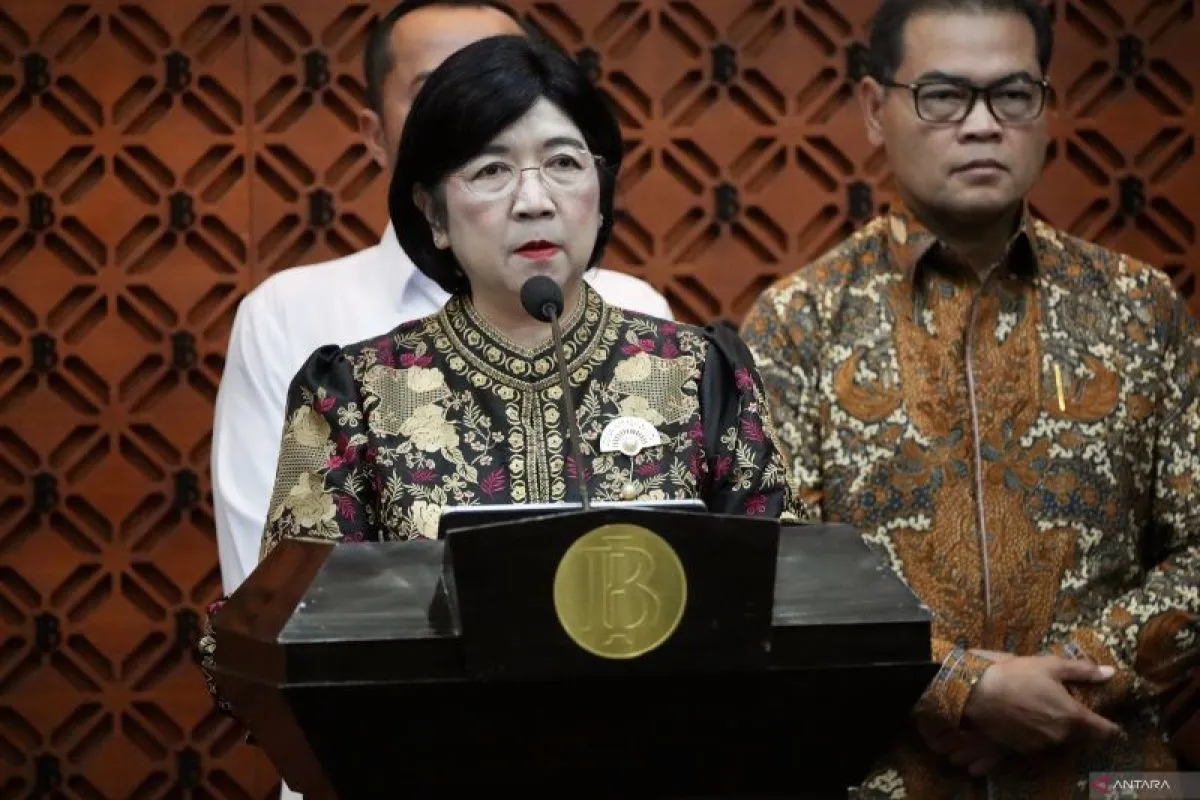
Bank Indonesia Acting Governor Destry Damayanti speaks during a press conference at the Bank Indonesia headquarters in Jakarta, on July 27, confirming Governor Perry Warjiyo resignation. (ANTARA)
Also attending the briefing was Senior Deputy Governor Destry Damayanti, who has since taken charge as acting governor while awaiting a successor. She delivered a message of stability and continuity to prevent financial market disruptions.
“Bank Indonesia (BI) will continue to implement policies that we have carried out previously,” she affirmed.
Concerns have heightened regarding the institution’s independence, as analysts attribute the outgoing governor’s sudden resignation to political influences. This was reflected in the immediate market volatility following the 8:00 am announcement, which triggered a modest negative shock.
The Indonesian rupiah weakened past the 18,000 per US dollar mark, while the main stock index (IHSG) briefly plummeted by nearly 1%, though it ultimately closed the session down to 0.17% at 6,185 points.
The outgoing governor had served in the top post since 2018, during President Joko Widodo’s administration, before beginning a second five-year tenure in 2023 that was scheduled to conclude in 2028. He was previously a deputy governor in 2013, following his two-year term as an International Monetary Fund (IMF) Executive Director.
Perry Warjiyo is widely perceived as a stabilising force for an economy undergoing massive pro-growth adjustments under President Prabowo Subianto, where programmes like Free Nutritious Meals (makan bergizi gratis, MBG) and the “Merah Putih” Village Cooperative (Kopdes) absorb a huge amount of cash.
In response to heightened global turmoil triggered by Middle East conflicts, Perry had led BI in implementing critical monetary tightening measures, including raising the BI rate to 5.25% in May and utilising Bank Indonesia Rupiah Securities (SRBI), which have significantly stabilised the rupiah exchange rate.
What does this mean for businesses?
The long-term corporate outlook hinges less on a single leader’s exit, and more on how the administration manages the leadership transition. Business confidence is likely to hold steady if Interim Governor Destry Damayanti permanently succeeds Perry Warjiyo, given her stellar track record as Senior Deputy Governor since 2019, guiding the economy through the COVID-19 pandemic and recent global energy shocks. However, enterprises must brace for near-term volatility; any signs that Jakarta intends to appoint a politically compliant figure who favors fiscal dominance over central bank autonomy could rapidly undermine the rupiah’s stability and escalate import costs.
Kala Advisory helps investors navigate shifting monetary horizons and turn structural openings like these into targeted, country-by-country market entry plans across Southeast Asia. Visit kala-advisory.com.
About The Author




One thought on “Modest Market Shock as Indonesia’s Central Bank Governor Unexpectedly Resign”