
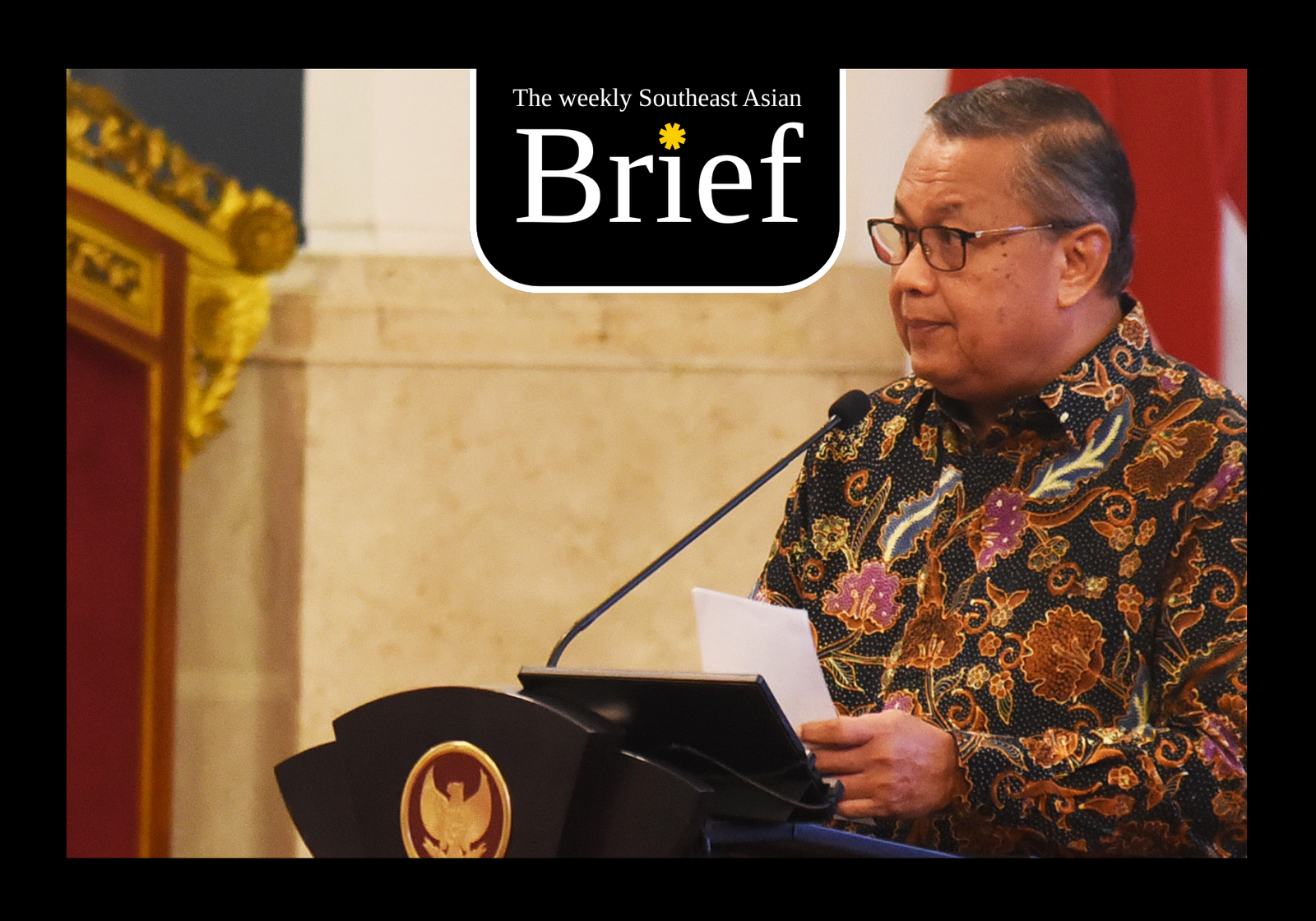
Outgoing Governor of Bank Indonesia Perry Warjiyo during a financial reporting in 2024. (Indonesian Presidential Secretariat)
In an unprecedented development, Indonesia’s central bank governor has suddenly resigned, citing personal reasons. The outgoing governor Perry Warjiyo was originally scheduled to conclude his second five-year term in 2028.
As an immediate response, a press briefing at the Indonesian central bank, Bank Indonesia (BI)’s headquarters in Jakarta was held on July 27. “He submitted his resignation letter for personal reasons and we respect it,” explained Minister of the State Secretariat Prasetyo Hadi.
In accordance with the constitution, Senior Deputy Governor Destry Damayanti has stepped in as an interim governor before the country names the governor’s successor. She affirmed to the public and the market in particular, that BI will maintain its authority, declaring that “BI will continue to implement policies that we have carried out previously”.
Just as the 8.00 am media conference concluded, the Indonesian rupiah fell past 18,000 rupiah per US dollar. The main stock market index (IHSG) mirrored this volatility with a 1% plunge, though late-session buying trimmed those losses to a minor 0.17% decline, closing at 6,185.
Though modest, this negative reaction was accompanied by growing anxieties over BI’s independence—concerns that, if left unmanaged, threaten to weaken Indonesia’s long run stability and growth.
This narrative is somewhat validated by empirical evidence of institutional instrumentalisation. The recent passing of the Financial Sector Development and Strengthening (P2SK) Law might be a concrete example, as it expands BI’s mandate to not only stabilise the currency exchange but also to support the country’s economic growth and create job opportunities, which are usually not responsibilities of a monetary institution. Furthermore, provisions within the law legally bind BI to submit its annual budget plan for parliamentary approval, integrating the legislature directly to allow it to gain leverage over the central bank.
On top of that, the public is also questioning the relevance of including the newly formed sovereign wealth fund Danantara into the Financial System Stability Committee (KSSK), whose task is to monitor, maintain and restore financial system stability. Its initial board comprised the Minister of Finance, the Governor of BI, the Chairman of Financial Services Agency (OJK) and the Chairman of the Board of Commissioners of the Deposit Insurance Corporation (LPS).
It is also worth noting that with an ambitious 8% economic growth target, this is not the first time President Prabowo Subianto’s administration has replaced highly disciplined financial figures with more expansionist, pro-growth successors. Hence, many have argued that the BI governor’s sudden resignation was driven by political influences.
Former Finance Minister Sri Mulyani’s replacement by Purbaya Yudhi Sadewa in September 2025 was a glaring case. For the record, she had served in her position for over 13 years across three presidential administrations, guarded Indonesia’s 3% gross domestic product (GDP) fiscal deficit ceiling and resisted overleveraging the state budget (APBN) by stringently managing the fiscal pacing of highly costly administrative programmes like Free Nutritious Meals (makan bergizi gratis, MBG) and the “Merah Putih” Village Cooperative (Kopdes).
Earlier this year in January, OJK’s three top orthodox leaders also stepped down, following the resignation of the executive director of the Indonesian Stock Exchange (IDX), on the pretext of “moral responsibility” after the IHSG sharply declined. Analysts argued that it partly reflected political pressure and an intervention in independence from the executive branch, and that the consecutive resignations served as a “direct critique”.
The recent reshuffle of the Head of the National Nutrition Agency (BGN) on July 22, was another stark case. Nanik Deyang had only been in her position since June, during which time she reportedly cut the MBG budget and conducted a criminal investigation into its scheme. She was replaced by Sudaryono, a senior member of President Prabowo’s political party, Gerindra.
If a political intervention was intentional, it implies an impending, significant change in the economic policy direction that diverges from the default.
Nonetheless, decision makers should rationally understand that international business assessments would depend less on one leader’s departure and more on how the transition is managed. This means, in BI’s case, corporate confidence will likely hold steady if Acting Governor Destry is appointed to succeed Perry. Though tension is also palpable as the public awaits President Prabowo nominating a candidate to the parliament, at a time when his nephew Thomas Djiwandono, who is also a Deputy Governor since February, has a chance to be named.
The outgoing seven-year governor Perry Warjiyo is widely acclaimed as a stabilising force for an economy weathering external challenges (namely Covid-19 until recent global energy disruptions) and the internal dynamics of a massive, pro-growth adjustments under President Prabowo.
Following the US-Iran conflict de-escalation in mid-May, Indonesia has arguably experienced a temporary relief of a stable market and currency. Analysts largely attributed this remedy to BI’s vital monetary measures under Governor Perry, such as the aggressive interest rate hikes, the deployment of Bank Indonesia Rupiah Securities (SRBI) with high interest, alongside foreign exchange triple intervention involving the selling of US dollars.
Admittedly, those were effective measures, as BI had to work twice as hard, pointing to the fact that Indonesia’s monetary manoeuvres are frequently subordinate to, or constrained by, its aggressive fiscal policy.
If the regime appoints a politically compliant figure who favours fiscal dominance over central bank autonomy, monetary policy will potentially be used to serve fiscal policies in executing certain political agendas. Should this worse-case scenario be realised, the nation will sacrifice long-term targets for short-term economic growth.
A central bank’s core duty is to control inflation. If monetary policy is weaponised to support populist fiscal projects, BI will likely pump excessive liquidity into the market. It will gradually erode international reputation and the Indonesian currency will continue to lose trust and thus trigger massive capital flight.
On the grassroots level, without the “monetary brake”, excess money supply will rapidly drive up the cost of living, eroding household purchasing power.
About The Author




2 thoughts on “Indonesia’s Central Bank Governor Resigns as Political Fiscal Dominance Continues”