
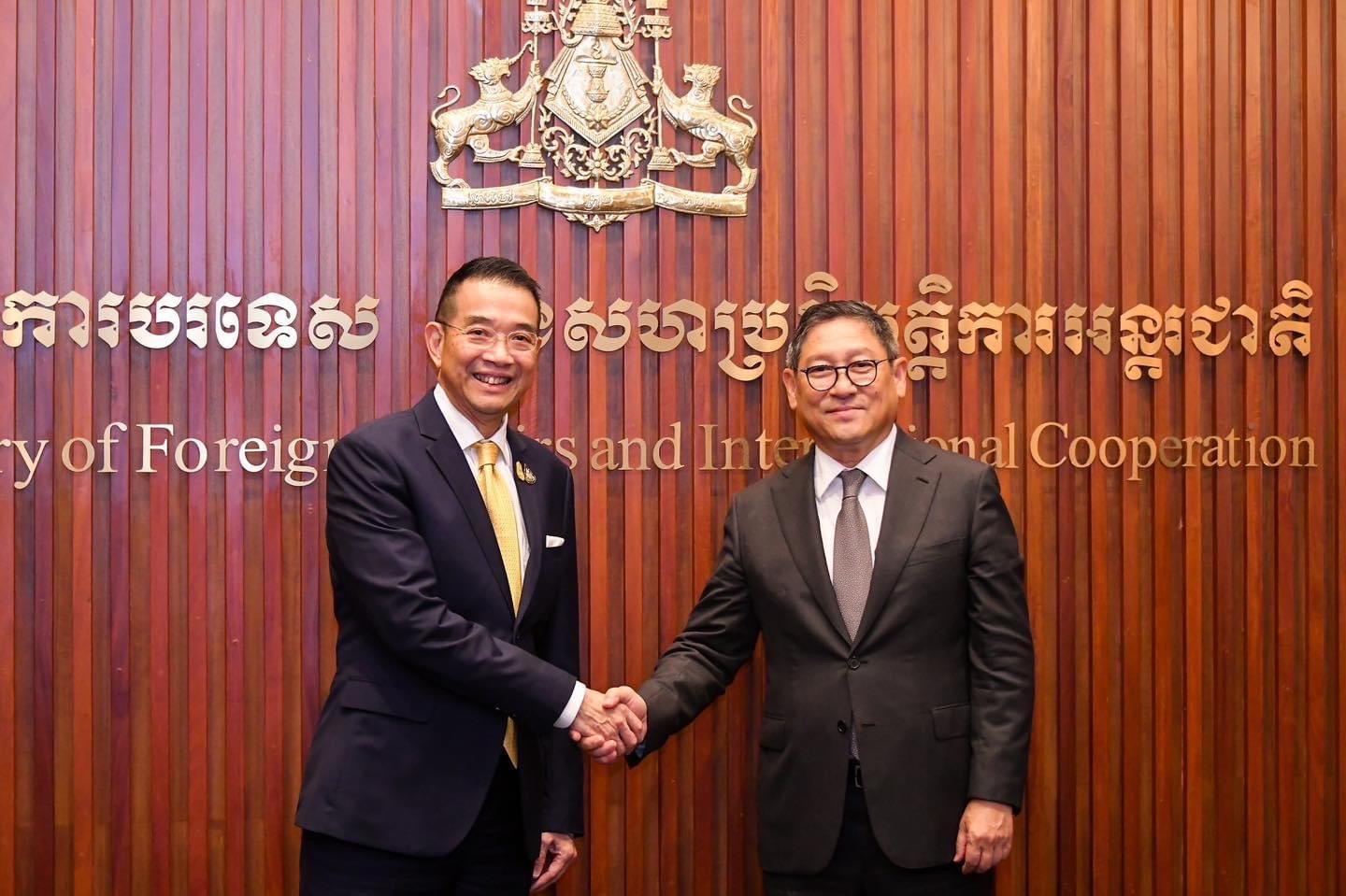
Officials shake hands at Cambodia’s Ministry of Foreign Affairs and International Cooperation in Phnom Penh. (Ministry of Foreign Affairs, Kingdom of Thailand)
On July 19, Cambodia confirmed that it has made an agreement with Thailand to allow additional time for the appointment of the Chairperson of the Conciliation Commission under the United Nations Convention on the Law of the Sea (UNCLOS), playing down the delay as “modest and entirely appropriate.” Phnom Penh has staked a great deal on the UN-backed process, as it tries to compel reluctant Bangkok to join, in an attempt to resolve amaritime dispute around Koh Kut Island that the two governments do not yet agree is even about the same thing.
The announcement follows Cambodia’s confirmation earlier this week that it had initiated conciliation proceedings under UNCLOS to address maritime differences with Thailand, describing the mechanism as a peaceful means of resolving the dispute in accordance with international law.
The Cambodia’s Ministry of Foreign Affairs and International Cooperation (MFAIC) said the four independent conciliators overseeing the proceedings had requested additional time to consider who should be appointed as Chairperson of the Conciliation Commission. It said both Phnom Penh and Bangkok had agreed to the request.
The ministry added that the extension would have no effect on any prescribed timetable or procedural step under UNCLOS, describing it as a reflection of the rigorous process being undertaken by the conciliators. It also thanked the conciliators for their diligence and reiterated Cambodia’s confidence in the process.
“Cambodia looks forward to advancing this peaceful route to resolving our maritime differences with Thailand based on international law,” the statement said.
Behind the diplomatic statements, the disagreement between the two capitals goes beyond the choice of a chairperson. Thailand wants the conciliation to settle the maritime boundary first and defer any talk of sharing resources, while Cambodia wants boundary and joint development taken up together, with a roughly 26,000-square-kilometre zone of Gulf oil and gas at stake. That split risks exacerbating tension between the two countries, following two bouts of border fighting in 2025. With the bilateral channel severed and the border still tense, Cambodia has the most to lose if the conciliation stalls, which is why it is the party that pushed hard for the process.
About The Author


One thought on “Cambodia Plays Down Delay in UNCLOS Gulf Case Against Thailand”