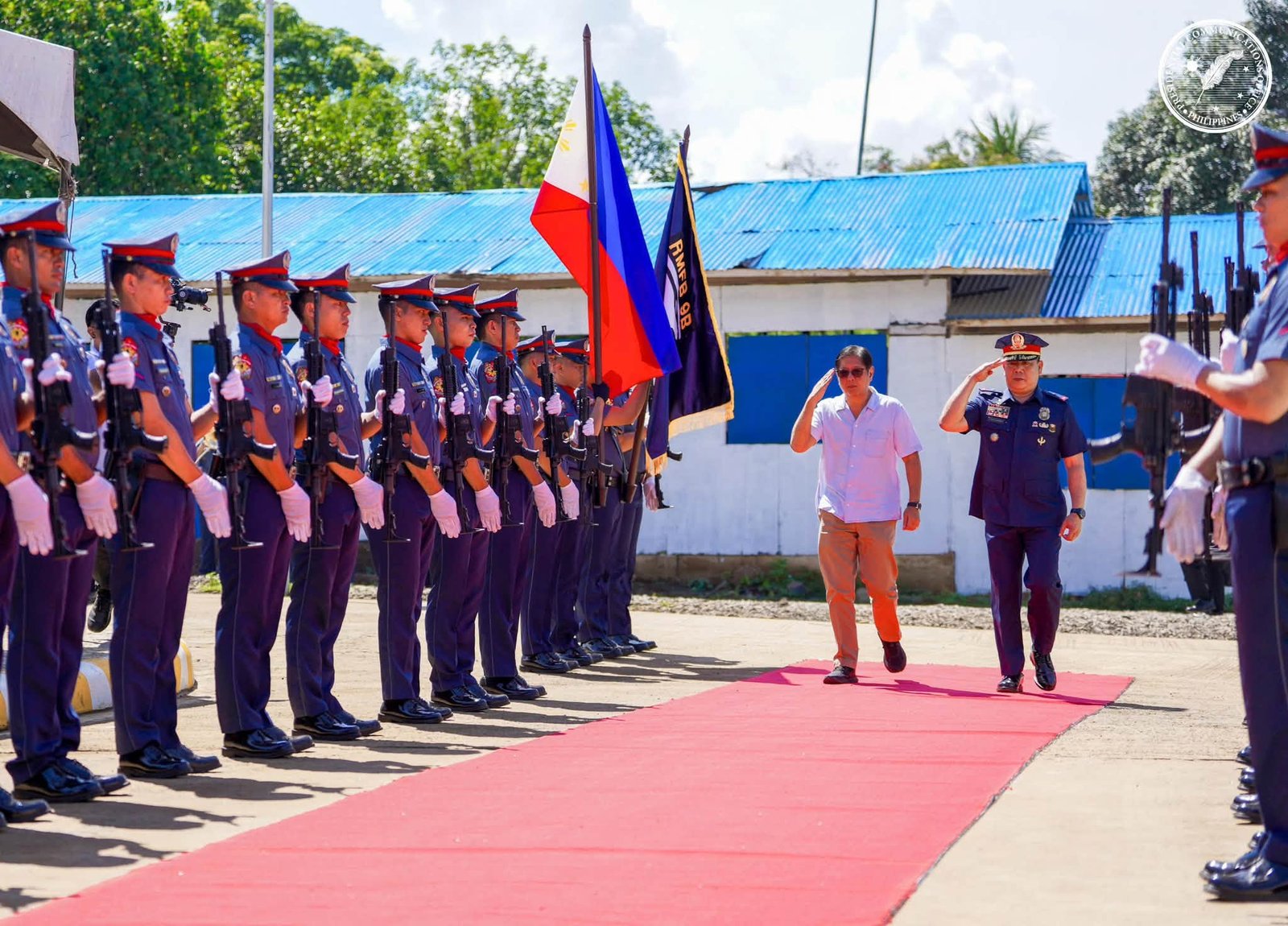
President Ferdinand R. Marcos Jr. inaugurates the new headquarters and support facilities of Regional Mobile Force Battalion 9B in Maimbung, Sulu. (Presidential Communications Office)
President Marcos emphasised the need to strengthen intelligence operations and law enforcement officers’ capacity as essential elements to preserving peace in the region. The government aims to convince hundreds of active fighters to surrender.
Alongside the security dimension, the president also brought with him 82 million Philippine pesos of in a development package through the Bawat Bayan Makikinabang programme (his administration’s flagship assistance scheme to relieve grassroots poverty). This included allocations from the Socio-Civic Program Fund (SCPF), with individual barangays each receiving 200,000 Philippine pesos.
He also disbursed a 10 kilogrammes of rice to around 3,000 Tausug beneficiaries and granted a scholarship programme for 2,050 students in 19 municipalities across the province.
In addition, the president also visited Zamboanga Peninsula to handover 371,8 million Philippine pesos for development initiatives.
Historically, the southern part of the Philippines (among them are Sulu and the Zamboanga Peninsula) has been one of the most conflict-prone regions in the Philippines.
Both provinces have endured decades of volatility, marked by longstanding conflict. A separatist group once dominated, with the rise of the Moro National Liberation Front (MNLF) leading in earlier years, before splinter factions gave rise to the Abu Sayyaf Group (ASG), which triggered a more violent edge to the region’s insurgency. Moreover, the region also faced rebellion, most notably from the New People’s Army, and became a hotbed of piracy networks.
Sulu’s regional status was further complicated by the Supreme Court ruling, which separated it from the Bangsamoro Autonomous Region (BARMM) and integrated it into Region 9, the Zamboanga Peninsula.
This signifies Manila’s active engagement in the Southern region. Through a dual approach of fund disbursement and development programmes, along with security initiatives, the administration seeks to ease conflict and bring peace.
About The Author