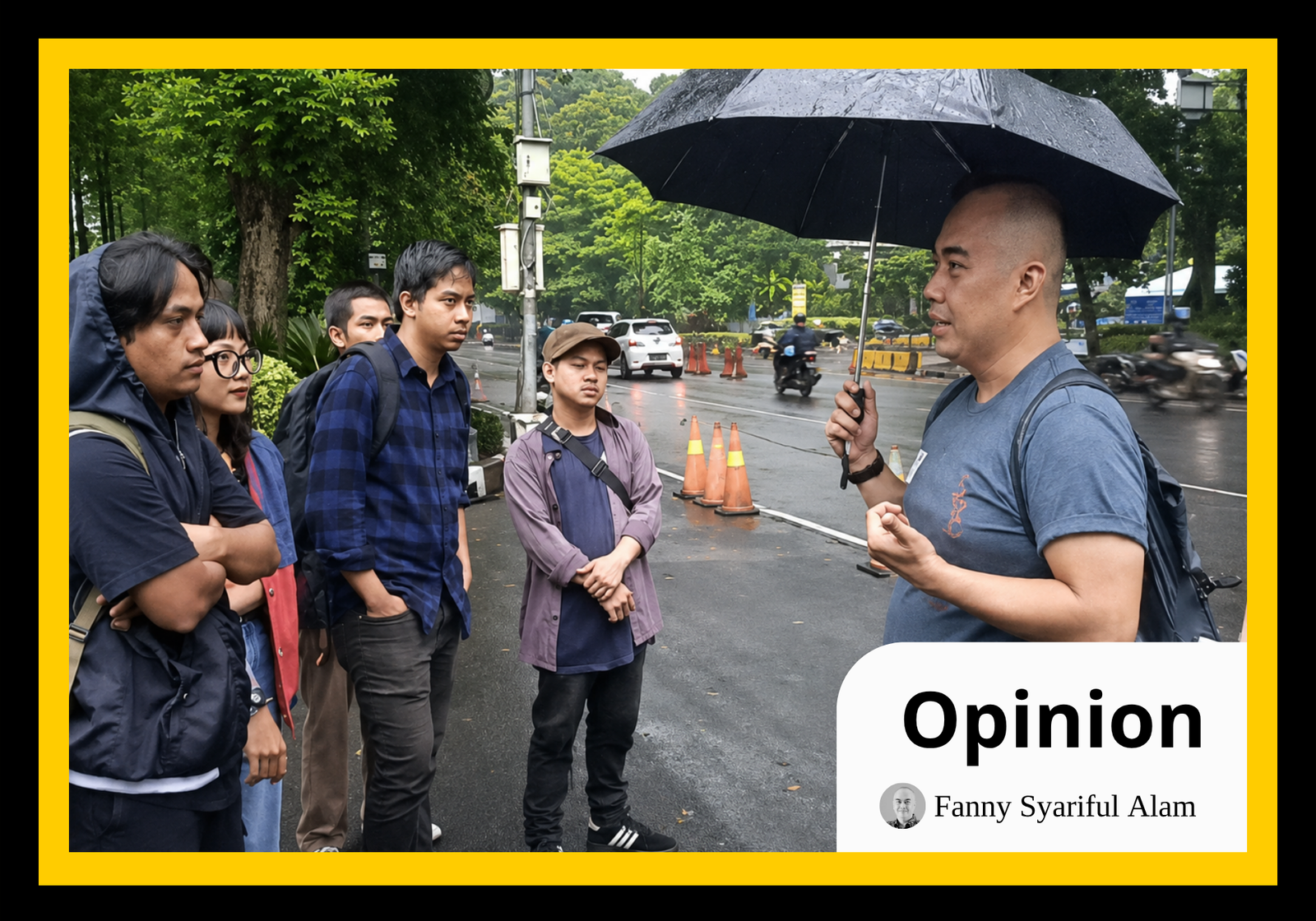
Fanny Syariful Alam from SEKODI Bandung talked about the risks of democratic regression on the Thursday Action or Aksi Kamisan in front of the West Java Governor’s Office, Bandung, on February 22, 2024. (Wanggi Hoed)
Fanny Syariful Alam is the Regional Coordinator of Bandung School of Peace Indonesia (SEKODI Bandung). The views expressed are his own and do not represent SEA Daily or that of another organisation.
Vice Coordinator of the Commission for Missing Persons and Victims of Violence (KontraS), Andrie Yunus became the victim of an acid attack by unknown individuals at 23.00 on March 12, 2026. He suffered from serious injuries, particularly in the right- and left-hand areas, face, chest and some parts of his eyes. The incident occurred as soon as he finished recording his podcast in the Indonesian Legal Aid Foundation (YLBHI), entitled “Remilitarisation and Judicial Review in Indonesia”.
Twelve years prior, on September 7, 2004, Munir Said Thalib, the founder and former coordinator of KontraS, was assassinated by arsenic poisoning in his drink during his flight to the Netherlands. Despite the imprisonment of the alleged executor, a senior Garuda Indonesia Airways pilot, who flew with him, the alleged mastermind behind the killing remained at large until now. Munir worked to uncover several serious human rights violation cases, starting from the mass murder of Talangsari, Lampung (1989) and was part of the Commission of Human Rights Violations in Timor-Timur (1999).
Recently, Indonesian President Prabowo Subianto has bestowed the “national hero” title to Marsinah, a former worker at a watch factory in the Indonesian province of East Java. She became a symbol of labour struggles, who fought for equality and justice, particularly for more equitable wage and female labour rights, including pregnancy leave and a sufficient overtime salary. On May 5, 1993, she picked up her 13 labour fellows after a mass protest in the military post on May 5, 1993, where they were detained after being considered as provocateurs. Three days later 200km from her work station, she was found dead with autopsy showing indications of serious and brutal physical and sexual violence. Both Munir’s and Marsinah’s cases remain unsolved.
Multiple cases of crackdowns on activists by the local and national authorities signify how Indonesia reacts to those who attempt to voice injustice and unfair practices, as well as struggle for the underrepresented and the disadvantaged. The nationwide demonstrations of August 2025 have led to the allegedly wrongful arrest of 3,000 activists, with concerns over inhuman actions during detention. The protests broke out after the government announced higher salaries for members of parliament amidst austerity measures in other sectors.
A Sign of Democratic Regression
Violence against activists signifies democratic regression, which, in Indonesia’s case, is reflected in Freedom House’s ranking of the country as partly free. Some techniques implemented include the stigmatisation and vilification, which lead to a hostile environment inciting violence against activists, repression, and criminalisation, used by the government to silence activists and maintain control over social movements.
Unjustified violence evidently erodes the implementation of Article 28E, verse (3) of Indonesia’s 1945 Constitution, which guarantees the freedom to associate, to assemble and to express opinions,” as well as Article 19, verse (2) of the ICCPR or Law No. 12 of 2005, which upholds the freedom of expression, which include freedom to seek, receive and impart information and ideas of all kinds, regardless of borders, whether orally, in writing, in print, in the form of art or through any other media of their choice.
Despite positive democratic gains after the fall of the authoritarian regime of President Soeharto in 1998, signified by political and media pluralism, several significant constraints restrict the fair democratic implementation on the ground, including systemic corruption, discrimination and violence against minority groups, continued conflict in the eastern island of Papua and the politicised use of defamation and blasphemy laws, particularly through the mission creep of the Electronic Information and Transactions Law (UU ITE), which theoretically regulates electronic transactions and personal data protection.
UU ITE—amended consecutively in 2016 and 2023—outlaws expressions that incite “hatred or hostility” toward protected individuals, including public officials or authorities. Therefore, it sometimes serves as the legal basis to detain activists. Rifa Rahnabila, a young female activist who took part in the August 2025 protests, was put in the spotlight for her involvement in the demonstration, following an allegation that her social media post incited people in the city of Bandung to act against the government. In Jakarta, UU ITE was used against Laras Faizati who faced multiple accusations after her Instagram posting allegedly contained the incitement to commit arson against the national police headquarters. She was charged with 6 months in prison, but the charge was dismissed after it was found that she had not even organised meetings or gathered people to carry out her action.
A Position in the Human Rights Council?
On January 8, 2026, Indonesia was selected as the President of the United Nations Human Rights Council (UNHRC) for 2026, providing it with significant global responsibilities, including presiding over sessions and overseeing the Council’s activities through diplomacy to promote human rights worldwide. The role also puts Indonesia as a regional representative on human rights, reflecting regional interests and priorities within the Council and upholding the highest standards in promoting and protecting human rights, thereby embodying the UNHRC’s mission and aligning with the principles of the UN Charter and the Universal Declaration of Human Rights.
This position should be notably beneficial for Indonesia, as the country is deemed worthy of serving as a role model for other member states in addressing their existing human rights challenges, while promoting international human rights standards as universal guidance, including within the country itself. Nevertheless, the Indonesian government still has unsolved cases related to human rights violations against activists, which hints at a potential structural flaw in upholding the constitutional freedom of expression, primarily those against the government.
Civil Society as a Balancing Force
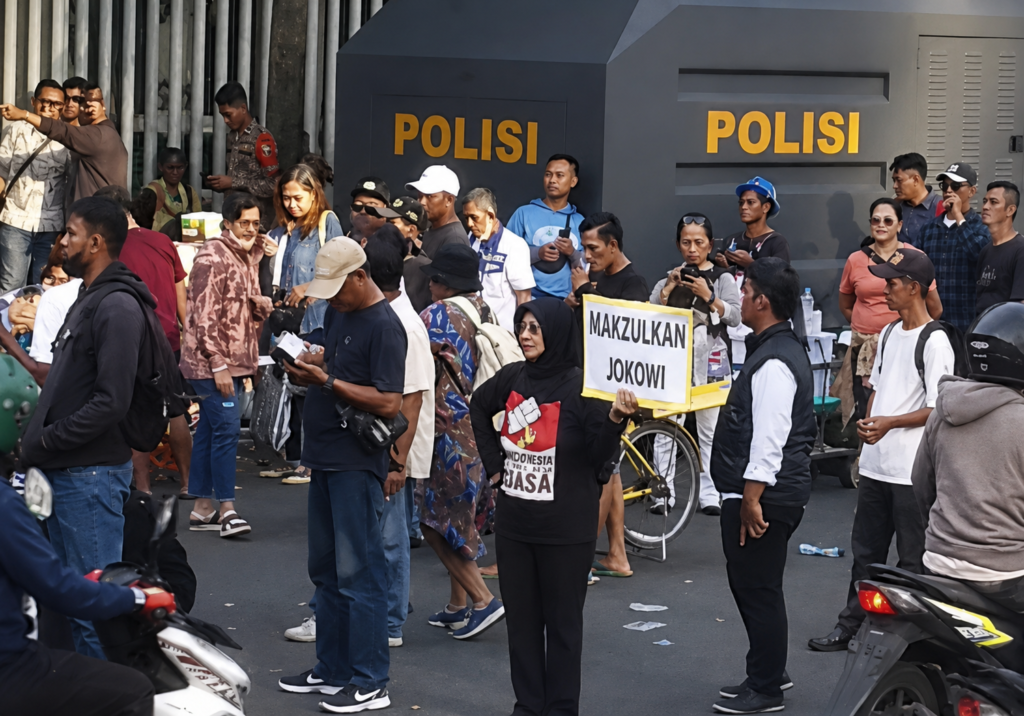
A group of women with their dissenting voice to demand the government’s accountability and democracy in its electoral governance, in front of the building of the General Election Supervisory Agency in Jakarta in 2024 (Fanny Syariful Alam)
The current societal landscape in Indonesia reflects the government’s stagnation in addressing human rights issues, particularly those linked to unjustified violence against criticism. Therefore, civil society, especially grassroots groups, should be empowered not only to exercise freedom of expression and opinion but also to develop critical awareness of violations in democratic and civic life. This would enable civil society movements to identify and criticise problematic government policies more effectively, encouraging the state to become more accountable, responsive, and capable through simultaneous institutional reform and social mobilisation. Moreover, movements such as street protests and other expressions against injustice in Indonesia should not be met with repressive actions. By resisting the normalisation of violence and repression against freedom of opinion and criticism, society can push the country toward stronger protection for activists, reform of restrictive regulations, and the resolution of long-standing human rights cases. Only then can Indonesia truly embody the principles it is entrusted to uphold on the global stage.
About The Author