
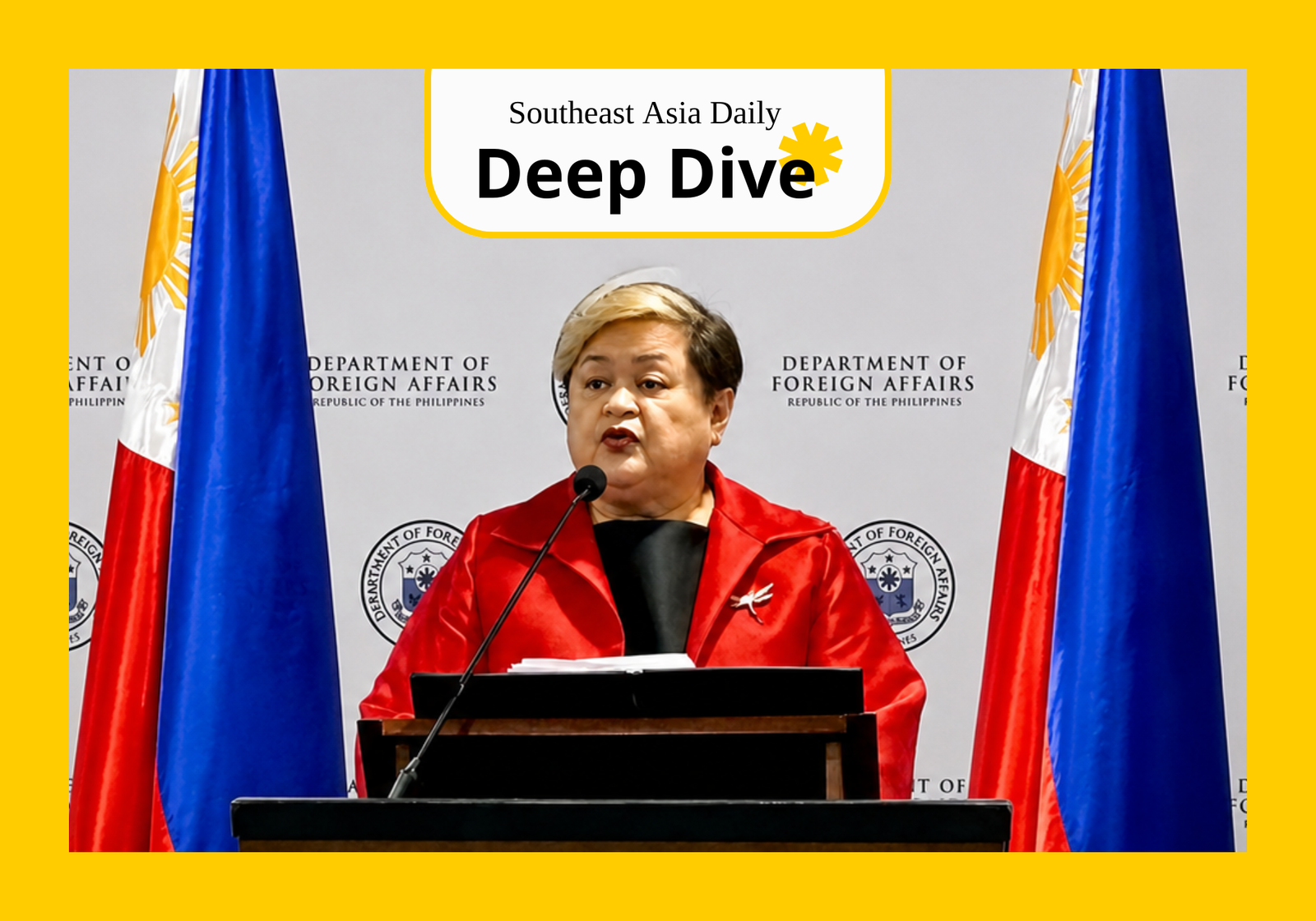
Philippine Foreign Affairs Secretary Theresa Lazaro speaks to the press at the DFA office on the Code of Conduct on South China Sea in Pasay City in July 2025. (PNA)
A Chair Built on Contradictions
When the Philippines assumed the ASEAN rotating chairmanship on 1 January 2026, President Marcos Jr. announced two headline ambitions: conclude the long-stalled South China Sea Code of Conduct (CoC) and reinvigorate the Five-Point Consensus on Myanmar. Four months later, as Manila prepares to host the 48th ASEAN Leaders’ Summit in Cebu on 6-8 May, the shape of the chairmanship looks rather different from what was promised.
The Cebu summit will be a stripped-down affair. Amid the energy and food crisis triggered by the ongoing war in the Middle East, Marcos directed that all 650 preparatory meetings be shifted to virtual format to save costs, with funds redirected to cushion the impact of the oil crisis on ordinary Filipinos. The summit itself, in Marcos’s own words, will be “bare bones”—its agenda dominated by energy security, food supply chains and the safety of ASEAN nationals abroad, rather than the CoC or Myanmar. When former Finance Secretary Gary Teves suggested suspending the summit altogether to save the Philippine government an estimated 17 billion Philippine pesos (277 million US dollars), Foreign Secretary Theresa Lazaro pushed back with a notably revealing formulation: “ASEAN is very important. In fact, ASEAN is like the main anchor of our foreign policy.” The chairmanship, in other words, is not just a diplomatic assignment—it is a domestic political asset that Manila cannot afford to relinquish, even under financial strain.
This tension between the chairmanship’s institutional ambitions and the political uses Manila is making of it runs through everything that follows. The Philippines is simultaneously ASEAN’s convener, its most assertive South China Sea claimant and the hub of a rapidly expanding network of Western defence partnerships. It is being asked to broker consensus among eleven member states at the precise moment when its own strategic posture makes it the least natural candidate for the role of neutral mediator. The 10th anniversary of the 2016 Permanent Court of Arbitration ruling in Manila’s favour—a date that carries significant moral weight for the Philippines—is a reminder of just how far ASEAN has failed to translate legal clarity into political progress. Domestic pressures compound the external ones: Marcos faces an all-time low approval rating, large-scale anti-corruption protests and an impeachment attempt against Vice President Sara Duterte, all of which sharpen his incentive to deliver a visible foreign policy success before the year is out.
Three Crises, One Framework

Independence-class littoral combat ship USS Mobile (LCS 26) conducts a Maritime Cooperative Activity with Philippine Navy’s Gregorio del Pilar-class patrol ship, BRP Ramon Alcaraz (PS 16), in the South China Sea, July 31, 2024. (Wikimedia/LCDR Seth Koenig)
Foreign Secretary Lazaro has not abandoned the CoC ambition. Speaking at a Jakarta forum ahead of the Cebu summit, she reaffirmed that she “endeavours to craft and finish the Code of Conduct with China in the South China Sea before the end of 2026,” while acknowledging there is “some movement” in the monthly negotiating sessions ASEAN and China have been holding since January. Four structural issues remain unresolved: the legal relationship between the new CoC and the existing non-binding Declaration on Conduct; the question of legal bindingness itself; the geographical scope and the definition of terms such as “self-restraint.” None of these are procedural quibbles—they are the core substantive disagreements that have blocked progress for over two decades.
Chatham House’s assessment is direct: a CoC deal is simply unlikely under a Philippine chair. Three reasons stand out. First, the Philippines insists the CoC must be legally binding—a position China categorically rejects. Second, Beijing has proposed banning joint military exercises with non-ASEAN countries in the South China Sea, which would dismantle Manila’s own defence architecture. Third, ASEAN’s internal divisions—several member states hold overlapping and competing claims—make a unified negotiating position very difficult to sustain. CSIS adds a fourth dimension analysing that Manila’s real strategy is dual-track. CoC rhetoric is maintained at the ASEAN level, but the substantive security work is happening elsewhere—through the “Squad” quadrilateral with the US, Japan and Australia; reciprocal access agreements with Japan and New Zealand; visiting forces agreements with Canada and France; and nine EDCA sites that have made the Philippines the anchor of US force posture in the Indo-Pacific. As a Cebu summit dominated by energy triage rather than maritime law approaches, the gap between the CoC’s stated priority and the actual agenda has rarely been more visible.
On 3 April 2026, Myanmar’s parliament elected Senior General Min Aung Hlaing as President, completing the junta’s transition from emergency rule to nominally civilian government. Less noted in Western coverage was that China’s Foreign Minister Wang Yi visited Naypyidaw on 25 April—barely three weeks after the election—conveying congratulations from President Xi and declaring the “pauk-phaw” friendship fully intact. Beijing’s rapid normalisation has already begun to reframe the diplomatic terrain that ASEAN must navigate.
The Philippines’ own Myanmar posture is harder to read than it appears. Lazaro, as the ASEAN Chair’s special envoy, visited Myanmar on 6 January—mid-election, without prior concessions from the junta and met Min Aung Hlaing, his prime minister and his foreign minister, describing the talks as “warm and constructive.” The visit drew sharp criticism. The Irrawaddy called it “deeply problematic,” arguing it offered the junta a propaganda image of ASEAN endorsement at a moment when elections were still ongoing and the ICC Pre-Trial Chamber was reviewing an arrest warrant request against Min Aung Hlaing. The opposition National Unity Government and ethnic revolutionary organisations were not informed in advance. Foreign Policy noted that the visit created the perception that Manila was favouring regime engagement over the civilian opposition.
Since then, Lazaro has maintained the formal Five-Point Consensus line: Myanmar has not fully complied, the 5PC remains the framework, and incremental progress—a Chair’s Statement welcoming the planned release of over 4,000 prisoners, including former President Win Myint, and calling for Suu Kyi’s shift to house arrest—should be acknowledged. But the structure of the crisis resists this procedural gradualism. The Five-Point Consensus was agreed by all ASEAN leaders, including Min Aung Hlaing himself, in April 2021, and none of its five provisions — immediate cessation of violence, dialogue among all parties, humanitarian access, special envoy appointment, envoy visit — has been meaningfully implemented in five years. RSIS observes that the junta simply absorbed the cost of high-level exclusion without compliance. Meanwhile, Thailand is actively pursuing bilateral “bridge” engagement with Naypyidaw, and Foreign Policy reports that Cambodia, Laos, Vietnam, and Thailand at minimum favour full normalisation, a fracturing of collective posture that the Cebu summit is unlikely to reverse. Academic literature frames the underlying dynamic precisely: the non-interference principle, as a 2024 paper in the Journal of International Studies demonstrates, structurally curtails ASEAN’s capacity for firm action even when its own charter commits it to human rights protection.
The wider strategic environment adds a further layer of complexity. Marcos has built the most extensive minilateral defence network in Philippine history. But the same president is simultaneously pursuing a “reset” with China—publicly expressing openness to resumed joint oil exploration in the South China Sea and emphasising the Philippines-China Bilateral Consultative Mechanism as a channel for managing maritime flashpoints. The Middle East energy crisis is a key driver: Marcos was the first global leader to declare a national energy emergency and pragmatic engagement with Beijing on energy and supply chains carries immediate domestic benefits that ideological consistency does not.
Washington is not making this easier. Foreign Policy notes that the Trump administration’s National Security Strategy made no mention of the Philippines—a pointed omission for a treaty ally—while Philippine goods face a 19% US tariff, a rate ASEAN collectively failed to negotiate down. Plus, the Lowy Institute’s analysis reads Marcos’s China overtures less as a strategic pivot than as a signal of profound frustration with US reliability. Frontline allies, the Institute argues, are hedging by building indigenous defence capacity and middle-power coalitions rather than deepening dependence on a Washington that may not show up when needed.
For ASEAN, this produces a structural bind. Richard Heydarian writing for China-US Focus describes Manila’s posture as “strategic tightrope walking”—simultaneously deepening US alliance ties and pursuing Chinese engagement—but notes that the more Manila deepens its Western security network, the less credible it appears as a neutral convener to ASEAN members that prefer non-alignment. Cambodia and Laos lean toward Beijing. Indonesia, under Prabowo, is pursuing its own multi-directional hedging. The consensus mechanism that underpins ASEAN’s decision-making remains, as history has shown, weaponisable by China-aligned members—as illustrated by Cambodia’s successful blocking of a joint communiqué on the South China Sea in 2012.
Success on Whose Terms?

The leaders of the Association of Southeast Asian Nations (ASEAN) pose for a family picture doing the signature “ASEAN-way” handshake at the ASEAN Summit in Kuala Lumpur, Malaysia, on 26 May 2025. (Wikimedia/Presidential Communications Office)
The conventional analytical recommendation for the Philippines’ chairmanship is to accept that the CoC will not be concluded in 2026, shift the goal from conclusion to framework consolidation and focus on institutionalising incident-avoidance protocols that Singapore can build on in 2027.
But there is a problem with this recommendation that the analysis rarely confronts directly: governments do not willingly lay foundations for other governments to claim credit. Marcos is facing an all-time low approval rating, an infighting with his vice president and a domestic economy under significant stress. His administration needs a foreign policy win—and the CoC, however elusive, is the most visible foreign policy prize on offer. Lazaro’s insistence that she “endeavours” to finish the CoC before 2026 ends is not simply diplomatic optimism. It reflects the political logic of an administration for which passing the credit to Singapore’s 2027 chairmanship would be a domestic political cost, not a strategic contribution. That incentive—the reputational arithmetic of international success—is likely to push Manila toward either claiming a weak or unenforceable agreement as a victory or holding out for a breakthrough that external conditions make structurally improbable.
The more durable contribution Manila could make is one that requires less political capital: using the Cebu summit and the November 49th summit to institutionalise below-the-consensus-threshold crisis management tools—hotlines, incident-prevention mechanisms, civilian protection protocols—that function regardless of whether a CoC is ever signed. UPI’s analysis notes that as patrols, surveillance flights and military exercises intensify in 2026, the risk of miscalculation is rising faster than the pace of diplomacy. Clear rules of engagement at sea may matter more in the near term than a binding document that takes another decade to negotiate.
Concerning Myanmar, ASEAN must confront the fact that the Five-Point Consensus has become a placeholder rather than a roadmap. It has now become too politically costly to abandon, too structurally weak to enforce. The Cebu summit should produce a formal reassessment with accountability provision. The Special Envoy mechanism needs access mandates and reporting requirements, not just renewed affirmations of the existing five points. Whether the Philippines, which has already drawn criticism for the optics of Lazaro’s January visit, has the political standing to lead this reassessment is an open question.
The broader stakes are clear. If the Philippines cannot advance ASEAN’s most consequential security initiatives—under sustained Chinese pressure, with uncertain US backing and amid a global energy crisis—it may signal that the limits of an ASEAN-led regional order have been reached. The bare-bones summit in Cebu will not resolve that question. But the choices Manila makes there will make it considerably harder to avoid.
About The Author


One thought on “The Philippines as ASEAN Chair: Claimant, Convener and the Limits of Consensus”