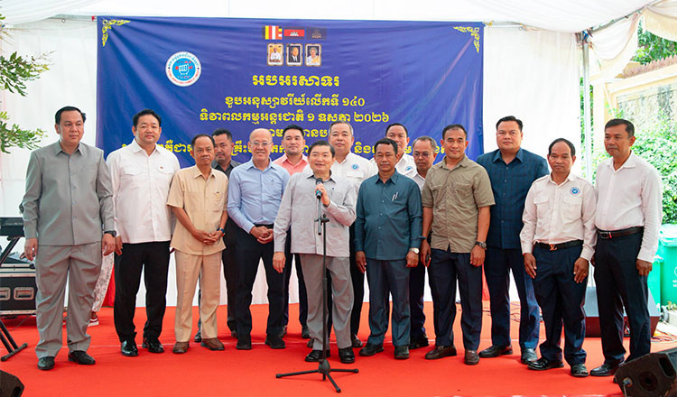
Labour Minister and Vocational Training Minister Heng Sour joins workers for a solidarity meal at National Union Alliance Chamber of Cambodia. (Khmer Times)
Cambodia’s Labour and Vocational Training Minister, Heng Sour, expressed confidence that the country will achieve textile independence by 2027. The remark was made during the commemoration of International Labour Day on 1 May, where the ministry hosted a solidarity meal at the National Union Alliance Chamber of Cambodia.
This initiative aims to bolster the efficiency and resilience of the textile, garment, footwear and travel goods industries. Heng Sour emphasised that by establishing its own fabric manufacturing, Cambodia will build a robust foundation for industry endurance.
With a strong foothold in local production, Cambodia could attain a self-sufficient capacity of over 40%—which will be a vital step in preserving duty-free trade access to key markets such as the US and the European Union (EU).
Heng Sour also reflected on Cambodia’s 2026 Labour Day theme, “Together Building Resilience for Decent Work”, underscoring the government’s commitment to a sustainable labour market—through improved workplace conditions, freedom of association and expanded social safety nets.
What does this mean for businesses?
Despite ranking as the world’s eighth-largest apparel exporter, Cambodia remains structurally dependent as nearly half of its garment export revenue is immediately absorbed by imported inputs. Addressing this imbalance is central to the Cambodia Garment, Footwear and Travel Goods Sector Development Strategy 2022–2027, which prioritises building local supply chains for raw materials and thus reducing lead times as well as improving profit margins.
Furthermore, though this industry accounts for over a third of national gross domestic product (GDP) and remains the country’s fastest-growing sector, it faces a critical skills gap. Advanced vocational training is urgently needed to shift the industry beyond low-value assembly towards high-end design and production.
For investors, the sector holds considerable potential—provided businesses commit to adopting Industry 4.0 technologies, developing local textile waste recycling to meet global sustainability standards and integrating Cambodia’s silk-weaving heritage into its broader manufacturing identity.
About The Author