
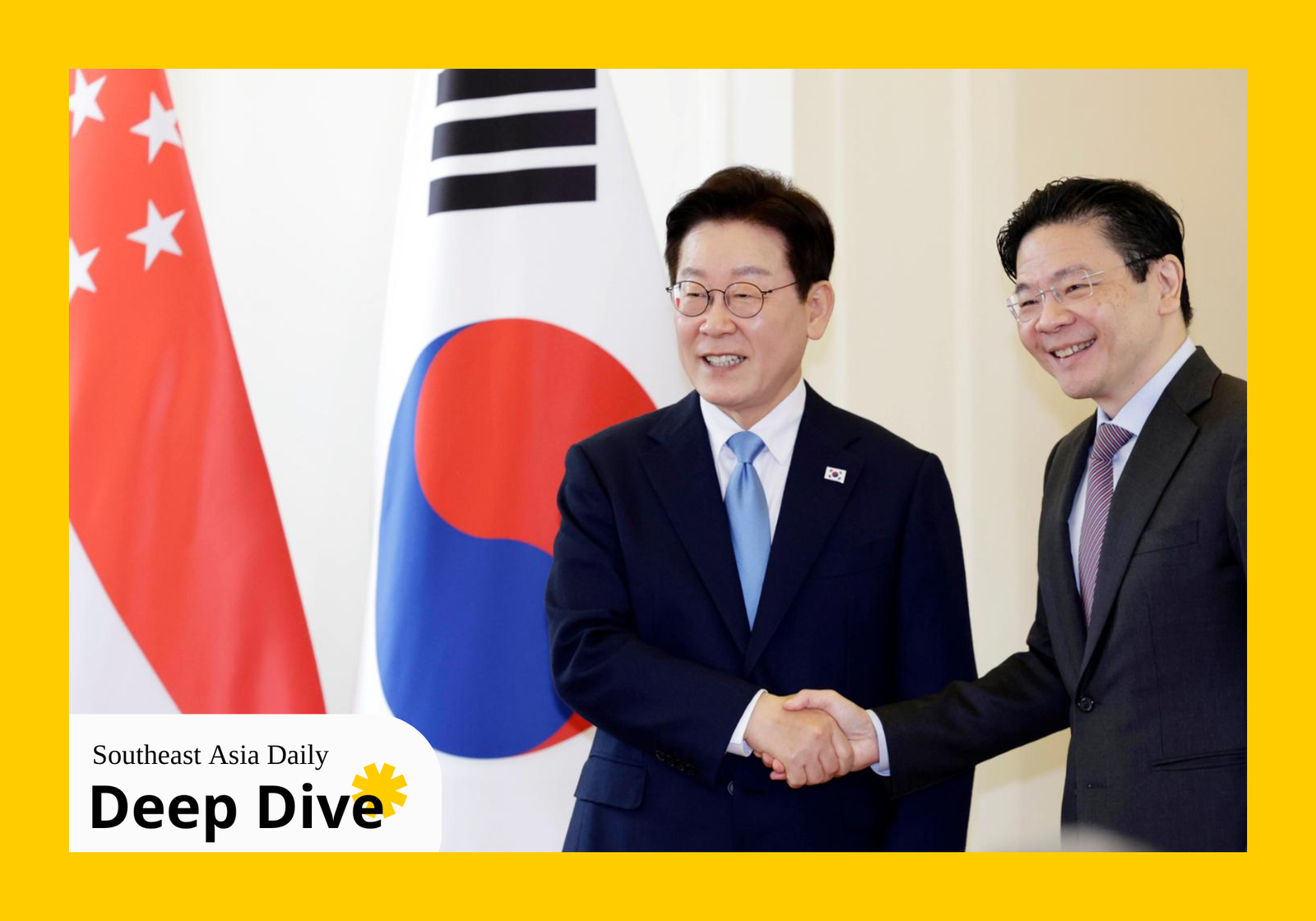
South Korean President Lee Jae Myung and Singapore Prime Minister Lawrence Wong shake hands after a joint press briefing at the Ministry of Foreign Affairs in Singapore, on March 2. (Yonhap)
A Trip Southeast
“We have decided to deepen our cooperation as reliable partners in an era of hyper-uncertainty.” On March 2, President Lee Jae-myung spoke at a joint press conference immediately after the summit at the Singapore Ministry of Foreign Affairs building.
In 2025, global defense spending has surged to historic highs, reflecting a world where interstate conflicts are becoming increasingly normalised. The erosion of international norms—marked by the US’ retreat from multilateral institutions—combined with the protracted wars in Ukraine and the Middle East, has effectively paralysed the traditional global security architecture. In response, middle powers like South Korea have shifted toward a sophisticated risk management strategy. No longer content with a sole reliance on traditional alliances, Seoul is aggressively diversifying its strategic portfolio. By strengthening ties with fellow middle powers in Europe—such as France, Italy, Germany, and the UK—and cementing new partnerships across Southeast Asia (SEA), the Middle East, and Africa, South Korea is positioning itself as a resilient, independent actor capable of securing its interests in an increasingly fragmented world. This diversification of partnerships is rendered rational by deepening global uncertainty. US allies across the Asia-Pacific have navigated an increasingly volatile diplomatic landscape under the second administration of US President Donald Trump. While Japan’s administration under Prime Minister Sanae Takaichi has doubled down on a resolute military and diplomatic alignment with Washington, South Korean President Lee Jae-myung appears to have adopted a more nuanced “hedging strategy”. His recent visit to Singapore and the Philippines further manifest it.
The agreements that followed reveal the logic behind the flexibility. Across both stops, four sectors dominated the agenda, namely artificial intelligence (AI), critical minerals, nuclear energy, and defence: a package that speaks directly what Seoul needs most in a world where these can no longer be taken for granted. In Singapore, Asia’s unchallenged hub for finance and technology, Seoul made its intentions clear. It was their second meeting in four months since elevating ties to a Strategic Partnership, and the pace of delivery matched the urgency of the moment. Lee and Wong agreed to modernise their two-decade-old bilateral Free Trade Agreement (in force since 2006) reorienting it around supply chain resilience, digital trade, and the green transition. On energy, Korea Hydro & Nuclear Power (KHNP) and Singapore’s Energy Market Authority (EMA) signed an Memorandum of Understanding (MoU) on small modular reactor (SMR) cooperation in support of both countries’ green transition agenda. At the heart of the visit was AI. Lee attended the AI Connect Summit—a bilateral business forum bringing together industry leaders from both countries—and announced plans to establish a US$300 million global fund-of-funds in Singapore by 2030, targeting joint AI ventures and cross-border research.
From Singapore, Lee flew to Manila—touching down on March 3, the exact date marking the 77th anniversary of Korea-Philippines diplomatic ties, established in 1949. As two of Washington’s most longstanding allies in the Asia-Pacific, defense cooperation was a natural starting point. Both sides expanded their procurement framework to allow more South Korean companies to contract with the Philippine government, adding provisions on shipbuilding, weapons maintenance, logistics support, and financial assistance. “Our closer defense, security and maritime cooperation reflects our mutual trust as we respond to a rapidly evolving international security environment,” Philippine President Ferdinand Marcos Jr. said. As one of the world’s most mineralised countries and the largest exporter of nickel ore globally, the Philippines agreed to expand cooperation on critical mineral supply chains with Seoul—a sector that sits at the heart of both countries’ industrial priorities. Both leaders also agreed to expand cooperation on nuclear energy, building on ongoing feasibility work tied to the long-dormant Bataan Nuclear Power Plant and Manila’s broader push to introduce nuclear power into its energy mix by 2032.
The deals are on the table. What brought Seoul to this table, at this moment, is worth examining more carefully.
Pivot or Pragmatism?
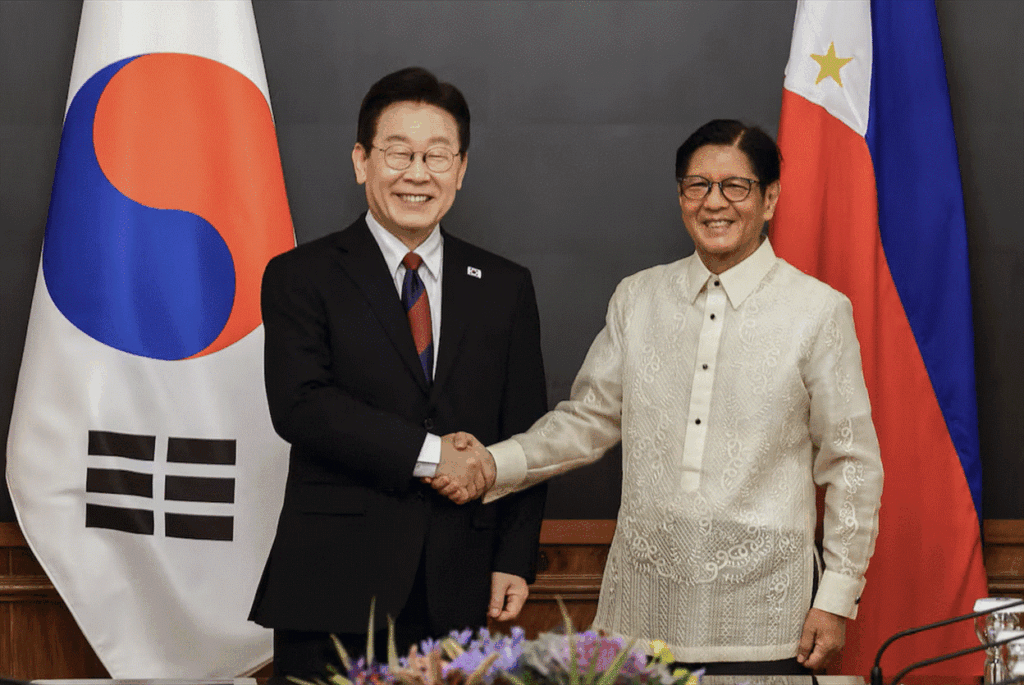
Philippine President Ferdinand Marcos Jr., and South Korean President Lee Jae Myung shake hands during a bilateral meeting at the presidential palace in Manila, Philippines, on March 3. (Reuters)
Ten months into the Lee administration, Seoul has embraced a markedly more pragmatic diplomacy compared to his predecessor Yoon Suk-yeol’s values-based approach. Where Yoon framed every foreign policy move through the lens of ideological alignment, Lee’s Cheong Wa Dae (Blue House, South Korea’s presidential office) operates with considerably more flexibility, prioritising national interest over bloc loyalty. Consequently, Seoul has laid its eyes toward the Global South, a region historically positioned on the periphery of South Korean foreign policy. Since its inception, the administration has aggressively sought to diversify its geopolitical footprint, prioritising deeper integration with the Middle East and North Africa (MENA) region and ASEAN member states. Yet Seoul looking Global South does not equal a pivot south. The visit is better understood as a calculated act of strategic pragmatism. Cheong Wa Dae is identifying where its interests align, and moving decisively to deepen those ties. To understand the rationale, two interlocking logics are worth examining.
The first is that the relationship has deeper roots than it appears. ASEAN, as an institution, and South Korea first established dialogue relations in November 1989, and from that modest post-Cold War beginning, two-way trade has since reached US$187 billion in 2023, making ASEAN the ROK’s second-largest trading partner and investment destination. The strategic elevation came under President Moon Jae-in, whose New Southern Policy (2017) lifted ASEAN to the same tier as Korea’s traditional partners. Lee carries that spirit forward with a harder pragmatic edge—in October 2025, both sides formalised a Comprehensive Strategic Partnership (CSP), with Lee positioning Korea as a “contributor” to ASEAN’s hopes, a “springboard” for growth, and a “partner” for peace and stability. During the Singapore visit, Lee himself noted that South Korea and ASEAN have grown together “over decades of deep trust and friendship”—and pledged to visit all 11ASEAN member states during his five-year presidency, beginning with Singapore and the Philippines. Hence the ties are not new. What is new is the concreteness of the commitment and further intention to connect. The second logic is structural. In today’s fractured international order, South Korea’s relevance increasingly hinges on its identity as a middle power. Squeezed between the competing gravitational pulls of the US, China, and Russia, middle power status grants Seoul the diplomatic flexibility that rigid great power alignment cannot. It also grants something equally valuable: legitimacy in the eyes of ASEAN, a grouping deeply protective of its own centrality and wary of being instrumentalised by great powers. A Korea that arrives as a middle power, not a hegemon, is a Korea ASEAN can engage on more equal terms.
That middle power logic is precisely what shaped Lee’s choice of first stops. Manila offers something of acute strategic value: the Philippines is among the world’s most mineralised countries and remains second-largest producer globally—critical inputs for the EV battery supply chains that Korea’s industrial future depends on. That Manila also holds the ASEAN chair in 2026 only amplifies the symbolism. Singapore, meanwhile, speaks to a different but equally urgent logic. Both South Korea and Singapore share a structural vulnerability: neither is endowed with natural resources, and both rely heavily on an open, rules-based trading order. As protectionism spreads and the multilateral system falters, both stand to suffer disproportionately. That shared exposure—alongside Singapore’s unrivalled position as Asia’s hub for finance, technology, and AI governance—makes it South Korea’s most natural partner for the technological and economic diversification Seoul urgently needs. Singapore is also next year’s ASEAN chair, extending Korea’s engagement across two consecutive chairships.
Taken together, the evidence points less to a genuine pivot south, and more to security and economic pragmatism at work. Seoul is not reorienting its foreign policy axis toward the ASEAN bloc, it is strategically deepening select bilateral ties with like-minded, Western-oriented partners that serve its immediate security and economic interests. The fact that Lee has yet to visit Vietnam—Korea’s largest ASEAN trading partner by volume—and made no effort to meet the ASEAN Secretary-General in Jakarta speaks volumes. Seoul’s approach, in this reading, reflects selective bilateralism rather than genuine multilateral engagement with ASEAN as an institution.
The Harder Question
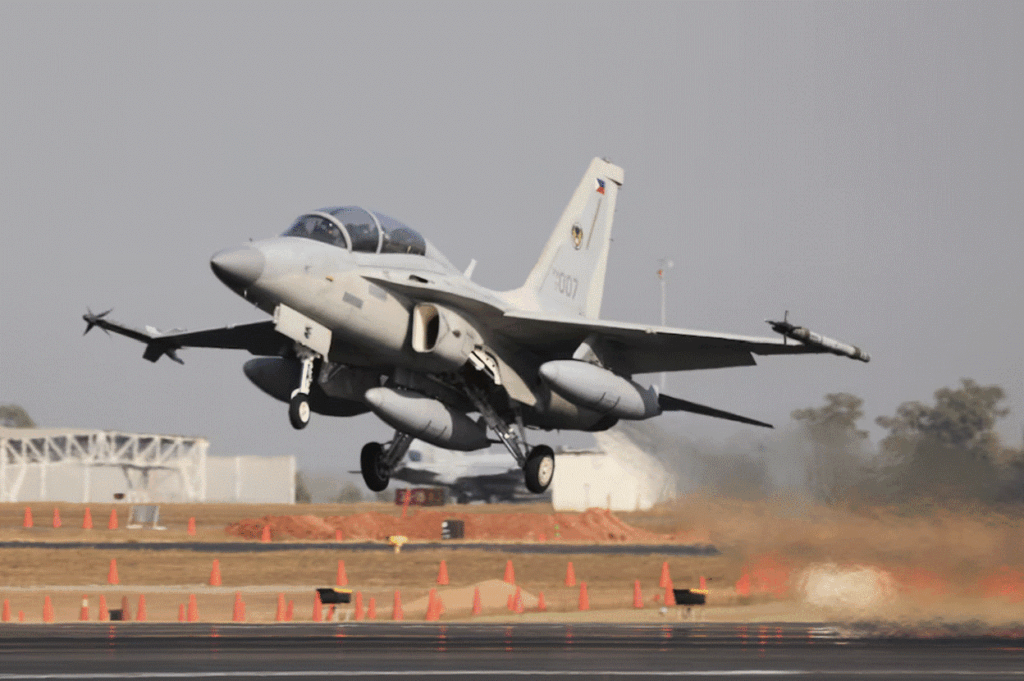
South Korean-made T-50 Fighting Eagle belonging to the Philippine Air Force (Gordon Arthur)
The deals are signed. The visits are over. The question now is not whether Seoul’s intentions are genuine, but what Southeast Asia stands to gain, or lose, depending on how it chooses to respond to this new Korean approach.
For Manila, the immediate goal has always been clear: harness its abundant critical mineral resources and develop them into a Filipino-led industry, not merely export raw materials to foreign processors. Expanding partnerships with developed nations like Korea, Japan, New Zealand, and soon Canada, under the Marcos administration reflects that ambition. Yet as a developing nation, the Philippines’ foreign policy agenda is ultimately driven by developmental concerns—the need for economic growth, poverty reduction, and state capacity-building. And here lies the loophole. The developed-nation partners Manila courts tend to perceive “security” primarily through a military lens—deterrence, defence capability, geopolitical positioning. For the Philippines, security is still tightly bound to economic security: jobs, infrastructure, food security. That mismatch is already visible in the numbers. The Philippines imported a third of its arms from South Korea in 2025. The security dimension of this partnership is deepening rapidly. However, the economic dimension has yet to find its footing. For an administration already navigating domestic pressures around corruption and economic uncertainty, the risk is that security deals generate headlines without generating livelihoods. Look no further than Vietnam, just across the South China Sea. Hanoi’s systematic reforms in infrastructure, legal frameworks, and governance have quietly transformed it into the region’s most attractive investment destination—a status Manila has yet to claim. If the South Korea-Philippines partnership cannot help close that gap, Manila risks emerging from this relationship as a valued security asset rather than a genuine development beneficiary.
Yet Manila is not without leverage. As ASEAN Chair in 2026, the Philippines holds an institutional platform that extends well beyond its bilateral relationship with Seoul. The ASEAN-ROK Plan of Action (2026-2030)—adopted under this very chairship—explicitly commits both sides to encouraging investments in minerals processing and promoting value addition in downstream minerals development, precisely the Filipino-led industry model Manila is seeking. Whether the Marcos administration uses its chairship to push for the full implementation of that commitment, or allows the bilateral security momentum to define the relationship by default, may prove to be one of the more consequential foreign policy choices of this administration.
The Singapore story reads differently, and more optimistically, at least on the surface. As a fellow rising middle power with no natural resources and an economy deeply exposed to protectionism and supply chain disruption, Singapore shares a structural vulnerability with South Korea that makes their partnership genuinely mutual rather than asymmetric. The deals struck during Lee’s visit reflect that balance: FTA upgrade, AI cooperation, SMR nuclear framework, a US$300 million fund-of-funds targeting AI and deep-tech startups, civil service exchange. This is not a security-skewed package—it is a broad-based economic and technological partnership between two countries with complementary strengths and aligned interests. In terms of new technology, Singapore has firmly established itself as the preeminent AI hub of the Asia-Pacific, boasting the region’s most advanced research clusters through the NUS AI Institute (NAII) and Nanyang Technological University (NTU). In a climate of intensifying tech decoupling, Singapore serves as a rare crucible where US cloud infrastructure and Chinese computational needs converge, mirroring the strategic hedging approach seen in Seoul. Simultaneously, South Korea has ascended to become the world’s third-ranked AI power, trailing only the United States and China, making the new-tech tie with Singapore further interesting. In terms of energy, strategically perched atop the Strait of Malacca—a vital artery for 25% of global trade and 80% of Northeast Asia’s energy supplies—Singapore remains an indispensable partner for Seoul in securing both economic supply chains. In return, South Korea is able to provide its expertise in nuclear energy to Singapore.
If South Korea-Singapore emerges as the showcase of what the ASEAN-ROK CSP can deliver, while the rest of the region remains locked in security-heavy bilateral deals with limited developmental returns, it risks deepening the very two-tier dynamic within ASEAN that Seoul’s “partner for all” rhetoric seeks to obscure. Even so, Singapore’s role as coordinator for ASEAN-Korea economic relations—and its commitment to commencing negotiations to upgrade the broader ASEAN-Korea Free Trade Area—offers a potential corrective. If Singapore chooses to leverage that institutional position, the Korea-Singapore corridor could become less a symbol of selective bilateralism, and more a bridge toward the broader partnership Seoul claims to want.
In conclusion, the partnership between Korea and Southeast Asia can evolve beyond mere unilateral transactions into a “strategic symbiotic system” for mutual survival and prosperity. In terms of security, a ‘joint security partnership’ can be strengthened to build a self-sustaining regional security ecosystem by combining Korea’s advanced defense technology with Southeast Asia’s local manufacturing capabilities. Meanwhile, in the economic and technological sectors, Korea’s AI prowess and nuclear and clean energy solutions are expected to combine with Southeast Asia’s abundant key minerals and growth potential to form a powerful tech-resource partnership. This comprehensive cooperation may serve as a key mechanism granting strategic autonomy to both sides amidst the hyper-uncertain international landscape. Ultimately, South Korea and Southeast Asia could emerge as partners in the digital and energy transition, with the potential to become a new economic and security axis for sustainable peace and shared prosperity in the Asia-Pacific region. But that future is not yet the present. As this visit has shown, the partnership remains selectively bilateral, security-forward, and unevenly distributed across the region. The next two years—with the Philippines and Singapore holding consecutive ASEAN chairships—represent a rare window to change that calculus. Whether Southeast Asia emerges as a genuine co-architect of this relationship, or merely its most convenient venue, will depend on whether individual member states can align their developmental objectives closely enough to negotiate from a position of collective strength—rather than competing for Seoul’s attention one capital at a time. The South Korea-Southeast Asia axis has real potential. The question is who gets to define it.
About The Author


3 thoughts on “Agreements or Alignment? South Korea Eyes Southeast Asia”