

US Attorney for the District of Columbia (DC) Jeanine Pirro leading a press conference announcing the Scam Centre Strike Force aimed at eradicating Southeast Asian fraud hubs, on November 12, 2025. Courtesy of US Attorney’s Office
The World Watches
On December 16, Russia’s TASS news agency reported the abduction of three Russian nationals for forced labour at online scam centres in Myanmar. Meanwhile, on October 18, more than 60 South Koreans left from similar sites in Cambodia before being brought in handcuffs upon their arrival at Incheon International Airport for suspected involvement in fraud networks. A month prior, a Belarusian model was reportedly forced to work in a Myanmar fraud network before being killed for organ harvesting.
These recurrent incidents have resulted in the intensification of crackdowns against scam operations—which include identity theft, phishing, financial fraud, online gambling, and human trafficking—across Southeast Asia, especially in Myanmar, Laos, and Cambodia. For instance, in a part of its larger border clashes with Cambodia, on December 17, Thailand destroyed two buildings in Cambodia’s Poipet city allegedly housing fraud networks. Separately, the Myanmar junta raided the notorious Shwe Kokko scam hub in November, leading to the arrests of 1,016 foreigners from 22 countries. Furthermore, the region’s bloc, Association of Southeast Asian Nations (ASEAN) has announced scam centre eradication within its territory as a top priority, declaring it a transnational crime.
Moreover, the involvement of foreign nationals in these illegal activities have put Southeast Asian scam hubs in international crosshair. In November 2025, the United States (US) announced the formation of a strike force against Southeast Asian scam centres. Similarly, China has prosecuted two criminal gangs last October running scam operations in northern Myanmar, arresting a total of 57,000 suspects. At the same time, the US and UK sanctioned 146 entities and individuals connected to the notorious Prince Group, another “sprawling cyberfraud empire”, in Cambodia.
Nevertheless, the region’s scam operations have only increased in scale. The industry’s financial output has risen from US$37 billion in 2023 to US$43.8 billion in 2024, and US$40 billion by the first half of 2025, per United Nations Office on Drugs and Crime (UNODC) and US Institute for Peace (USIP) estimates. The drastic growth occurred despite longstanding efforts against the industry, with China, for illustration, launching its first crackdown in 2023.
An Embedded Economy

The Golden Triangle Special Economic Zone (SEZ) in Laos’ Bokeo Province, operated by the Chinese-owned Kings Romans Group on a special 99-year lease. Courtesy of Laotian Times
On the surface, the persistence of these networks rely on its operational flexibility. As an example, the infamous Golden Triangle Special Economic Zone (SEZ) in the Thai-Laotian border. Operated by Chinese national Zhao Wei—who is sanctioned by the UN for human trafficking, forced labour, and money laundering—the zone reportedly generated 80.3 billion kip (US$3.7 million) in income in 2023 alone. However, increased scrutiny from authorities has recently reduced client numbers by December 2025, along with the financial flows that accompany them. However, as noted by Crisis Group, instead of ceasing operations, these networks were only dislodged to other areas, such as Vientiane. Likewise, the infamous KK Park scam centre in Myanmar was raided by the junta government in October 2025, with around 3,000 mostly forced workers secured. Nonetheless, the main operators had already fled before the crackdown—apparently tipped off in advance—taking an estimated 20,000 labourers with them and likely relocating their operations to new sites elsewhere.
On a deeper level, the industry owes its proliferation to historical Chinese political and economic interests. In the second half of the 20th century, Southeast Asia supplied 60% of the global opium supply, with many of the illicit products being distributed to China. This pushes the Chinese government to lead an aggressive anti-opium campaign, supported by the UN, drastically reducing cultivation land from over 160,000 hectares in 1996 to just below 40,000 in 2023. However, the crackdowns have devastated the already fragile regional economy, which could lead to chaos along Chinese borders. Subsequently, China financed various projects in its southern neighbours, including negotiating the business rights of its nationals to SEZ. After obtaining these permits, the entrepreneurs quickly realised the profitability of establishing casinos outside across Chinese borders—as gambling is outlawed in China—prompting the rise of Chinese national-owned casino cities in Southeast Asia, prominent of which include the Golden Triangle SEZ in Laos, Mong La District in Myanmar, and Sihanoukville in Cambodia. These zones often operate under private governance with minimal oversight, using Chinese currency, Chinese language signage, and private security forces, effectively functioning outside normal state control. The latter condition would then trigger the proliferation of criminal activities inside these areas, with forced labourers conducting cyber-enabled scams and running illicit online gambling centres.
Like China, Cambodia, Laos, and Myanmar are similarly caught in this dilemma. If these networks—estimated to account for 32% of the three countries’ combined GDP—were to be completely dismantled, the fiscal fallout would be severe. Studies have found that the fraud operations are to some extent integrated to their economy, funneling money to the state coffer, which then gave rise to the term ‘scam-state’. In war-torn Myanmar, scam hubs pay tax-like payments, ‘protection money’, and even informal revenue sharing with both the junta government and opposition militias to fund the civil war. In Cambodia and Laos, the state often profits from these centres by elite capture and through legal land leases to private operators while largely ignoring reports of illegal activities. This is the case with the Laotian government’s 99-year lease of the Golden Triangle SEZ to Zhao Wei’s Kings Romans Group, which operates with very limited state oversight.
The Cost of Inaction
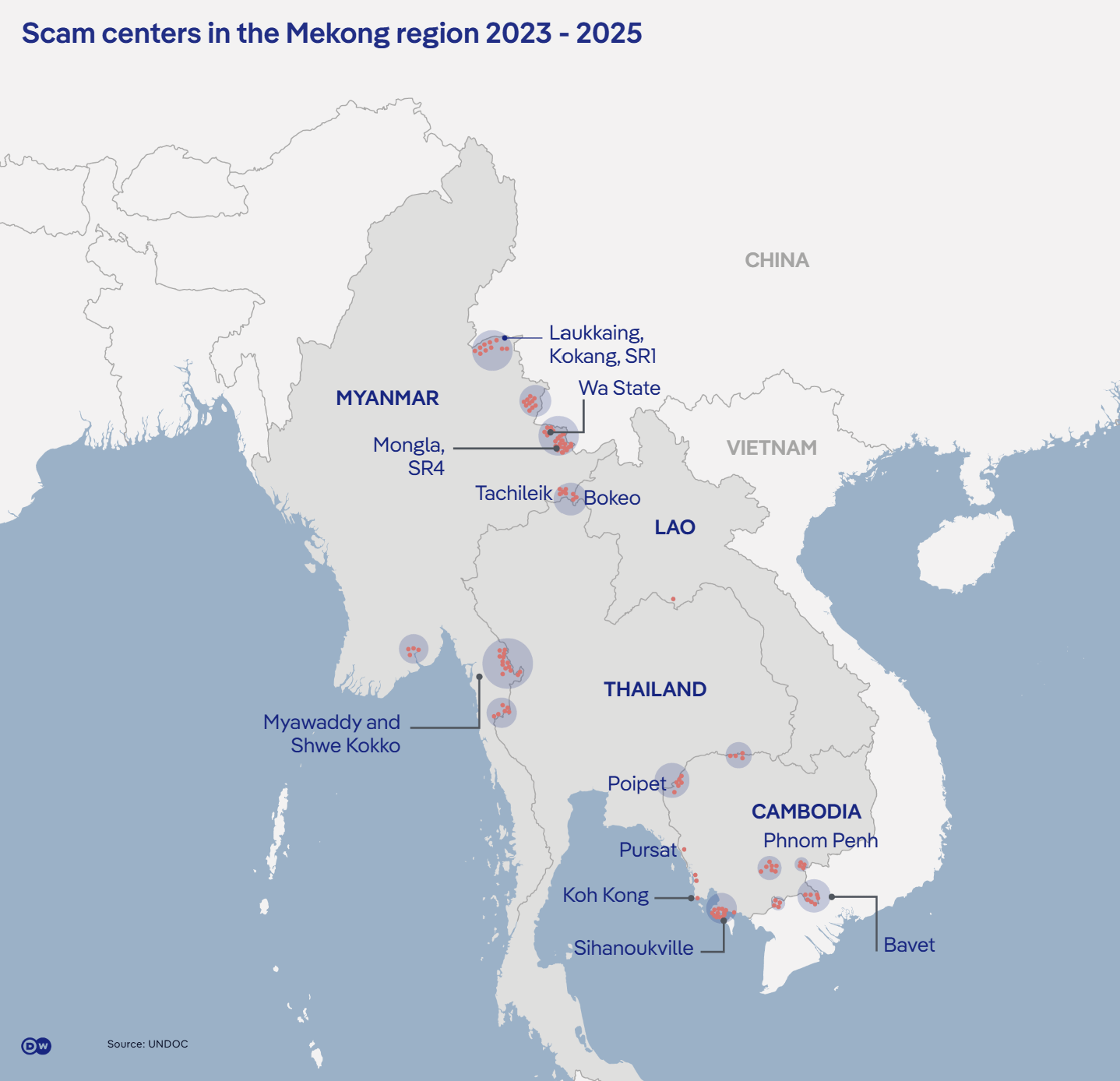
The distribution of scam centres in the Mekong region between 2023 and 2025. Courtesy of UNODC & DW
If this trend continues, scam centres risk fracturing ASEAN unity. Concentrated in Cambodia, Laos, and Myanmar, these hubs effectively encircle Thailand—a situation that has already fueled intra-regional tensions. On December 3, Thailand seized US$300 million of assets connected to Cambodia-based Prince Holding Group, whose founder Chen Zhi has been indicted by the US over allegations of running labour camps. Singapore has also borne significant costs from these networks, recording the region’s highest per-capita scam losses in 2024: an average of US$2,132 per person, amounting to a total loss of 456.4 million Singapore dollars (US$357 million). As a result, apart from introducing a corporal punishment of 24 canings against indicted scammers, its government has spoken out against Southeast Asian scam centres. Therefore, if left unaddressed, the continuation of these operations could prompt affected countries to impose tougher government-level retaliatory measures, including sanctions, which would risk undermining ASEAN cohesion as well as its core principles of free trade and regional integration.
Even more concerning, the persistence and expansion of these centres could cement Southeast Asia’s image as a region of “scam-states”, severely damaging its international reputation and political standing. For now, Western sanctions, primarily issued by the US and the United Kingdom (UK), are aimed at individual operators behind these hubs. However, if credible evidence emerges of state involvement, the entire countries could face sanctions, which could cripple their fragile economies. The US’ treatment of Venezuela, against which it has practically launched a military campaign by branding it as a “narco-state” offers a cautionary tale. If the label “scam-state” gains wider recognition, external intervention in Southeast Asian affairs—traditionally managed within the ASEAN framework—might become more assertive.
Hence, the dismantling of scam centres should indeed be a top priority for ASEAN and its member states. Yet, without viable economic alternatives to these hubs, substantial crackdowns are unlikely as they require political will from states currently harbouring them. Moreover, even if such raids succeed, another illicit industry could quickly emerge in the absence of legal opportunities—as demonstrated by how these scam centres originally replaced opium fields. Thus, ASEAN’s efforts to dismantle these centres should be paired with targeted investments in the surrounding regions, such as establishing outsourced tech support hubs, infrastructure projects, or agricultural plantations, in order to provide sustainable and legal economic alternatives.
About The Author




7 thoughts on “Scam States? How Southeast Asia Became the Global Fraud Hotspot”