A Vietnamese scrap collector cycles through a residential street. (Pexels/Man Fong Wong)
This is a top 10 entry in the Weaving the SEA Essay Competition 2026, written by Vân Hồ. Her essay traces the trust built between Vietnamese households and roving scrap collectors, weighing what is gained, and lost, as cities urbanise and that daily contact disappears.
Why Do People Keep Waiting for Her?
At the crack of dawn in Cần Thơ, Vietnam, while the small residential alley was still damp with morning dew and the aroma of coffee from the corner shop had just begun to drift through the air, a familiar cry echoed by: ‘Any junk, waste paper or scrap iron for sale?’ The cry lingered, slightly raspy, rising in pitch on the final word before fading away as the bicycle vanished around the bend. No one living in the alley looked out their doors. They all knew it was Ms. B, a middle-aged woman who had been cycling along this route as a roving scrap collector for over a decade. Though she went out crying for scraps every morning, she only passed through this alley once every three days. On her old bicycle, she wore a conical hat with a frayed brim and a deep red strap that had faded over the years.
Behind the gates of a few houses in the alley, flattened cardboard boxes and upside-down cans, drained of water, were neatly gathered into a sack, waiting for Ms B. No one had signed a contract with her, no invoices were exchanged, no schedules set and no phone numbers were stuck on the fridge. Yet, even when a strange collector passed by asking to buy them or even offering a slightly higher price, the grocery store owner at the top of the alley would refuse, saying she was saving them for Ms B.
Every time she stopped by, she would weigh the items, hand over the money, and skilfully tie the bundle onto her back rack. The bicycle would look just a little bit heavier. The entire transaction took less than five minutes, with most of that time spent catching up on how unpredictable the weather had been lately, or how their health was holding up today. The buying and selling was merely a pretext, a way to sustain a conversation that had already spanned years.
The Mechanism of Waiting
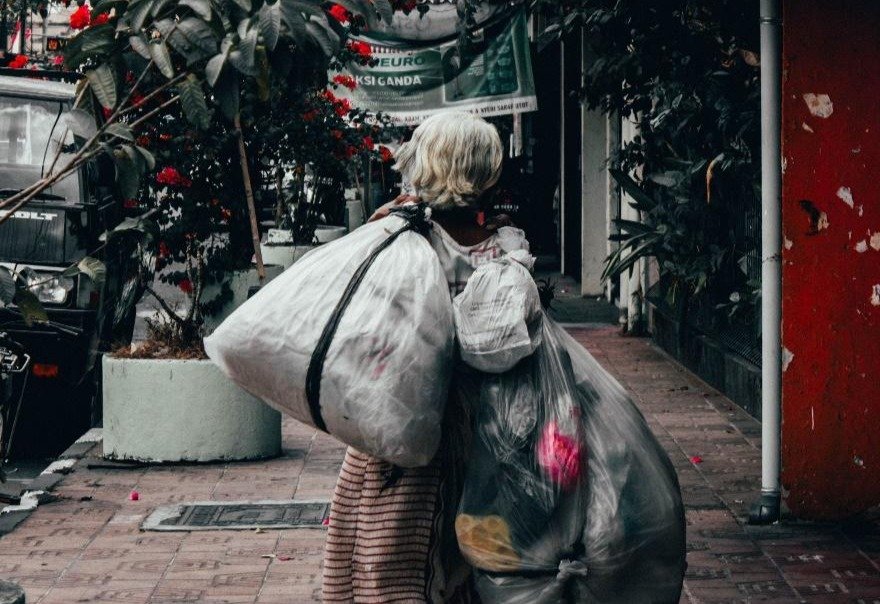
An elderly woman carrying trash bags in Yogyakarta, Indonesia. (Pexels/madebynoval)
So, what exactly causes ‘trash to be held in trust’? Scraps and recyclables possess a rather unique nature. Every vendor has their regulars. Take a sticky rice seller, for instance. But sticky rice cannot wait. The buyer is hungry, the seller has the goods and the transaction happens, ending on the spot. Scrap, however, can wait. Aluminium cans do not spoil and cardboard boxes do not go stale. It is this very capacity to wait that transforms an act of discarding into an act of retaining. Instead of throwing waste away immediately, people accumulate it to save for a specific, familiar person. During that interval, the sack in the corner of the yard ceases to be mere garbage. It becomes a form of ‘trust set aside’, reserved for someone whose name and familiar cry they have come to know by heart.
Beyond that small alley, those who share Ms. B’s work appear in many other corners across Southeast Asia. In Cambodia, these individuals are known as edjai, which is a term borrowed from the Vietnamese word ve chai. The trade follows the flow of scrap and the name follows the trade. In Indonesia, the occupation of scavenging and collecting recyclables is called pemulung, with approximately 4.2 million people registered, according to Indonesia’s national anti-poverty agency. Across the region, the names may vary, but the imagery remains identical: a bicycle or a cart, a few bulging sacks and a lone figure weaving through narrow alleys before the city even stirs.
The explanation of ‘trust set aside’ might be overly romanticised. Quite simply, the residents of this small alley save these items to sell to someone like Ms. B purely out of familiarity. Trust here is perhaps not some grand emotion, but rather the accumulation of previous satisfactory transactions. In a metropolis expanding faster than anyone can keep track of, being recognised by sight, by voice, even by a scrap collector, may be one of the few forms of continuity left. Yet, whichever way it is explained, when a stranger offers a higher price, people still choose the familiar face who has travelled down their alley for years.
What Is Lost When the Street Cries Fade?
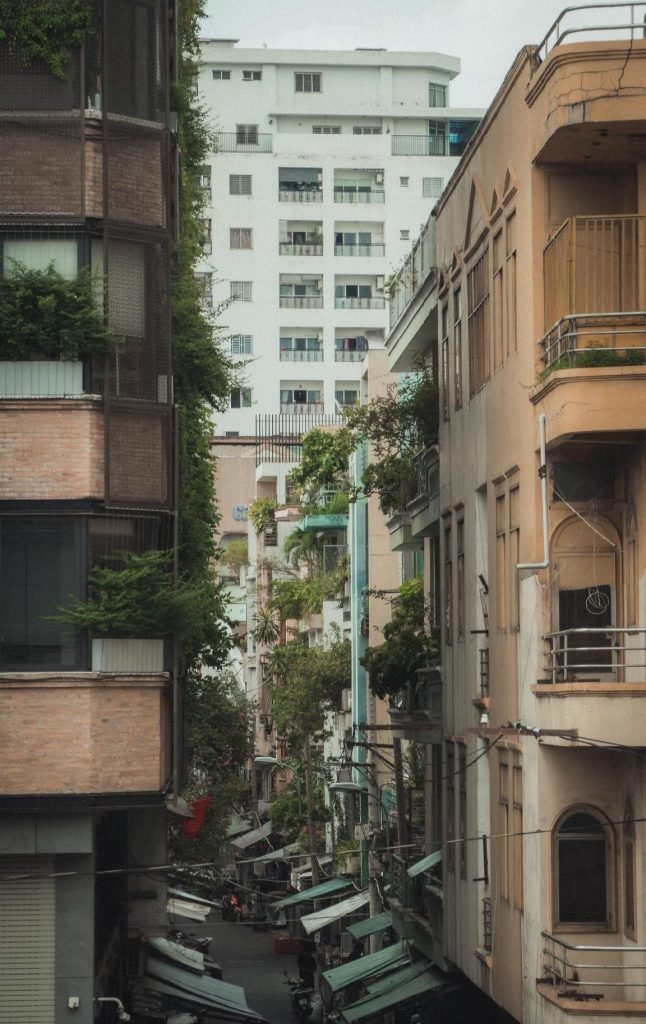
A bustling alleyway surrounded by closely packed high-rise buildings in Ho Chi Minh City, Vietnam. (Pexels/Phát Trương)
Ms. B said that over her many years in the trade, the number of people selling to her has decreased slightly. From her bicycle, waste initiates a long supply chain. She buys it on her rounds and resells it to scrap yards, which then pass it along to recycling factories. Independent workers in Vietnam’s collection and recycling chain are estimated to collect, aggregate, sort and transfer up to 80% of recyclable waste. At the very front of this chain are people like Ms. B. They operate without contracts, payrolls, or uniforms quietly gathering waste day after day. In Indonesia, more than half of the 4.2 million registered pemulung do not even possess identity documents, a figure that, the government says, still requires verification. This is a sign that the invisibility of this workforce is far from unique to Vietnam.
Across Southeast Asia, this kind of trade has endured for so long thanks to a few distinct conditions. Urbanisation has outpaced waste management capacities, a labour force has yet to find its place in the formal sector, and alleys remain too narrow for large garbage trucks but just wide enough for a bicycle to squeeze through. If their trade persists, then what exactly is changing? It is whether people still meet at the doorstep. In the traditional model, waste acts as a point of contact. It connects a household with a worker, sparking brief moments of catching up during each quick transaction. In the new model, however, waste becomes a point of disconnection. In high-rise apartment complexes, trash travels down garbage chutes or accumulates in basements, where roving collectors rarely have access. Consequently, no one needs to save cardboard boxes or empty beverage cans anymore, waiting to sell them to a familiar face.
Yet, not everything that is lost deserves equal regret. It would be overly romantic to mourn the disappearance of this habit out of pure nostalgia. Roving scrap collection is a brutal trade. Workers must endure the elements, carry excessive loads and expose themselves to sharp objects and chemicals, all while their income remains at the mercy of scrap prices set by others. Formalisation, if executed correctly, could offer what this trade has never had: contracts, occupational safety gear and social security. No one should have to subsist on the goodwill of neighbours in place of a proper social safety net.
This morning, Ms. B has already cycled far out of the small alley. Behind one of its gates, a new sack has begun to fill up again, waiting for her next visit. In three days, she will return. The question is, when that street cry finally fades into silence, will the alley hold onto its habit of waiting for a familiar face, or will it learn to wait for no one at all? That question belongs not just to this single alley; it is being asked, in different ways, wherever a street cry can still be heard across Southeast Asia.
About The Author