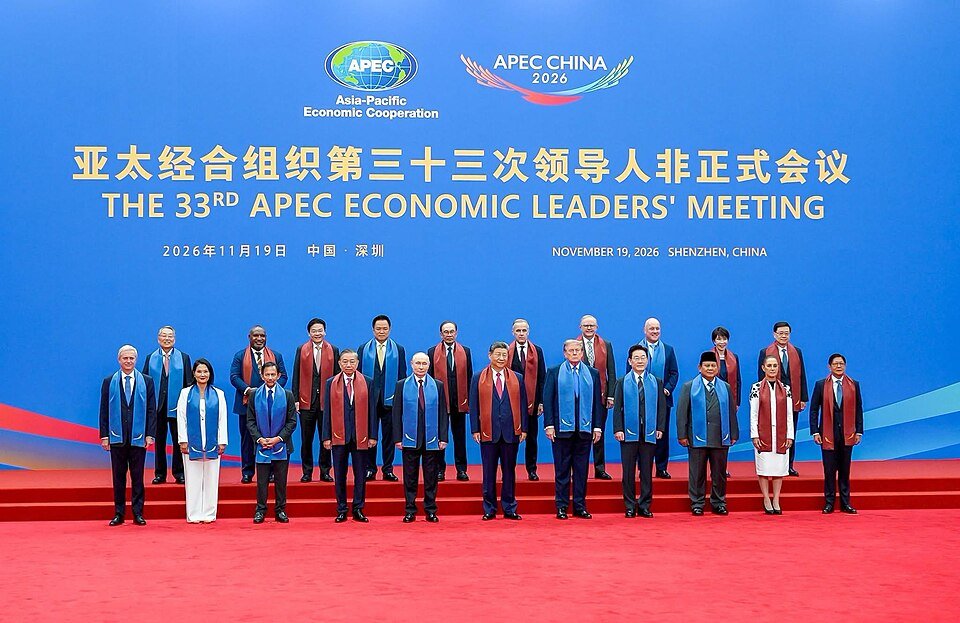
APEC leaders group photo during the 33rd APEC Economic Leaders’ Meeting in Shenzhen, China on November 19. (President Bongbong Marcos/Presidential Communications Office)
On November 18 to 19, Southeast Asian leaders joined regional counterparts at the 33rd Asia-Pacific Economic Cooperation (APEC) Economic Leaders’ Meeting in Shenzhen, China, where discussions focused on strengthening trade integration, supply-chain resilience and digital economic cooperation across the Asia-Pacific.
The meeting brought together leaders from Brunei, Indonesia, Malaysia, the Philippines, Singapore, Thailand and Vietnam, alongside other APEC member economies. Chaired by Chinese President Xi Jinping under the theme “Building an Asia-Pacific Community to Prosper Together”, discussions focused on economic openness, innovation and regional cooperation.
Chinese President Xi called for greater economic integration through the proposed Free Trade Area of the Asia-Pacific (FTAAP), improved trade and investment facilitation, and reduced barriers to regional commerce. He also emphasised strengthening infrastructure, harmonising regulations and facilitating cross-border movement to improve regional connectivity.
Meanwhile, digitalisation and technological cooperation also featured prominently. The meeting called for greater collaboration in AI, digital infrastructure and cross-border data flows, alongside support for small and medium-sized enterprises (SMEs). These priorities reflect the growing importance of technological innovation in regional economic development.
The meeting adopted the 2026 APEC Leaders’ Declaration, which sets out the Shenzhen Outlook, alongside three outcome documents covering trade, connectivity and innovation. China also announced a 20 million US dollars contribution to support APEC cooperation and plans to establish institutions focused on digital technology, cross-border data flows, clean energy and SME development.
The summit concluded with Vietnam assuming the role of APEC host for 2027. President To Lam outlined priorities for the country’s chairmanship, including improving economic productivity, expanding regional trade and investment, and strengthening economic resilience and people’s livelihoods. Vietnam will also work with all 21 APEC member economies to advance sustainable growth and supply-chain resilience.
The outcomes provide Southeast Asian economies with opportunities to strengthen their participation in regional trade, investment and technology networks. But, translating these commitments into economic benefits will require cooperation beyond high-level declarations, particularly in addressing infrastructure gaps, digital inequalities and supply-chain vulnerabilities.
Vietnam’s upcoming APEC chairmanship will also provide an opportunity to advance these priorities and connect regional economic commitments with the development interests of Southeast Asian economies.
About The Author