
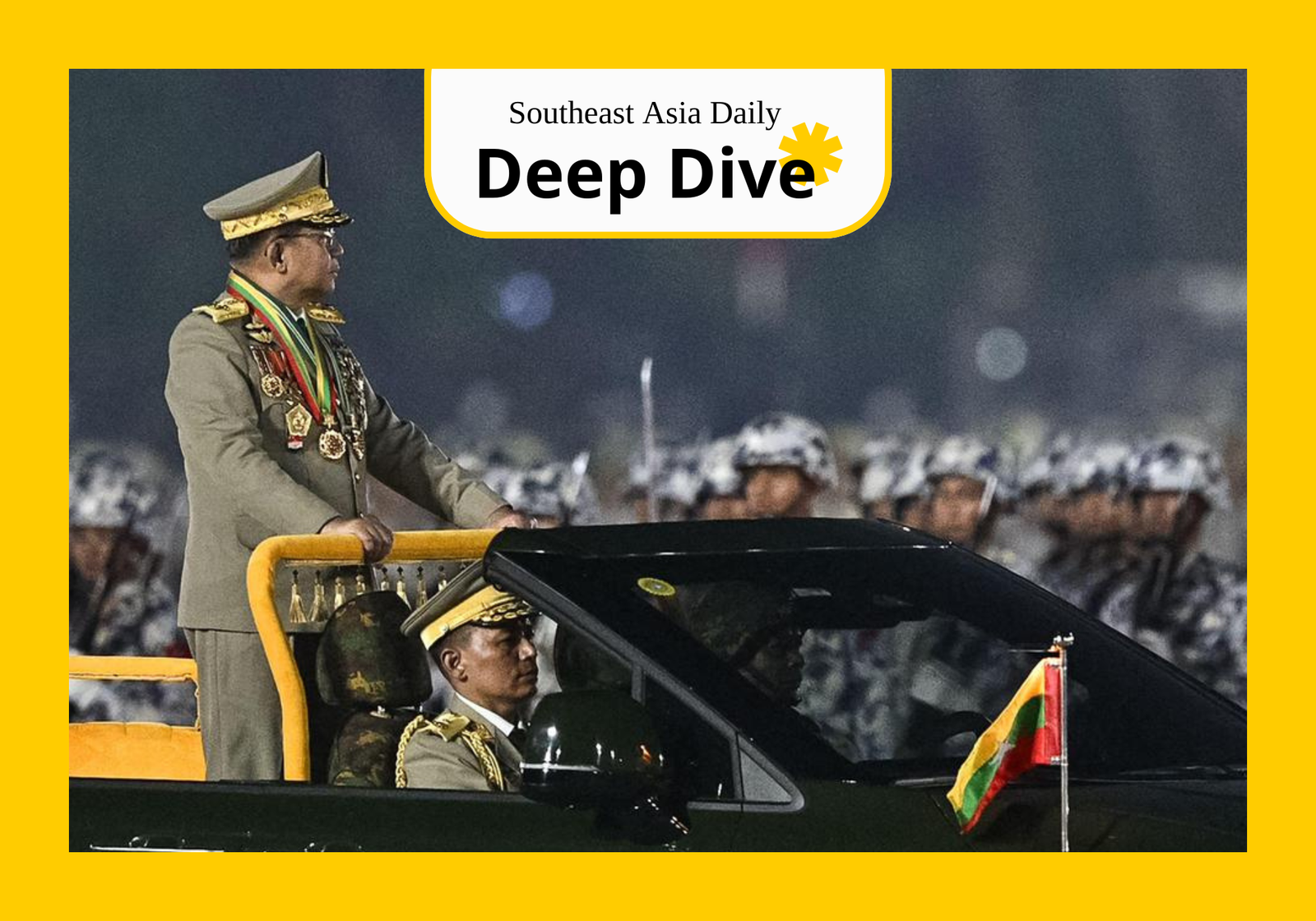
Then-Military Chief Min Aung Hlaing inspects the troops during a ceremony marking Myanmar’s Armed Forces Day in Naypyidaw on March 27, 2026. (AFP)
From Coup to Controlled Ballot
On 3 April 2026, Myanmar’s Union Parliament elected Senior General Min Aung Hlaing—the man who seized power in the 2021 coup d’état—as the state president, with 429 of 584 votes. Having handed command of the armed forces to loyalist General Ye Win Oo days before, the architect of the 2021 coup has now completed a remarkable institutional circuit: from general to coup leader, from coup leader to emergency ruler, and from emergency ruler to constitutionally installed president—all without ever facing a competitive election or relinquishing effective control over the military. The transition encapsulates the purpose of Myanmar’s 2025-26 elections, which is not to restore democracy, but to dress military rule in civilian clothing.
The path to this moment was cleared by nearly five years of systematic political demolition. Following the February 2021 coup, the junta detained State Counsellor Aung San Suu Kyi and President Win Myint, dissolved the National League for Democracy (NLD), imprisoned thousands of dissidents, and triggered a civil war that has displaced millions and left the military controlling less than half the national territory.
Elections were held in three phases—28 December 2025, 11 January 2026, and 25 January 2026—under conditions that made meaningful contestation impossible. Over forty political parties, including the NLD, had been dissolved or barred. A new Election Protection Law criminalised public criticism of the polls, under the threat of death sentence.with penalties reaching the death sentence. The military-backed Union Solidarity and Development Party (USDP) faced no serious competition and won an overwhelming majority: 233 of 264 lower-house seats contested and 108 of 224 upper-house seats, on top of the 25% of parliamentary seats constitutionally reserved for serving military officers. Turnout hovered around 55%—well below the roughly 70% recorded in the 2015 and 2020 elections—and voting was cancelled outright in dozens of conflict-affected constituencies, leaving 77 seats vacant across both chambers.
On 16 March 2026, the new Pyithu Hluttaw convened for the first time, electing USDP chairman and former general Khin Yi as seeker. A hastily legislated Union Consultative Council—a five member body designed to oversee both the military and civilian administrations—was created to ensure that Min Aung Hlaing retains effective authority regardless of which title he holds. The opening of parliament was thus not a democratic reopening but the first act of a managed succession, a choreographed transition from emergency rule to a nominally constitutional government still anchored in military power.
Legitimacy on Paper
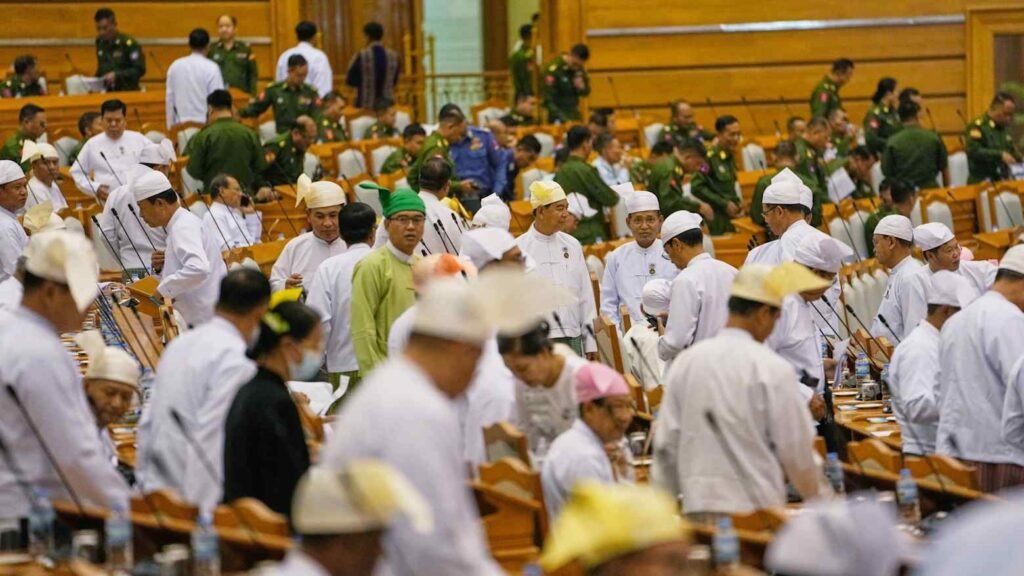
Myanmar’s military representatives in parliament and other lawmakers arrive for a session of the assembly in the capital, Naypyidaw, on April 3 to elect the new president (AP)
The junta’s strategy rests on a straightforward proposition: that holding elections, seating a parliament, and installing a president under the 2008 Constitution, restores lawful governance. In its own framing, i.e., echoed by state media describing the parliament’s opening as a “historic and proud day”, the vote represents the fulfilment of the constitutional requirement to hold elections within six months of the expiry of a state of emergency. The argument appeals to procedural form: if the constitution timetable has been observed, legitimacy follows.
This claim is legally problematic. The 2008 Constitution itself was drafted by the preceding military regime to guarantee the military junta—Tatmadaw—a permanent veto over governance, reserving a quarter of all parliamentary seats for uniformed officers and requiring a supermajority for any constitutional amendment. More fundamentally, the election violated every substantive condition that constitutional or international standards attach to legitimate political participation. The principal opposition was dissolved. Political prisoners remained behind bars. Civic space had been crushed. Freedoms of expression, assembly, and association were not merely restricted but actively criminalised in the election’s specific context.The UN Special Rapporteur on Myanmar, Thomas Andrews, concluded in his final report to the Human Rights Council that the elections amounted to “electoral theatre” designed to hide military oppression behind civilian trappings, and urged governments to refuse recognition of the resulting government. ASEAN, despite its tradition of non-interference, declined to send observers or certify the results. This signifies the clear signal from the regional bloc that it would not endorse the outcome.
The point is not merely that the elections fell short of democratic ideals. It is that their design was incompatible with the minimum conditions under which an election can confer authority. Exclusion of all credible opposition, suppression of political speech, and entrenchment of military control are not imperfections to be weighed against a procedural checklist. They negate the legitimating function of the vote itself. An illegitimate election, as the UN Special Rapporteur put it, can only yield an illegitimate government.
A Façade With Limits
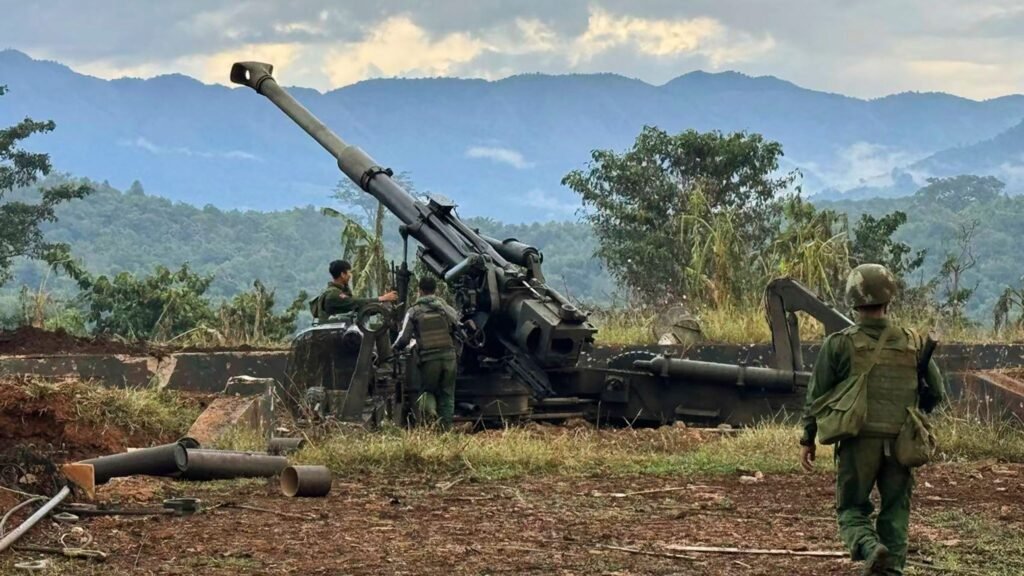
Members of the opposition militia Three Brotherhood Alliance check weapons the group allegedly seized from a Myanmar army outpost. (AP)
If the elections cannot deliver genuine legitimacy, they may still yield practical diplomatic gains. Min Aung Hlaing has long calculated that a civilian-looking government would lower the political cost for neighbouring states to re-engage. There are early signs this is partly working: Japan, India, Cambodia, and Vietnam sent observers to the polls, and China publicly welcomed the exercise. Thailand and Bangladesh, which need the junta’s cooperation on refugees, crime, and border security, may find the new government a more convenient interlocutor. The Philippines, as ASEAN’s 2026 chair, sent an envoy to Naypyidaw even before the vote was complete. For states inclined toward pragmatic engagement, the institutional makeover—however thin—provides diplomatic cover.
Yet the limits of this strategy are already visible. Western governments have shown no inclination to lift sanctions or upgrade relations. ASEAN’s refusal to certify the results deprives the junta of the regional endorsement it most wanted. And the broader geopolitical context—in which the United States has been notably silent on the elections, while its Myanmar policy review remains pending—offers no clear path to rehabilitation. The junta’s strongest external relationships, with Beijing and Moscow, were already secured without the need for elections; the vote changes little in those partnerships.
For businesses, the picture is blacker still. Myanmar’s economy, already hollowed out by five years of civil war, Western sanctions, and capital flight, has been hit by a severe fuel crisis triggered by Middle East shipping disruptions. The junta imposed sweeping fuel rationing in early March 2026, including odd-even driving restrictions and QR-code purchase quotas. Diesel prices have surged, domestic airlines have suspended routes, and the UN Food and Agriculture Organization (FAO) has warned that fuel shortages threaten the April rice harvest—a potential food-security catastrophe in a country where millions already depend on humanitarian assistance. For international investors and companies, the combination of ongoing armed conflict, an unpredictable sanctions environment, currency instability, and now energy disruption makes Myanmar one of the highest-risk operating environments in Asia.
In sum, 2025–26 elections have given Myanmar’s military rulers something they lacked: a parliament, a constitutional calendar, and an institutional vocabulary of civilian governance. What they have not given is what the junta most needs—broad domestic acceptance, international recognition, or a credible foundation for stability. The regime’s institutional façade may ease selective diplomatic re-engagement, but it cannot substitute for the political settlement that the civil war demands. Five years after the coup, the fundamental contest in Myanmar remains unresolved: between a military that insists on ruling and a population that has made clear, at enormous cost, that it does not consent.
About The Author

2 thoughts on “Military in Civilian Clothing: Myanmar Junta’s Post-Coup Rebrand”