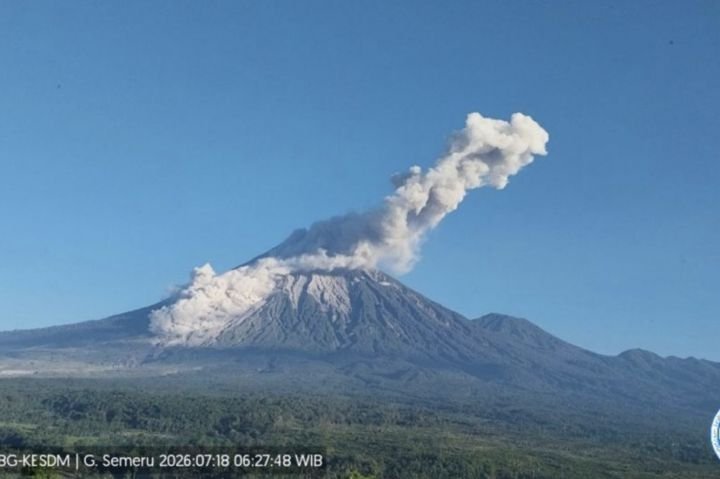
A pyroclastic flow descends 3.5 kilometres towards Besuk Kobokan as Mount Semeru erupts in East Java on July 18, 2026. (ANTARA/HO-PVMBG)
On July 18, Mount Semeru, locatedin the province of Jawa Timur, Indonesia, erupted and released a hot pyroclastic flow that travelled approximately 3.5 kilometres down its slopes.
According to Mukdas Sofian, an officer at the Mount Semeru Observation Post, the most significant eruption occurred at 6:21 a.m. local time. The eruption generated an ash column rising about 1,000 metres above the summit, reaching an altitude of roughly 4,676 metres above sea level.
The volcanic plume appeared white to grey and was observed drifting towards the north-east, south-east and south. Monitoring equipment recorded the eruption with a maximum seismic amplitude of 22 millimetres, while the volcanic activity lasted for around 6 minutes and 35 seconds.
The eruption was accompanied by a pyroclastic flow that descended about 3.5 kilometres through the Besuk Kobokan drainage area, one of the main channels for volcanic material from the mountain.
Authorities reported that Semeru, the highest volcano on Jawaa Island, erupted three times on the same day. The first eruption took place at 5:24 a.m., producing an ash column around 500 metres above the summit. Two further eruptions were recorded at 6:21 a.m. and 9:09 a.m., both sending ash approximately 1,000 metres into the air.
The volcano remains at Alert Level III—the second highest level in a four-layer alert system—prompting officials to maintain strict exclusion zones. Residents have been instructed to avoid all activities within 13 kilometres of the summit along the Besuk Kobokan sector. People are also advised to stay at least 500 metres away from riverbanks in the area due to the risk of expanding pyroclastic flows and volcanic mudflows reaching up to 17 kilometres from the crater.
Authorities further warned against entering a 5 kilometres radius around the summit because of the danger of incandescent rock fragments, while urging communities to remain alert for lava flows, pyroclastic clouds and lahars along rivers originating from Mount Semeru, particularly Besuk Kobokan, Besuk Bang, Besuk Kembar and Besuk Sat.
About The Author