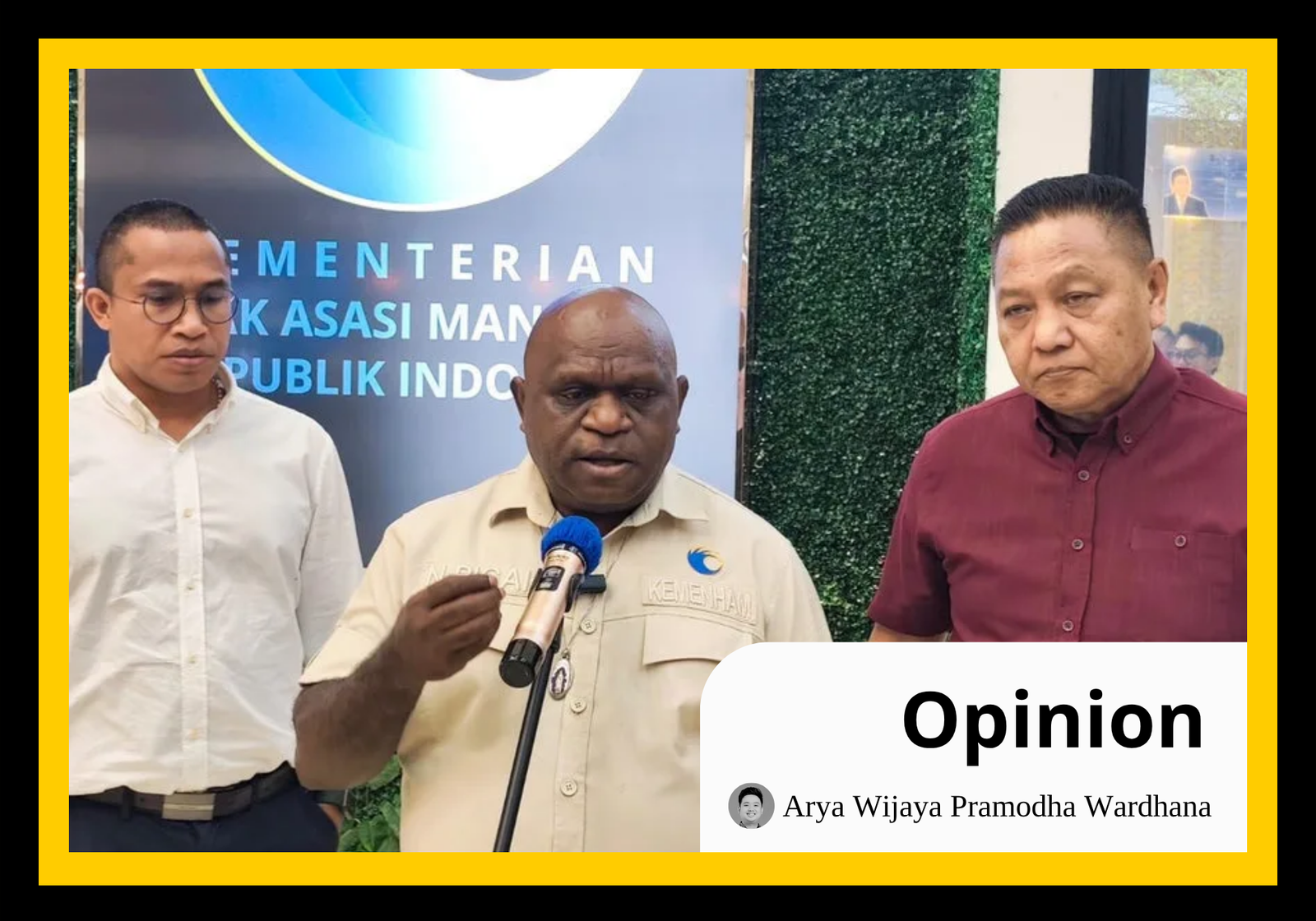
Natalius Pigai, Indonesia’s Minister of Human Rights, explains the role of the Human Rights Assessor Team during a press statement at the Ministry of Human Rights office in South Jakarta, Monday, 4 May 2026. (tirto.id/Auliya Umayna)
Arya Wijaya Pramodha Wardhana is a lecturer at the Department of Information and Library, Faculty of Social and Political Sciences, Universitas Airlangga. His research interests include information studies, the information society, modern cultural studies, and media literacy. His work primarily explores the intersection between digital information access and its social implications, with a particular emphasis on strengthening media literacy within contemporary culture. The views expressed are his own and do not represent SEA Daily or that of another organisation.
In early May 2026, Indonesia’s Ministry of Human Rights announced plans to establish an advisory team that would evaluate and determine who qualifies as a legitimate human rights activist. The government’s stated justification was straightforward: the team would ensure that only legitimate defenders receive legal protections. But stripped of its bureaucratic language, the proposal carries a more troubling meaning. It is a claim by the state that it alone should decide who is entitled to scrutinise the state. That is not a protection mechanism, but rather a “gatekeeping” tactic. Understanding why this matters requires stepping back from the immediate controversy and asking a more fundamental question: what is human rights activism actually for, and where does it come from?
Criticism Was Never Meant to Be Comfortable
Human rights activism does not emerge from government offices or policy committees. It grows from the lived experience of people whose rights have been violated, ignored or traded away for political convenience. A farmer whose land has been seized without compensation does not need a certificate to become a human rights defender. An indigenous community displaced by a state-backed infrastructure project does not require administrative validation to speak about what has happened to them. A worker dismissed without recourse does not need to pass a capacity assessment before their grievance can be considered legitimate.
This point matters because it goes to the very architecture of democratic life. The philosopher Jürgen Habermas described civil society as occupying a public sphere that exists precisely to hold power accountable from the outside. It is not a consultative body that advises the government. It is a space where citizens can speak freely, organise and challenge those in power without needing their approval to do so. Once that independence is compromised, the function disappears. An activist who must first be validated by the government they are criticising is no longer, in any meaningful sense, an independent critic.
Legal scholar Bivitri Susanti has argued that civil society movements in Indonesia serve as one of the last functioning instruments of democratic checks and balances, particularly at a time when formal political institutions have been increasingly captured by elite interests. The advisory team proposal, viewed through this lens, is not a bureaucratic refinement. It is an attempt to bring the watchdog inside the house.
A Familiar Pattern
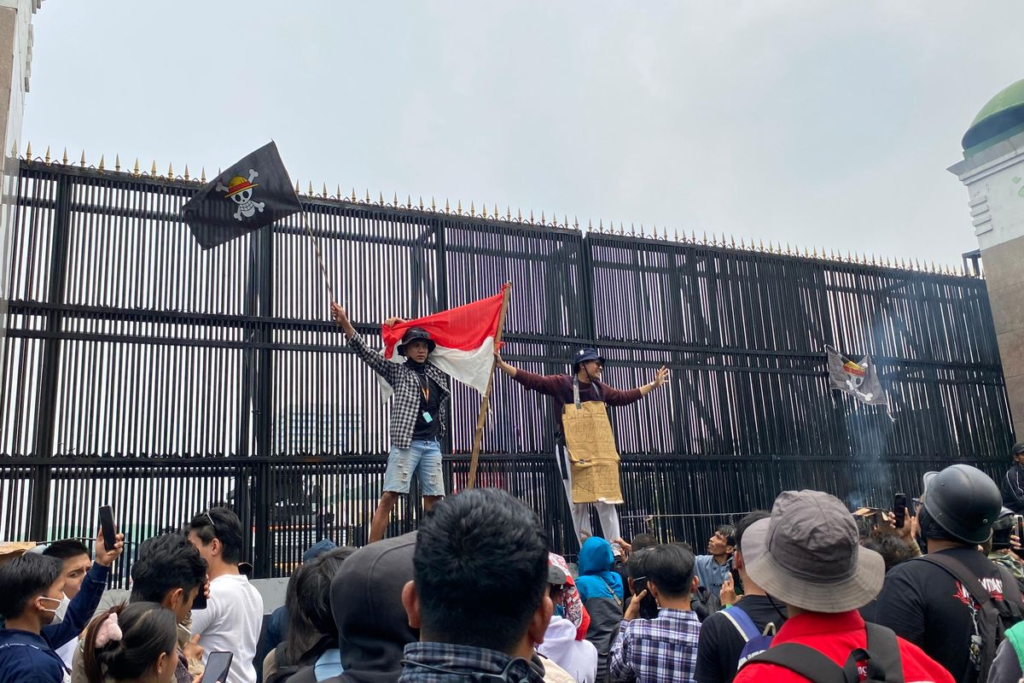
A demonstration in Indonesia in 2025 (KOMPAS.com/Lidia Pratama Febrian)
The proposal does not exist in a vacuum. It arrives at a moment when the evidence of democratic backsliding in Indonesia is both extensive and disturbing. The Economist Intelligence Unit (EIU) recorded Indonesia’s democracy score at 6.44 in 2024, placing the country in the “flawed democracy” category and dropping three ranks from 56th to 59th out of 167 nations surveyed. Indonesia’s democracy score had already declined in 2023, falling to 6.5 from 6.71 in 2022, marking three consecutive years of decline within the flawed democracy category. Among the five indicators the EIU measures, Indonesia received its lowest scores in political culture at 5.00 and civil liberties at 5.29 out of 10.
The picture on the ground is considerably grimmer. Amnesty International Indonesia documented at least 295 human rights defenders who were attacked throughout 2025, with the organisation describing the year as “one of living dangerously for everyone who thinks critically”. In the first half of 2025 alone, the rights watchdog recorded 54 separate incidents affecting 104 individuals, in the form of police reports, arrests, criminalisation, intimidation, and physical violence. Indigenous communities and journalists made up the largest share of victims.
The physical dangers are not abstract. In March 2026, four military intelligence officers carried out an acid attack on an Indonesian activist from the Federation of The Commission for the Disappeared and Victims of Violence (KontraS), Andrie Yunus, who had been vocal in opposing the controversial revision of the Military Law and in defending protesters who faced police repression during the mass demonstrations of August 2025. The left attack 20% of his body burnt, and he will likely lose his right eye. Meanwhile, KontraS’s monitoring from December 2024 to November 2025 recorded approximately 42 incidents of extrajudicial killings resulting in 44 deaths, alongside 71 incidents of torture. Against this backdrop, the government’s decision to announce an advisory team to assess activist credentials might not be merely poorly timed, but might reveal something about the political logic at work.
The Illusion of Participation
The Ministry framed the advisory team as a multi-stakeholder body that would include representatives from civil society alongside government and law enforcement. This framing deserves scrutiny. Governance scholar Yanuar Nugroho has argued consistently that genuine democratic participation requires more than a seat at the table. It is essential that citizens are recognised as equal subjects, rather than merely as voices that can be managed, filtered or approved. Political scientist Sherry Arnstein’s foundational framework, the Ladder of Citizen Participation, differentiates between genuine participation and what she terms tokenism: a superficial semblance of inclusion that obscures an ongoing concentration of power. At its lowest rungs, tokenism involves inviting citizens into a process that has already been designed to reach a predetermined conclusion. The advisory team proposal fits this description precisely. The government is not being asked to justify itself to civil society. Civil society is being asked to justify itself to the government.
This distinction is not semantic. When the state controls the criteria by which activists are evaluated, it controls which criticisms can be heard and which can be dismissed on procedural grounds. A farmer organisation lacking sufficient institutional capacity may face exclusion from the category of “legitimate defenders”. An indigenous rights group that lacks formal documentation may not meet whatever standards the advisory team develops. The result is not a more orderly civil society. It is a more compliant one.
It Doesn’t Look Like Repression
One of the more unsettling aspects of administrative gatekeeping is how unremarkable it appears from the outside. There is no violence. There is no dramatic confrontation. There is only a form to fill in, a panel to appear before, and a process to complete. This is what political theorists sometimes call the bureaucratisation of repression: the use of procedural requirements to achieve, quietly and legally, what physical force achieves loudly and illegally.
Human Rights Watch has found that Indonesia under President Prabowo Subianto has undergone democratic backsliding, crackdowns on protests, media censorship, and intimidation of activists. The Bertelsmann Transformation Index has noted that fast-tracked lawmaking has reduced space for civil society and that weakened democratic institutions and limited civic space reduce accountability. The advisory team proposal is consistent with this broader pattern. Each individual measure may appear defensible in isolation. Taken together, they describe a government steadily narrowing the space in which independent criticism can operate.
There is also a deeper irony worth naming. The government has justified the advisory team in part by pointing to the need to protect genuine human rights defenders. But the Executive Director of Amnesty International Indonesia, Usman Hamid, has noted that the fact that almost 300 human rights defenders were attacked throughout 2025 has not been enough to move the government to provide protection. The state has shown little urgency in protecting defenders when they are attacked. It is now showing considerable urgency in evaluating whether they deserve to be called defenders at all. That inconsistency might not only be an administrative oversight, but rather a political statement.
The Needs
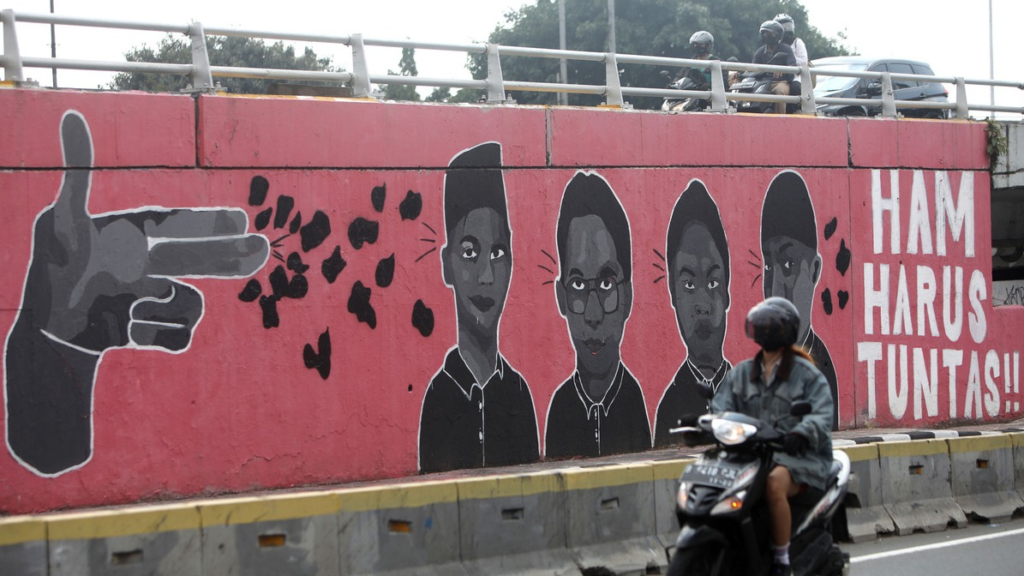
Murals on human rights violations in Jakarta (KOMPAS.id)
The advisory team proposal should be rejected, and rejected clearly. Not because it lacks good intentions, but because its logic, followed to its conclusion, is incompatible with the conditions that make democracy functional. A healthy public sphere requires that citizens can speak, organise and dissent without first obtaining the approval of those they are dissenting against. It requires that the legitimacy of a human rights defender is determined by whether they are defending human rights, not by whether they have satisfied a government-appointed panel. It requires, above all, that the state understand criticism as a feature of democratic life rather than a problem to be managed.
Indonesia’s government holds, as of 2024, a seat on the UN Human Rights Council. That position carries obligations. One of them is to demonstrate, through domestic practice, a genuine commitment to the protection of those who hold power to account. Establishing an advisory team to vet the credentials of human rights activists is not consistent with that commitment. It is, in the clearest terms, an obstacle to it.
If the government genuinely wishes to protect human rights defenders, the path forward is not assessment, it is accountability: for the acid attacks, for the arbitrary arrests, for the documented pattern of intimidation that has made Indonesia, in Amnesty International’s own words, “a dangerous country for anyone who thinks critically”. That is where the state’s energy should go. Not into deciding who is qualified to notice.
About The Author