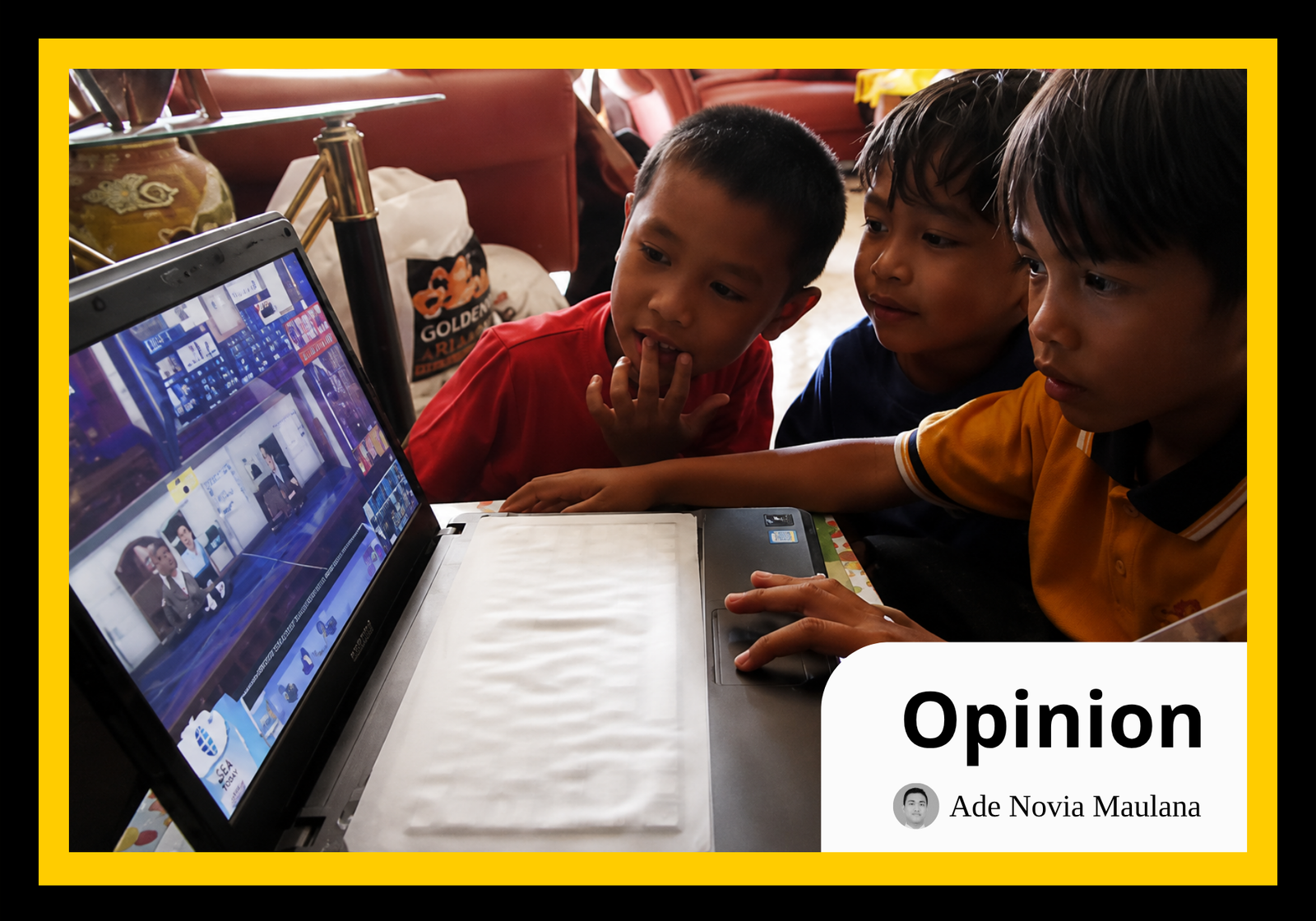
Indonesian children browsing the internet (Indonesian Ministry for Communication and Digital Affairs)
Ade Novia Maulana is a lecturer at the Department of Information Systems of Universitas Islam Negeri Sulthan Thaha Saifuddin Jambi. The views expressed are authors’ own and do not represent SEA Daily or that of another organisation.
A Nation Connected, A Generation Exposed
On 2 May 2026, Indonesia marked its National Education Day under the theme “Strengthening Universal Participation to Realise Quality Education for All.” It is a theme that carries weight beyond ceremony. As the government unveiled the scale of its digital education programme, there was genuine cause for pride: 316,167 schools across the archipelago, from early childhood centres to special needs institutions, now have internet connectivity. A student in the province of Jambi can access the same learning materials as a peer in the capital city of Jakarta. A teacher in a remote corner of the Kalimantan island can tap into a professional community spanning the globe.
These are real gains and they deserve recognition. But honest celebration demands a harder question: is the digital space where these children learn actually safe for them?
The data suggests the answer is not yet. A 2025 report by the National Statistics Bureau records that 92% of Indonesian students use the internet primarily for entertainment, whilst 69% are regular social media users. The classroom and the living room are no longer separate: they share the same screen. And that screen carries risks the education system has been slow to reckon with.
The risk is not theoretical. UNICEF’s 2023 baseline study found that 50.3% of Indonesian children have encountered sexual imagery on social media, and 42% have felt uncomfortable or frightened as a result of their online experiences. A joint investigation by UNICEF, INTERPOL and ECPAT, the most comprehensive national-level research of its kind, estimated that some 500,000 children in Indonesia had experienced online sexual exploitation and abuse within a single year. Researchers emphasised that the figure was likely an undercount, given the sensitivity of the subject and the barriers children face in disclosing such experiences.
These numbers are not cited to alarm, but to reframe the story. The success of digital education cannot be measured solely by the number of schools connected. It must also be measured by the safety of every child who logs on.
When Access Outpaces Protection
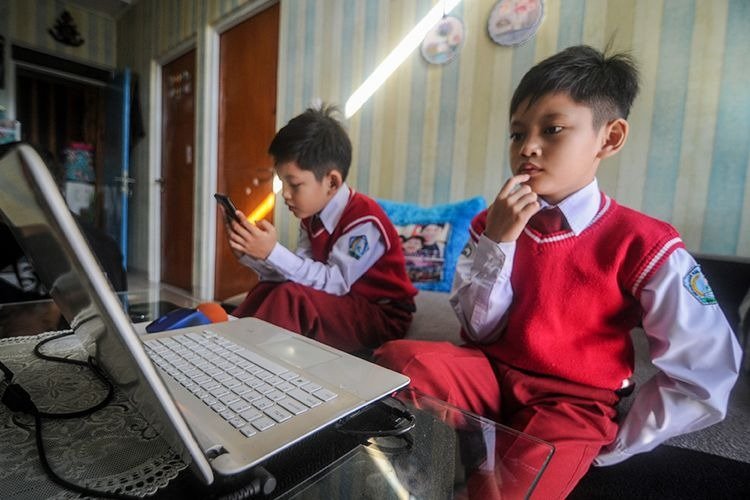
Two children engages with online content on a device in Indonesia.
This tension is not unique to Indonesia. It is the defining dilemma of education technology policy across Southeast Asia. Governments in the region have rightly invested heavily in
connectivity, but the governance frameworks that should accompany that investment have consistently lagged behind.
The core problem is structural. The digital infrastructure children use for learning is the same infrastructure they use for entertainment, socialisation and self-expression: a space built largely by and for adults, optimised for engagement rather than wellbeing. Without strong regulatory frameworks, the burden of protection falls disproportionately on families, many of whom lack the digital literacy to bear it.
Indonesia’s response to this gap is worth studying closely. Government Regulation No. 17/2025 on the Governance of Electronic System Operations in Child Protection, known as PP TUNAS, entered into force on 28 March 2026. The regulation marks a genuine shift in how Indonesia frames the problem. Rather than treating child online safety as a parental responsibility, it places binding obligations directly on digital platforms: restricting access for children under 16 to high-risk services, prohibiting commercial profiling of minors, banning the default collection of children’s location data and requiring parental consent at every level of a child’s digital access. Platforms are also required to deliver digital literacy education to both children and parents, and to report compliance to the government annually.
Crucially, PP TUNAS shifts accountability away from families alone and onto the platforms that profit from children’s attention. The early compliance picture was telling: when the regulation entered into force, only two of the eight designated platforms, X and Bigo Live, met its requirements in full. Others followed only after government enforcement actions, including formal written sanctions. By the end of the first implementation period, all eight had declared compliance. When states set clear standards and show the will to enforce them, even the world’s largest technology corporations can be compelled to comply. The lesson for the region is plain.
Malaysia’s concurrent approach offers a useful point of contrast. In November 2025, Malaysia’s Cabinet approved a minimum age of 16 for social media account registration, enforced through electronic know-your-customer checks and a broader licensing regime placing major platforms under regulatory oversight from January 2026. The instinct is sound: shift accountability onto platforms rather than families alone. Yet analysts have noted that age-gate policies of this kind carry structural risks. Teenagers who cannot register officially tend not to disappear from social media; they borrow older relatives’ accounts, share credentials or migrate to less regulated services. A policy that changes the registration screen without addressing the underlying harm architecture may produce cleaner compliance data whilst leaving children’s exposure largely intact. The contrast with PP TUNAS’s layered obligations
around consent, data minimisation and literacy shows that the two approaches are not equally ambitious and the region’s policymakers should note the difference.
Yet regulation, however well-crafted, cannot work alone. Indonesia’s national education day theme of “universal participation” points to a deeper truth: protection at scale requires every institution in the system to play its part and none carries more untapped potential than schools. Across the region, schools risk becoming hi-tech delivery channels for technology, without the capacity to help children navigate it wisely. Putting devices in classrooms without building digital literacy into the curriculum is like issuing chemistry sets without teaching lab safety. The hardware arrives; the safety culture does not.
Teachers are at the centre of this challenge. They are expected to model and instil digital citizenship in students who already spend more hours online than in any classroom. Yet across much of Southeast Asia, neither initial teacher training nor continuing professional development has kept pace with the demands of the digital environment. Preparing teachers to guide children safely through online life is not a supplementary concern: it is fundamental to whether digital education delivers on its promise.
Embedding Safety in the Architecture of Digital Education
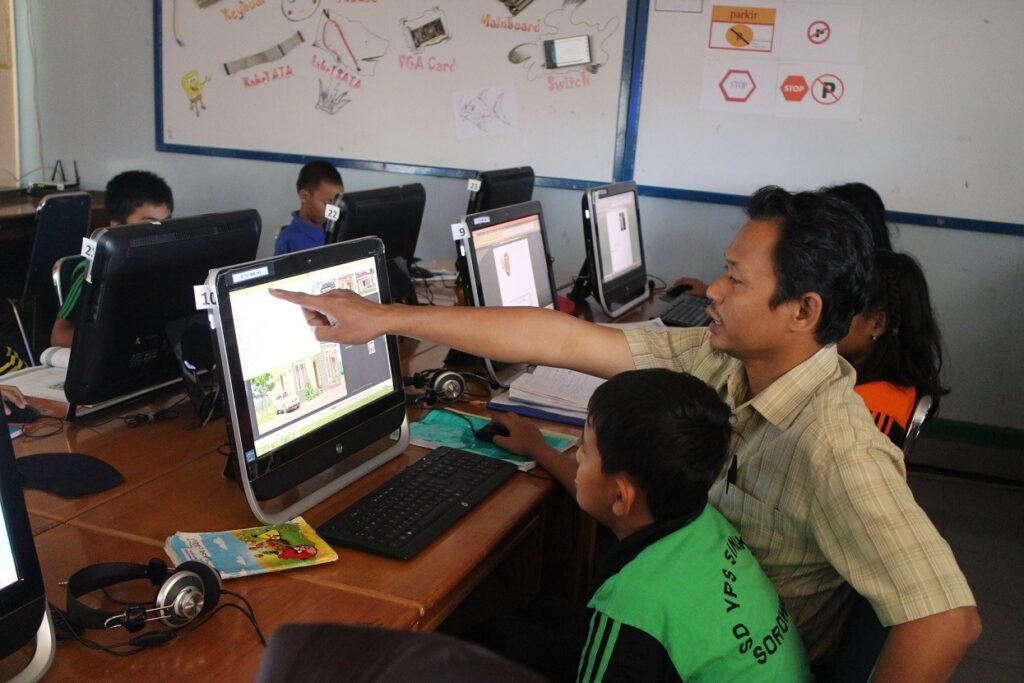
A teacher leads a digital learning session in a classroom in Indonesia. (Made Nuryadi)
PP TUNAS arrives at a pivotal moment for the wider region, not just for Indonesia. Several Southeast Asian governments are either mid-rollout of digital education programmes or actively planning their expansion and the momentum from PP TUNAS is already reverberating across the region. Indonesia became the first Global Majority country to adopt binding regulation for age-appropriate design, prompting parallel action elsewhere: Thailand criminalised online grooming targeting minors through its 2025 Criminal Code amendments; Singapore introduced mandatory age assurance under its Code of Practice for Online Safety; and Vietnam issued a directive requiring platforms to implement identity checks and age restrictions for minors in early 2026. ASEAN member states are furthermore set to adopt a renewed Regional Plan of Action embedding safety-by-design principles across the bloc. The central question before each of them is whether child online safety will be built into these programmes from the start or bolted on afterwards, once harm has already accumulated. History suggests the latter is the default. It should not be.
Three imperatives stand out. First, platform accountability must be treated as a core part of digital education policy, not an afterthought. Access and safety are not competing priorities: they are the same priority, seen from different angles. No digital education programme should go to scale without binding standards for the platforms through which it is delivered.
Second, schools must become genuine centres of digital literacy, not simply end-users of digital equipment. That means investing in teacher capacity, embedding digital citizenship in the curriculum, and building structured partnerships between schools and parents on online safety. This is precisely the participatory model PP TUNAS envisions. Indonesia’s digital device distribution programme had reached nearly 100% of its national target across schools of all levels. That is a serious investment. Its full return will depend on a parallel investment in the people and programmes around those devices.
Third, ASEAN should consider developing a regional framework for child online safety standards. Indonesia’s PP TUNAS, alongside the EU’s Digital Services Act and the UK’s Online Safety Act, offers a credible starting point. Without regional coordination, the risk is a patchwork of inconsistent protections. Sophisticated global platforms are expert at finding gaps; Southeast Asia’s children deserve a region that does not give them any to find.
Ki Hajar Dewantara, Indonesia’s founding father of education, devoted his life to ensuring that every child had the right to learn. The task for this generation of policymakers is more specific: to ensure that every child can learn safely. A generation protected in digital spaces is not a footnote to the story of educational progress in Southeast Asia. It is the story.
About The Author