
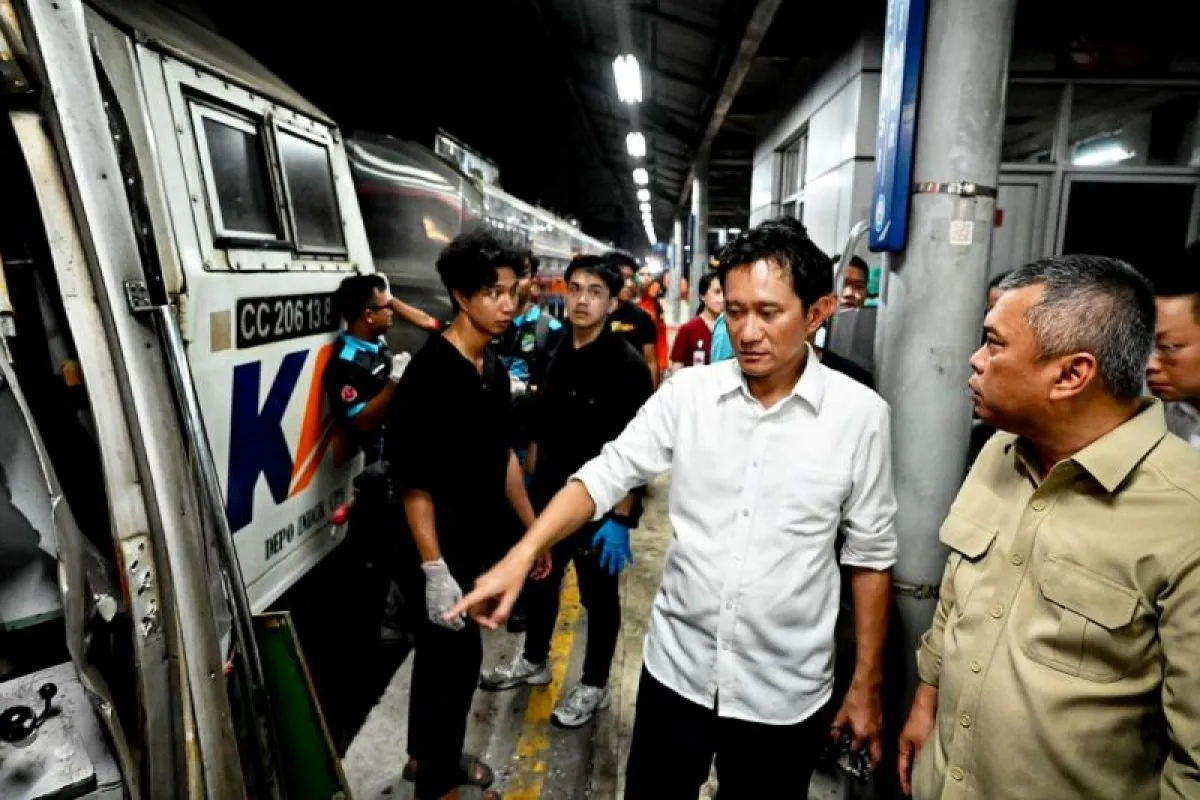
Indonesia’s Transportation Minister Dudy Purwagandhi (right), accompanied by PT KAI President Director Bobby Rasyidin (left), visited the train crash site at East Bekasi Station on April 28, 2026. (ANTARA/HO-Kemenhub)
On April 27, a railway accident occurred late in East Bekasi, near Indonesia’s capital Jakarta on a busy rail line. It involved a commuterand a long-distance train. The collision caused extensive damage to several carriages and prompted a large emergency response. As of April 28, authorities confirmed that 15 people had lost their lives while at least 84 others sustained injuries.
Bobby Rasyidi, chief executive of the state-owned railway operator PT Kereta Api Indonesia (KAI), confirmed that the number of fatalities increased as rescue teams gradually accessed sections of the wreckage that were initially difficult to reach. Many of the injured passengers were transported to nearby hospitals for treatment, while authorities coordinated recovery operations at the crash site.
Early reports suggest the accident began with a separate incident at a railway crossing identified as JPL 85, where a commuter line train struck a taxi operated by the ride-hailing company Green SM. The disruption created by that collision forced another commuter line service to stop at East Bekasi Station.
While the commuter train was stationary at the platform, it was subsequently hit from the rear by the Argo Bromo Anggrek intercity train, one of the long-distance services operating on the line between Gambir (Jakarta) and Surabaya. The impact caused significant damage to several train carriages and resulted in numerous casualties.
Authorities stated that all hospital treatment for those injured in the crash will be fully funded by KAI and its insurance providers. The company has also pledged to cover funeral costs for those who lost their lives in the disaster. In the meantime, East Bekasi station has been closed to passenger services as recovery and investigation efforts continue.
The exact cause of the accident remains unclear and is currently being examined by the National Transportation Safety Commission (KNKT). Investigators are working to reconstruct the sequence of events and determine whether operational, technical or infrastructure factors played a role in the collision.
Following the tragedy, Indonesian President Prabowo Subianto stated that the government would launch a comprehensive investigation and accelerate improvements to railway crossing safety across the country. The president made the remarks after visiting several victims receiving treatment at dr. Chasbullah Abdulmadjid hospital in Bekasi.
As part of immediate preventative measures, the president also approved plans for the construction of a flyover in Bekasi, a step aimed at separating road and rail traffic in one of the region’s busiest transport corridors. Authorities hope the project will help reduce the risk of similar accidents in areas where heavy road congestion intersects with railway lines.
About The Author



One thought on “Indonesia train crash leaves 15 dead and dozens injured”