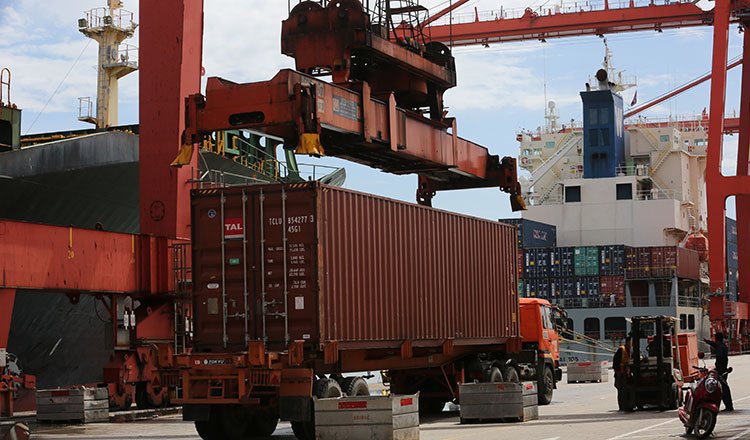
Cargo containers are loaded at a Cambodian port. (Khmer Times/Chor Sokunthea)
Established in 2022, RCEP is the world’s largest free-trade agreement (FTA) aimed to create a seamless, modern economic market across the Asia-Pacific region. It unites ASEAN member states alongside China, Japan, South Korea, Australia and New Zealand, covering roughly 30% of the world’s population and 30% of global gross domestic product (GDP).
Cambodia’s highest commercial activity remains concentrated heavily around five dominant members, namely China, Vietnam, Singapore, Japan and Thailand.
According to the report, the Kingdom’s outbound shipments to RCEP countries climbed nearly 12% to 5.63 billion US dollar in the H1, compared to 5 billion US dollar during the corresponding period last year. Meanwhile, inbound trade from the bloc expanded by 33%, totaling $18.8 billion, with main imports comprising garment manufacturing raw materials, pharmaceuticals, consumables and food products.
For the Secretary of State and Spokesperson for the Ministry of Commerce, Penn Sovicheat, this framework serves to nurture the country’s export momentum amid global economic volatility. He stated that “the RCEP plays an important role in Cambodia’s long-term export expansion, giving additional complementary markets over Cambodia’s existing markets for ma-in-Cambodia products”.
Echoing the sentiment, the Vice-President of the Cambodia Chamber of Commerce, Lim Heng, elaborated that the RCEP is a catalyst for attracting foreign capital. “The RCEP agreement has given Cambodian enterprises wider market access and lower trade barriers in the regional market, particularly contributing to attracting foreign direct investments to Cambodia for producing products to export to other members,” he said.
What does this mean for businesses?
The substantial trade surge under the RCEP framework offers clear strategic advantages for regional enterprises, particularly through the optimisation of cross-border supply chains. However, for developing economic players (namely most ASEAN member states, including Cambodia) this rapid integration introduces a complex double-edged sword. While the pact slashes operational overheads, local authorities and businesses face the delicate task of ensuring they do not become mere peripheral branches of the global value chain. Without proactive structural reforms and domestic industrial upgrading, developing nations risk getting locked into low-value assembly and processing roles, ultimately preventing them from breaking out of the middle-income trap.
Kala Advisory helps investors weigh openings like these against the structural risks that come with them across Southeast Asia. Visit kala-advisory.com.
About The Author