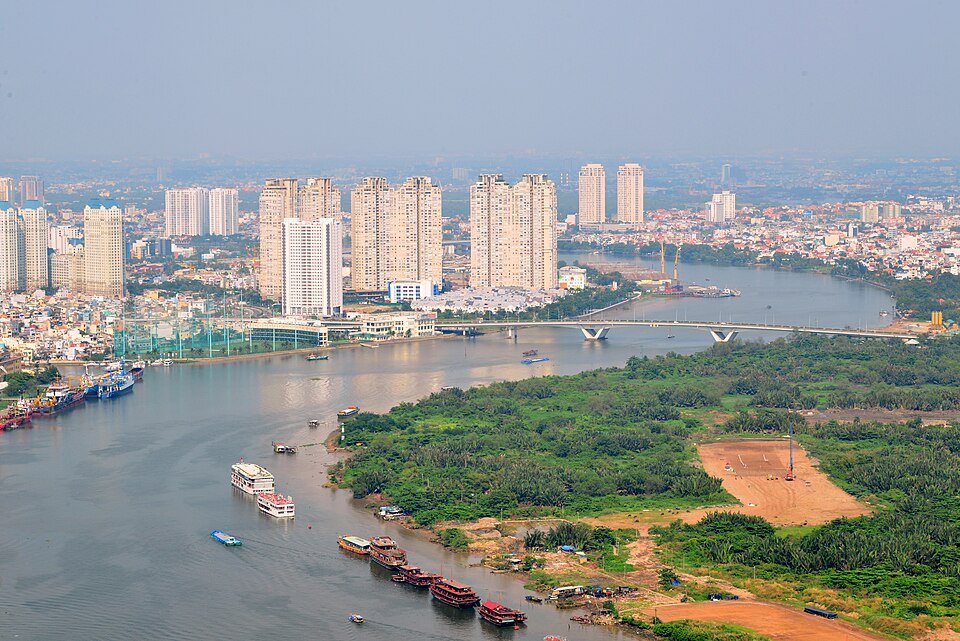
An aerial view of Ho Chi Minh City’s skyline along the Saigon River, Vietnam. (Wikimedia/Andrei Bobrovsky)
The Joint Stock Company Bank for Investment and Development of Vietnam (BIDV) Securities reported on July 10 that the projects will focus on high-speed rail, expressways, airports and urban development. Market analysts welcomed the massive influx of capital as they anticipated strong credit demand by 2027.
Vietnam’s largest private conglomerate Vingroup is slated to pledge the lion’s share of funds valued at 2.3 quadrillion Vietnamese dong (87.6 billion US dollar), through 12 projects encompassing the energy sector, steel production and high-speed rail.
Trailing in second is Sunshine Group, which will be in charge of five projects worth over 800 trillion Vietnamese dong (30 billion US dollar).
Furthermore, Sun Group is set to lead ten projects valued at 457 trillion Vietnamese dong (17.41 billion US dollar), while THACO will undertake five projects projected at 342 trillion Vietnamese dong (13.03 billion US dollar). Equally massive is Masterise Group that will fund three projects worth 232 trillion Vietnamese dong (8.84 billion US dollar), as well as Hoa Phat Group with four projects valued at 12.5 trillion Vietnamese dong (476 million US dollar).
BIDV noted that this announcement excludes major projects valued at 1.5 quadrillion Vietnamese dong (57.13 billion US dollar) financed with state capital. Moreover, consortium projects between different conglomerates have not been included either.
What does this mean for businesses?
Commercial banks stand to be the primary beneficiaries of this massive capital, as they can project a massive surge in corporate borrowing to fund these initiatives. This liquidity injection will trigger a powerful multiplier effect across secondary industries like logistics, raw materials and construction supply chains. However, this rapid economic expansion is not without commercial risk. Because the funding is concentrated within just six major conglomerates, the banking sector faces significant credit concentration risk and thus a failure or severe delay in one mega-project could send shockwaves through the financial system. Consequently, the ultimate success of this boom relies heavily on robust government regulation, transparent risk-allocation frameworks and effective oversight to ensure that this aggressive credit growth does not compromise systemic financial stability.
Kala Advisory helps investors weigh openings like these against the concentration and credit risks that come with them across Southeast Asia. Visit kala-advisory.com.
About The Author