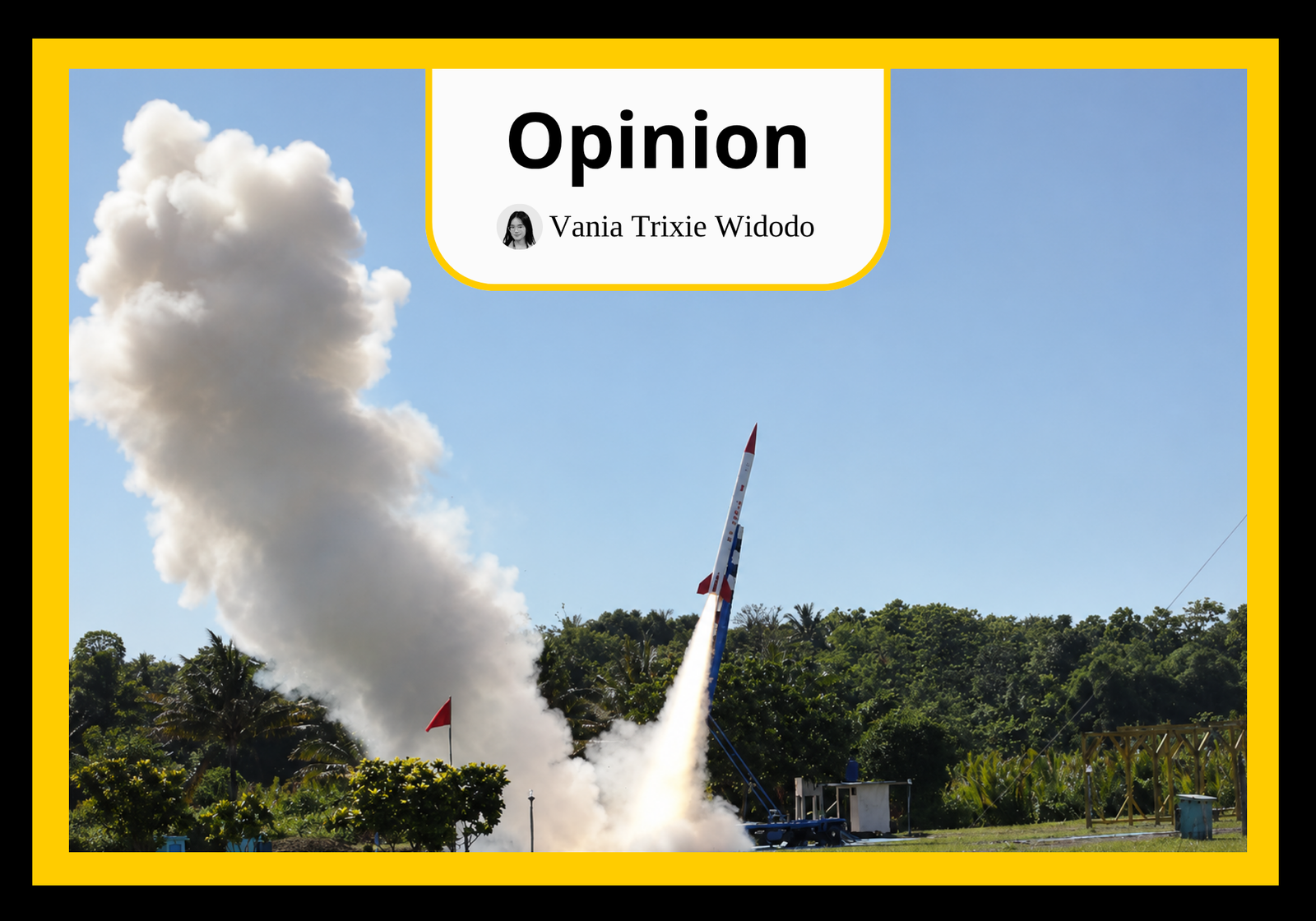
Indonesia’s Institute for Aeronautics and Space (LAPAN) launched its experimental rocket RX450-5 in West Java in 2020. (LAPAN)
Vania Trixie Widodo is an independent researcher in politics and international relations. The views expressed are the author’s own and do not represent SEA Daily or that of another organisation.
In space, ASEAN’s non-interference principle is doing precisely what it was built to do and that is the problem. In March 2026, ASEAN Secretary-General Kao Kim Hourn spoke in Manila, pointing to a new tracking station on Biak Island, Indonesia, as a critical step in building out a regional space economy projected to hit 100 billion US dollar by 2030. And days later, the head of Indonesia’s National Research and Innovation Agency (BRIN) Arif Satria arrived in Moscow, where he told Glavkosmos officials that “the development and operation of a Russia-based launch cosmodrome in Indonesia is one of the main focuses of our cooperation.” By July, the same chairman was telling reporters in Jakarta that the government had not yet determined Biak’s final status at all. Even as BRIN, in the same set of disclosures, confirmed it was simultaneously regulating a second, parallel bilateral track with an Indian private launch firm at the same site.
This illustrates how ASEAN’s non-interference, known as ASEAN Way, works, performing exactly as designed. The Secretary-General was narrating a collective vision while Indonesia was already signing it away.
For 58 years, the standard critique of ASEAN Way has been that it prevents collective action when it matters, while in reality, it produces a specific kind of collective action, reliably and by design. The bloc was designed as what can be termed as a collective risk insurance mechanism to protect themselves from each other’s bilateral decisions. But the standard reading of non-interference, that states want to protect their own sovereignty from external pressure, misses the more important dynamic. ASEAN Way functions as mutual immunity where every member state gets to pursue its best available option. It merely seeks to minimise individual exposure to the risks that other members’ decisions are already working on. Now, space is the first domain where the physics of orbital governance makes this design structurally inoperable.
Last October, the 47th ASEAN Summit unfolded with a familiar ceremony. Malaysian Prime Minister (PM) Anwar Ibrahim handed the chairman’s gavel to Philippine President Ferdinand Marcos Jr., a ritual meant to signal continuity and collective purpose. On the margins of the same summit, Malaysia signed the US-led Artemis Accords governing how nations cooperate in space. The next day, on October 27, the Philippines signed the same Accords alone. It was one day away from receiving the ceremonial gavel. Two successive stewards of ASEAN’s collective agenda, in the same city, at the same summit, joined a foreign governance framework on consecutive days. Despite its own 2045 vision flagging outer space as a peace and security issue, ASEAN’s space future has been built by the accumulation of rational decisions made in separate capitals. This is exactly the behaviour that is currently fragmenting ASEAN’s space future.
Perhaps, space security was not part of ASEAN’s focus this whole time. At the 47th ASEAN Summit, space appeared in none of the political or defence documents. It was surfacing only in subordinate clauses under science and technology cooperation, in three of 45 outcome documents. Moreover, the ASEAN Regional Forum (ARF) held workshops on space in 2012, 2014 and 2015, then went silent for a decade. This year, ASEAN has planned to streamline the bloc’s only institutional response to space, the Sub-Committee on Space Technology and Applications (SCOSA), into a broader body, Sub-Committee on Earth, Ocean and Space Science (SCEOSS). SCOSA has held 34 meetings and produced zero binding commitments on space security for 27 years. Now at the 48th ASEAN Summit in Cebu this May, space received three bullet points in the Chair’s Statement. It came with language that recognised the importance of outer space and looked forward to continued progress toward a declaration that had yet to be adopted. Whether the merger redefines space governance or simply buries it inside a broader technical committee is a question the bloc needs to answer by their policy.
The Biak Contradiction
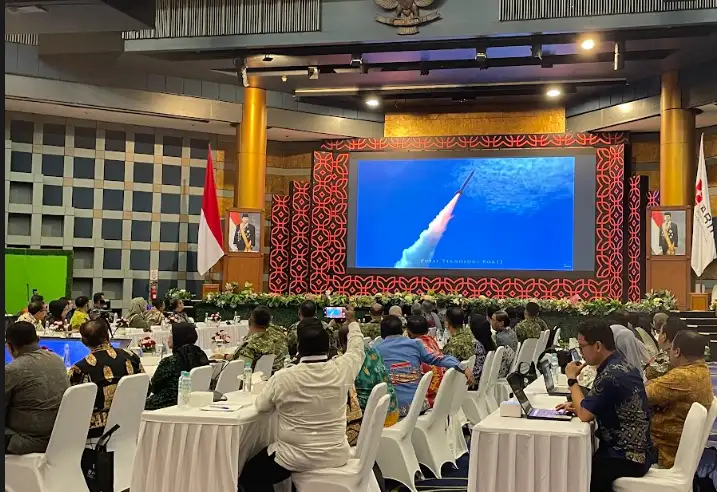
Indonesia’s National Research and Innovation Agency (BRIN) during an event held on space technology in 2025. (BRIN)
One of the member states, Indonesia, designated Biak as the future anchor of a regional ASEAN navigation constellation under its 2040 national space plan. Since 1997, India had been building the physical infrastructure bilaterally with Indonesia to make that vision real. When Kao Kim Hourn named Biak as one of the anchors of the bloc’s collective space future, he was describing infrastructure built under the ASEAN-India Space Cooperation Programme. He painted it as a collective asset for regional space data sharing, to be completed by 2029. India spent 20 years building space-tracking stations in Indonesia before handing them over in 2024. Now, those stations are being framed as a major space hub for Southeast Asia, even though Indonesia promised that very same island to Russia for a separate launch site.
What makes space categorically different from every prior ASEAN governance failure? COVID-19 protocols left no permanent physical transformation of sovereign territory. On the other hand, cybersecurity frameworks produce no irreversible environmental consequence on specific communities. Surprisingly, a spaceport on Biak does both. The Biak indigenous population has historically resisted centralised Indonesian authority over their land. A cosmodrome permanently transforms indigenous land, creates generational environmental liability and imposes physical risk on a specific community that has no voice in ASEAN’s collective risk insurance calculus.
The challenge also encompasses the legal foundation of space launches. Under Article VII of the Outer Space Treaty and the 1972 Liability Convention, international law does not care if a launch failure is caused by a Russian engineer or a Russian-manufactured valve. Because the rocket lifts off from Biak, Indonesia is legally one of the ‘Launching States.’ If a payload malfunctions and crashes into an ASEAN member state’s asset, Jakarta holds absolute international liability for the financial damages (jointly and severally with any other Launching State, such as Russia if it procured the launch or is the state of registry).
The ASEAN Secretary-General is pitching Biak as one of the collective anchors for a regional navigation constellation, but collective regional governance requires a legally defined object to govern. While Indonesia possesses an overarching space law via LawNo. 21 of 2013, the actual operational machinery remains in limbo. As late as December 2025, BRIN acknowledged that the specific Government Regulation Draft on Spaceport Operations had only just cleared harmonisation and was still awaiting final execution, targeted 2026 for initial land-clearing. Furthermore, domestic frameworks like Government Regulations Number 7 of 2023 on Space Technology Security bind Indonesia to strict, sovereign “technology safeguards” designed to lock down tech assets. This legal framework underscores Jakarta’s pursuit of self-reliance and its refusal to submit to rules set outside the United Nations (UN). Indonesia’s domestic laws remain unready for the very technology it insists on deploying without outside interference. So, how can the member states work, consensus-based, with each other in space cooperation?
Equatorial Competition and the Architecture of Incompatibility
ASEAN leaders perform the traditional crossed-arm handshake at the 48th ASEAN Summit in Cebu, the Philippines in May 2026. (ASEAN Secretariat)
Indonesia’s push to develop a spaceport at Biak has intensified regional competition for equatorial launch sites. Kuala Lumpur is now pursuing a feasibility study with the China Great Wall Industry Corporation for a proposed international equatorial spaceport in Pahang. The State Investment Committee chairman has stated openly: “If approved, Pahang will become the first location in Southeast Asia to host a rocket launching port.” In the commercial space economy, equatorial launch real estate is scarce and strategically valuable and Malaysia has correctly interpreted its neighbors’ incentives.
Just as the Philippines proposed a 400 million US dollar spaceport budget and signed the U.S.-led Artemis Accords at the 47th ASEAN Summit, Myanmar quietly solidified its own bilateral space pact with Roscosmos. This geopolitical splitting is even visible among the member states. Singapore anchored its alignment with the West by signing the US-led Artemis Accords in 2022. Conversely, Bangkok signed the US-led Artemis Accords in late 2024 while simultaneously contributing payloads to China’s rival International Lunar Research Station (ILRS). This makes Thailand the only nation in the Asia-Pacific to straddle both superpowers’ lunar architectures.
The calculation is rational for each individual state, but maximising optionality under uncertainty today means maximising incompatibility once the hardware is built. On the other side, the architecture itself demands unity to function. No ASEAN body will confront Bangkok about its contributions because non-interference immunises every member from accountability for what their bilateral decisions cost the collective. Thailand is straddling superpowers because the ASEAN Way makes that costless. And it is regional coordination functioning exactly as the mutual immunity logic prescribes where each state maximises its bilateral position and none bearing collective accountability for what that position costs its neighbours.
Superpowers are now competing in the space domain within the bloc. As these facilities are built separately, ASEAN will have a fragmented archipelago of nationally controlled, externally aligned launch infrastructure where each is interoperable with its patron and incompatible with its neighbors. What happens above, however, will always determine what unfolds below. In the UNIDIR Outer Space Security Conference 2025 Report, the International Telecommunication Union (ITU) warned that global space services are increasingly vulnerable to a dual threat: deliberate electronic attacks like jamming and spoofing and a rising wave of accidental radio interference caused by rapid orbital congestion. Around 94,000 ships pass through the Strait of Malacca annually, with every container ship threading that corridor depending on satellite-based navigation, timing, and communications. Just north of the strait, Flightradar24’s red-coded map shows southern Myanmar as one of the world’s top hotspots for GPS-navigation disruption, warning aircraft of degraded satellite signals over the very same region.
However, the perils of this crowded orbital environment are no longer confined to invisible threats targeting digital signals. They are quite literally falling out of the sky into the exact same transport corridors. In 2025, the European Space Agency (ESA) reported that 130 million pieces of orbital debris (measuring 1 mm to 1 cm) pose escalating risks to space activities. And a year later, a Chinese CZ-3B rocket’s upper stage re-entered the atmosphere over Lampung and Banten, directly above Indonesia’s Sunda Strait. Because Indonesia sits along the equator, its vast territory acts as a primary crossroads for decaying orbital paths. According to BRIN, the country has been struck by falling space hardware at least six times since 1981. It could happen to any country in the ASEAN region and ASEAN as a regional organisation still lacks a unified, binding set of space debris mitigation rules.
Why the Hardware Won’t Wait for the Declaration
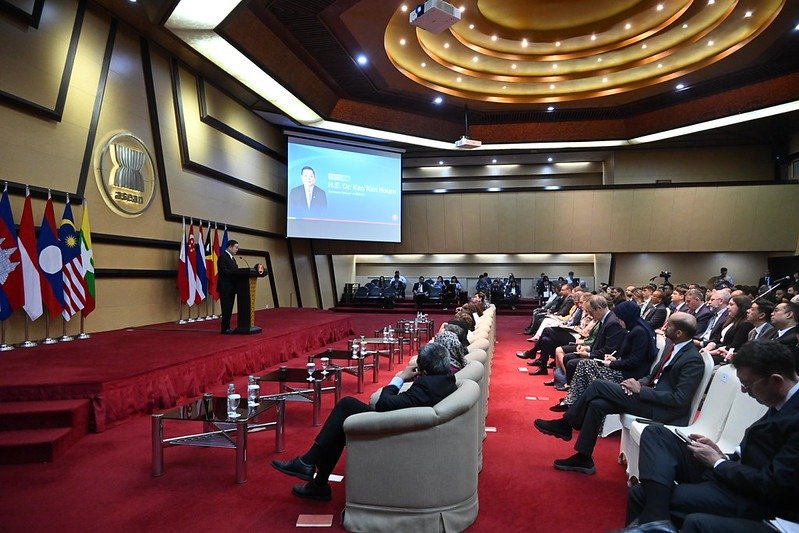
ASEAN Secretary-General Kim Kao Hourn during his speech highlighting key outcomes of the 48th ASEAN Summit and Related Meetings in May 2026. (ASEAN Secretariat)
Today the geopolitical footprint of commercial space is expanding rapidly and posing real questions of sovereignty. Critical national functions in the Philippines, Malaysia and Indonesia now route through a network that could in principle be disrupted without military force. This could possibly happen through commercial decisions made by private operators headquartered outside the region.
China has also embedded satellite data infrastructure more deeply. Through the ASEAN-China Satellite Remote Sensing Application Centre, satellite data nodes now push Chinese high-resolution imagery to Thailand, Laos, Cambodia and Indonesia. BeiDou, China’s navigation system, has been embedded through a decade of bilateral agreements across Thailand, Laos and Brunei Darussalam. Laos’s national satellite, launched in 2015, was financed, built, launched, and is majority-owned by Chinese entities. Each state pursued the best available terms from the most capable partner. When every country does what is best for itself on its own schedule, the entire region will pay the price.
Advanced economies like Singapore can afford to invest in long-term collective governance infrastructure. However, emerging economies rationally prioritise bilateral deals that deliver tangible capability in the present. The asymmetric temporal horizons that produce this pattern are not accidents of development. This is what happens when a framework lacks a reality check. ASEAN promises not to interfere in each other’s business, so no one can call out the countries causing collective harm in the region.
Now, Southeast Asia faces a looming “overlapping split” in its strategic and technological landscape. Since orbital infrastructure is not reversible, telemetry standards, launch protocols, and operational frameworks are technical commitments that embed themselves into hardware. While these bilateral deals are intended to fast-track national capabilities, they will ultimately swing back to paralyse regional security because incompatibility is an operational sovereignty problem. If Thailand’s space assets align with Chinese standards, they may lose compatibility with Singapore’s ground stations built to Western standards. And if Indonesia’s Biak spaceport operates on Russian standards, a Filipino receiver may not be able to communicate with the constellation it was built to anchor.
This pattern has already materialised in the military domain. ASEAN nations’ heterogeneous mix of Western, Russian and locally developed hardware renders joint exercises procedurally hollow. It is a preview of what orbital incompatibility will produce at regional scale once the infrastructure is built. TIn other words, the competition is regional coordination working exactly as the mutual-immunity logic designed it to.
Papering Over Unilateral Realities
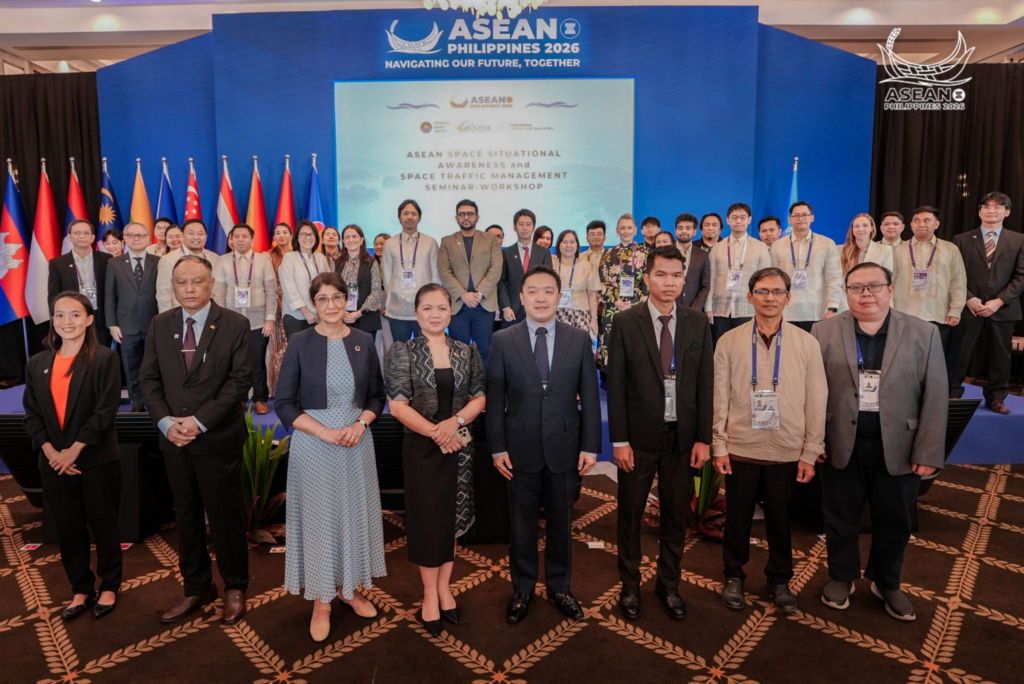
The Philippine Space Agency (PhilSA) convened the ASEAN Space Situational Awareness and Space Traffic Management seminar-workshop in March 2026. (ASEAN NOC)
The Philippines has become the anomaly pushing for collective discussion. Only three weeks after signing the US-led Artemis Accords alone, Manila introduced ‘Space Bayanihan’ (the Filipino spirit of communal effort applied to space) to the Asia-Pacific Regional Space Agency Forum (APRSAF) in Cebu. Space Bayanihan’s language of collective identity arrived before any actual collective space identity did in ASEAN, which reads less like solidarity than like the Philippines positioning itself as the field’s driver. In March 2026, the Philippine Space Agency (PhilSA) convened the ASEAN Space Situational Awareness and Space Traffic Management seminar-workshop where member states spent two days mapping their shared vulnerabilities and options. At this forum, the Philippines proposed an ASEAN Declaration on Space Cooperation for adoption at the 2026 Summit. This proposal, which Secretary-General Kao Kim Hourn has already hailed as the region’s “most consequential commitment” of the year, is now being drafted by the Philippines which has already acted unilaterally.
ASEAN has drafted declarations this way before. What’s different in 2026 is whether the doctrine underneath the declaration still commands belief or whether timing has already made the answer obvious. Previous ASEAN declaration processes unfolded over decades before coordination of this kind became operationally urgent. Every bilateral space agreement signed today incorporates technical standards into hardware that will operate for 15 to 20 years and this is what has happened this year. The declaration, obviously, still will come. It will be adopted in ceremonial language, celebrated in Chair’s Statements, and hailed as a historic milestone for regional space cooperation.
The Cebu Declaration, result of this year’s ASEAN Summit, creates a normative reference point. States that sign it cannot subsequently act as though space cooperation carries no collective obligation because the gap between commitment and practice now requires active maintenance. Over time, the gap between bilateral behaviour and collective commitment generates pressure for alignment. ASEAN has walked this path before. Indonesia ratified the Transboundary Haze Agreement 12 years after signing it. Twelve years of normative pressure, civil society engagement and accumulated relationship costs eventually moved Jakarta. The Cebu declaration, on this reading, simply begins the clock.
Although the declaration will also be late in a specific, technical sense, it will arrive to govern infrastructure it did not design, through standards it did not set and toward a collective architecture that individual states have already routed around. ASEAN has survived every previous governance failure because the crisis always created political pressure which created space for renegotiation. That logic assumes the crisis leaves the renegotiation infrastructure intact. In the orbital domain, the same debris event that would finally force ASEAN member states to the table would also degrade the satellite systems through which regional coordination operates. ASEAN’s crisis-driven institutional logic is structurally disabled in the orbital domain because the triggering event destroys the response infrastructure simultaneously.
The window has already been seized through the decisions being made in separate capitals this year, but with no regional framework defining what they collectively mean. When ASEAN finally discovers it has a space problem, it will discover something else too: that the problem was built by 58 years of doctrine performing exactly as designed.
About The Author