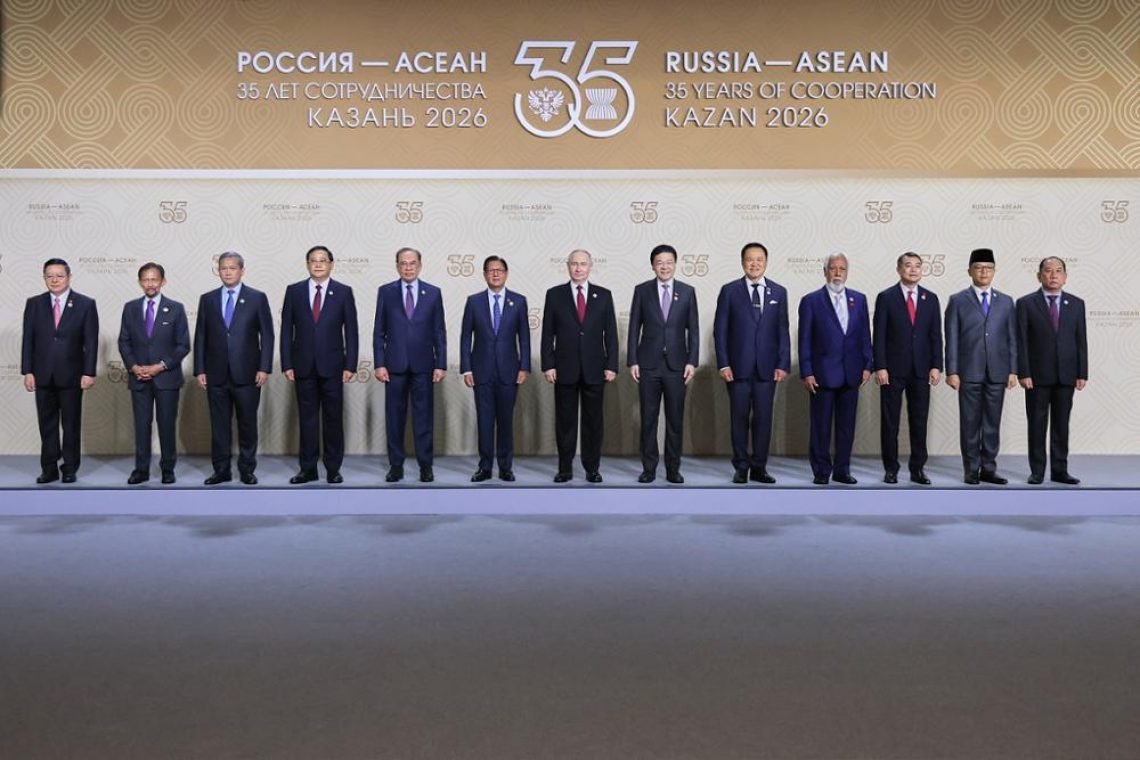
ASEAN leaders and delegations at the ASEAN-Russia Commemorative Summit in Kazan, Russia, on June 18. (ASEAN Secretariat)
On June 17, ASEAN member states and Russia commenced their commemorative summit to mark the 35th anniversary of ASEAN-Russian Federation relations, focusing on deepening security, economic and technological ties. The meeting was co-chaired by Philippine President and ASEAN Chair Ferdinand Marcos Jr. and Russian President Vladimir Putin.
On economic matters, President Marcos said that ASEAN and Russia “must be more deliberate and ambitious in expanding economic opportunities, improving trade facilitation, deepening investment flows and connecting business communities”.
President Putin noted that “many constructive ideas and useful practical proposals” were discussed during the summit, which “advanced the intensification of partnership in the economic sphere”. He added that “participants expressed support for both qualitative and quantitative growth in mutual trade, improvements in its structure and the expansion of reciprocal investment”.
What does this mean for business?
The newly enacted framework offers clear commercial signals for businesses looking to scale operations across a market that encompasses ASEAN’s fifth-largest global gross domestic product (GDP) footprint. While two-way merchandise trade reached almost 18 billion US dollar in 2025 (a 58% growth over the past decade), summit leaders explicitly stated that these figures remain “modest” compared to economic potential.
By prioritising simplified trade facilitation and enhanced digital connectivity, the accord establishes streamlined pathways for cross-border logistics, agribusiness, and technological joint ventures. For enterprise leaders, this strategic alignment opens fresh investment channels in energy, AI infrastructure and food supply security. However, corporate compliance teams must remain vigilant, navigating ongoing Western financial sanctions while capitalising on the newly approved local-currency payment mechanisms intended to reduce transaction friction.
Kala Advisory helps investors turn openings like these into a workable plan while navigating the compliance risks that come with them across Southeast Asia. Visit kala-advisory.com.
About The Author