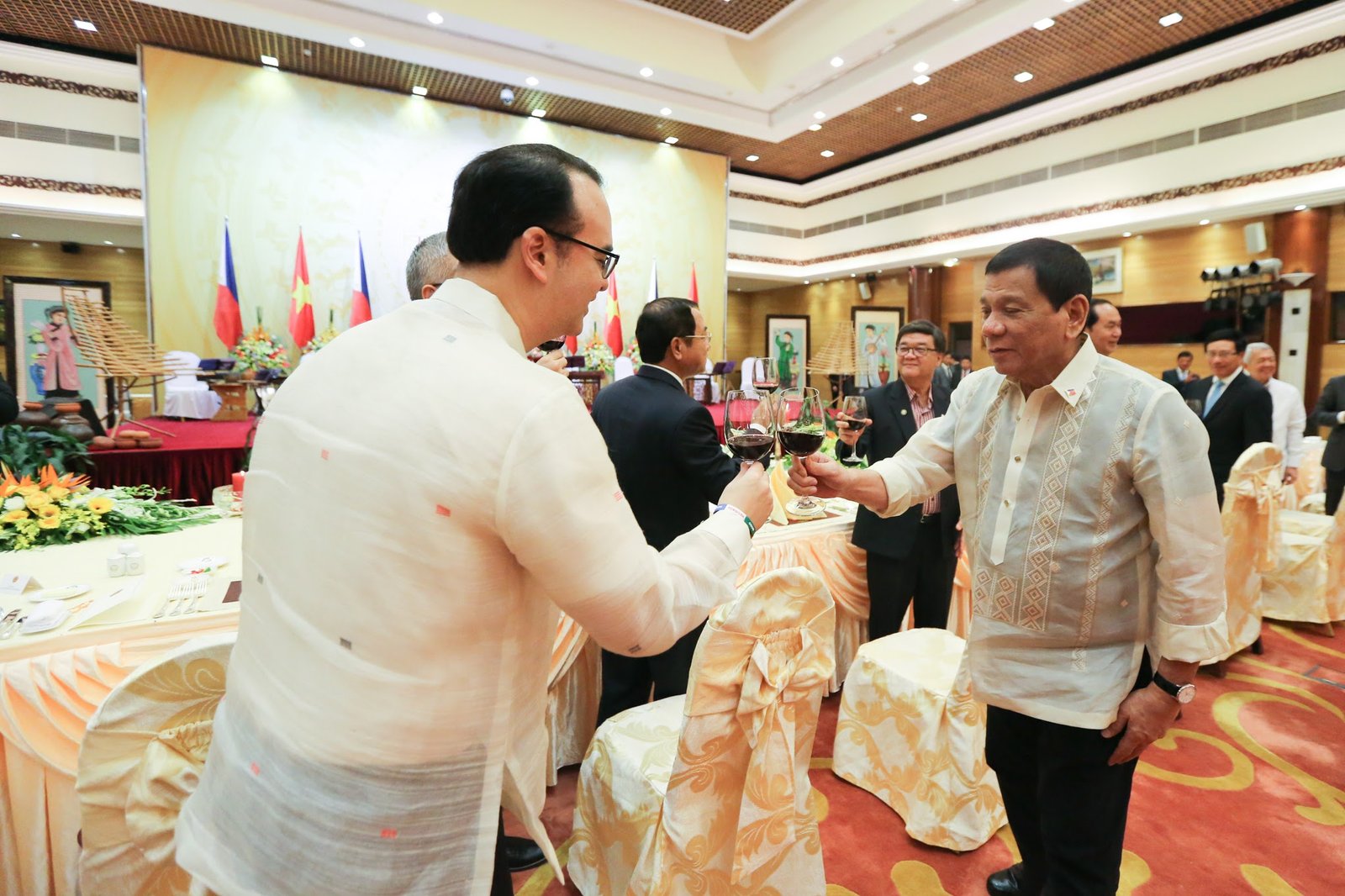
President Rodrigo Duterte offers a toast to Senator Alan Peter Cayetano during a state banquet at the International Centre in Vietnam, September 29. (Robinson Niñal/Presidential Photo)
The Philippine Senate has witnessed a leadership showdown following a coalitional shift that ended the 28-day tenure of the former President RodrigoDuterte’s close ally, Senator Alan Peter Cayetano. He was replaced by Sen. Sherwin Gatchalian on June 17, which was followed by leadership reorganisation within the committee chairmanships.
The dispute began when the new majority bloc declared a quorum after the Cayetano bloc’s absence from the plenary session on June 3. Twelve senators who sided with Gatchalian then moved to declare all Senate leadership positions vacant. Though Cayetano described this move as an “illegal coup d’etat”, he subsequently conceded defeat.
The official of the president, Malacañang Palace, quickly affirmed the change, declaring that it recognises the leadership of acting Senate President Sherwin Gatchalian”.
Two weeks later, Gatchalian expressed relief following his appointment, stating that “[…] those are the days that became unproductive. That is why I said in one of our press conferences that the people’s money for salaries and electricity was wasted”. He noted that the Senate spent 25 million Philippine peso (412,741 US dollar) a day to run the institutions. Declaring an end to the stalemate, he anecdotally said, “‘Ssenateflix’ is over. We are back to work.”
He pledged to advance legislation through the existence of the Legislative-Executive Development Advisory Council (LEDAC) and back an impeachment trial for Vice President Sara Duterte on July 6, preparing the logistical, security and protocol mechanisms. The Senate president stressed that he had also coordinated with relevant authorities to guarantee the clear and orderly process.
The political upheaval in the Philippine Senate was primarily sparked by the subsequent arrests and removal of the Duterte faction, including Senator Jinggoy Estrada on plunder charges and Senator Ronald dela Rosa, who was declared a fugitive by the International Criminal Court (ICC).
Furthermore, the tensions escalated when former Senate president Cayetano and his pro-Duterte camp boycotted the scheduled sessions, creating a deadlock and sparking public protests. Alongside this, Senator Francis “Chiz” Escudero and Senator Joel Villanueva took diverging paths from their original side, joining the pro-Marcos camp.
This new power arrangement within the Senate reflects the strengthened position of the pro-Marcos bloc, which possesses a more cohesive alliance among senators. On the date of the impeachment trial, Sara Duterte’s fate will be determined by this majority. Threats to her bargaining position and emerging risks within the camp will significantly undermine efforts to protect the Vice President.
About The Author