
Indonesian President Prabowo Subianto during an inspection of the implemention of his flagship programme, free nutritious meals in schools, which he claims would create job opportunities and grow the economy. (Indonesian Presidential Secretariat)
The Promise of Growth
Indonesian President Prabowo Subianto promoted his “Prabowonomics” at the World Economic Forum (WEF) Annual Meeting in Davos in January 2026, demonstrating to the world that Indonesia is a stable and peaceful nation.
Within his presentation, Prabowo—commonly referred to with his first name— outlined the numerous policies that have been implemented under his government: free medical checks, education, free nutritious meals, and most importantly, “Danantara” Sovereign Wealth Fund (SWF) to finance industrialisation. While these initiatives were framed as hallmarks of his administration, several are extensions of policies already in place under previous governments. For instance, universal healthcare was built upon the Jaminan Kesehatan Nasional (JKN) system in 2014, under President Susilo Bambang Yudhoyono.
What distinguishes Prabowo’s approach is not their novelty, but a clear shift in priorities—emphasis on health, education and stronger commitment to funding industrialisation for natural resources downsteaming or simply downstreaming (hilirisasi) through state-led investment vehicles. Downstreaming refers to the strategy of refining raw mineral resources domestically rather than exporting them in unprocessed form. Instead of exporting away raw materials, the government encourages investment in smelters and refining facilities to turn these resources into higher-value goods such as battery-grade materials for electric vehicles instead of exporting raw nickels directly. These accomplishments were framed as proof that Indonesia is now a place of opportunity, an ideal destination for foreign direct investment (FDI).
The President has stressed the value of FDI in Indonesia multiple times, frequently presented as one of the keys to boost natural resources downstreaming to create jobs. However, despite this optimistic narrative lies an economic contradiction—a growth bought through capital inflows and industrial upgrading, rather than one that is equally distributed.
Prosperity for Whom?
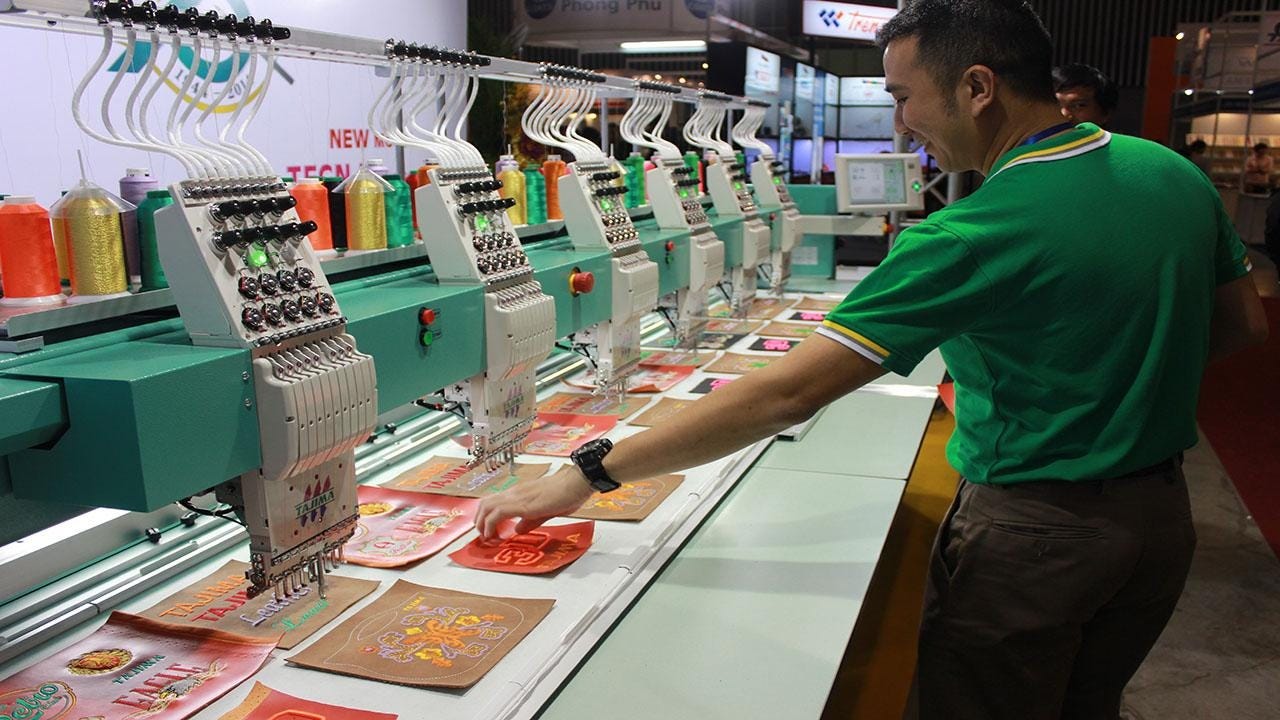
An industrial multi-head embroidery machine for high-volume textile production in Vietnam using environmentally friendly materials. 12th December 2021. Courtesy of The Saigon Times.
After Singapore, Indonesia is Southeast Asia’s largest recipient of FDI—yet it also records the region’s highest unemployment rate. The contrast is striking because FDI is typically associated with job creation. While it has driven record investment and headline growth in Indonesia, FDI has delivered far fewer jobs than expected as investment increasingly flows into capital-intensive activities such as base-metal industrialisation and mineral downstreaming. In 2025 alone, net FDI reached Rp900.9 trillion (US$ 54 billion), with Rp 584.1 trillion (US$ 35 billion) channelled into downstreaming, yet labour absorption lagged behind investment value. These technocratically driven industries require advanced machinery and specialised engineers, sidelining low-and medium-skilled workers and widening the gap between growth and employment. This mismatch is particularly critical in Indonesia, where the labour force remains dominated by low-and-medium skilled workers—accounting for approximately 88% of total employment, many of whom are employed in informal or semi-formal sectors.
Distributed correctly, FDI could greatly raise national living standards. Yet Indonesia’s open unemployment rate stood at 4.85% in 2025—one of the highest in Southeast Asia, notably above many ASEAN economies such as Vietnam (2,2%) and Malaysia (3%). This gap suggests that investment inflows have not translated proportionately into job creation. In a country where unemployment remains high, investment that boosts a country’s value without increasing job opportunities risks widening social and economic disparities. This imbalance is further reflected in Indonesia’s relatively weak performance in labour-intensive sectors and its ranking in the Global Talent Competitiveness Index (GTCI), which trails most ASEAN peers. The GTCI measures a country’s ability to develop, attract, and retain skilled talent, serving as an indicator of workforce quality and long-term competitiveness.
This is in contrast to Vietnam, which has emerged as the region’s preferred production hub through superior cost efficiency, infrastructure, and skills alignment. Samsung’s decision to relocate half of its smartphone production there, alongside Foxconn’s US$1.5 billion expansion, reflects an arrangement where investment absorbs labour more effectively. Although Vietnam attracts less FDI than Indonesia in absolute terms, it converts capital into jobs more efficiently, supported by sustained investment in workforce development. In 2024, over 28% of Vietnamese workers held formal training credentials, enabling the country to attract labour-intensive manufacturing alongside higher-tech industries.
Natural resource downstreaming remains central to Indonesia’s growth strategy, but its employment promises remain unfulfilled. This is particularly striking given that mineral downstreaming has been repeatedly framed by Prabowo—not only since taking office but throughout his presidential campaign—as a pathway to mass job creation. Yet the evidence suggests that this claim is fundamentally misplaced. These sectors are inherently capital-intensive and absorb limited labour, meaning they are structurally ill-suited to addressing high unemployment. The persistence of high unemployment alongside record FDI inflows demonstrates that downstreaming, as currently designed, does not function as a broad-based employment strategy. Rather than serving as a vehicle for inclusive development, it prioritises value-added industrial upgrading through capital heavy investment. In this sense, the promise that mineral downstreaming will generate widespread jobs is not merely delayed—it is contradicted by the economic structure of the industries being promoted. Growth is secured first; employment is deferred.
Bridging Inflows to Inclusion
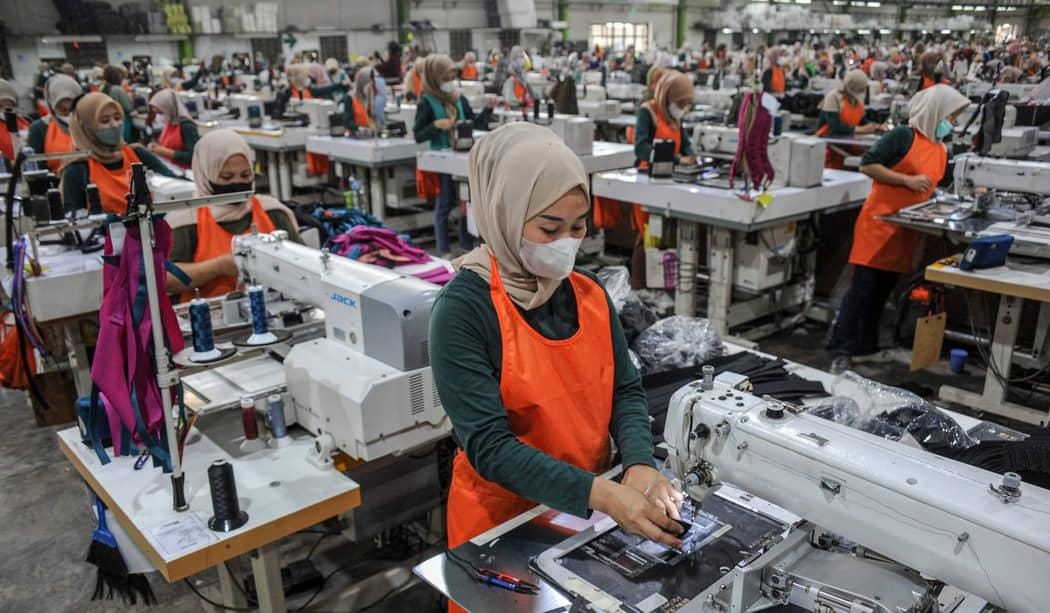
Employees at the PT Eksonindo Multi Product Industry (EMPI) facility in Katapang, Bandung regency, West Java, utilise machinery to make backpacks. Courtesy of Antara News.
Growth that is bought but not shared may elevate Indonesia’s global profile, but it does not guarantee sustainable or inclusive development. While it may inflate headline figures, it risks entrenching jobless growth that erodes social legitimacy and weakens long-term competitiveness—widening disconnect between government rhetoric and lived reality. Similar patterns have evolved elsewhere, such as Nigeria, oil-fueled boom resulted in significant GDP expansion without widespread job creation, exacerbated inequality and societal tensions. If Indonesia wants foreign investment to benefit its citizens broadly, it must match capital inflows with serious investment in skills, labour-intensive complementary sectors, and stronger worker protections.
Vietnam offers a useful contrast. Its manufacturing base spans both traditional labour-intensive industries, such as textiles, and advanced sectors like electronics and renewable energy. Although higher-tech sectors require skilled labour, Vietnam’s industrial strategy has integrated large-scale assembly operations, capable of absorbing semi-skilled workers, with sustained investment in vocational training. This layered structure has enabled it to translate FDI into broader employment. Crucially, Hanoi has not abandoned labour-absorbing industries in its pursuit of technological upgrading; instead, it has strengthened their position within global value chains alongside capital-intensive growth. By contrast, Indonesia’s downstreaming strategy concentrates on capital-intensive mineral processing, which generates high value but limited labour absorption, creating a structural mismatch between investment flows and the country’s predominantly low-and-medium-skilled workforce.
To avoid layoffs of labour-intensive workers and FDI that focus solely on capital-intensive industry, Indonesia must also channel FDI into integrated manufacturing clusters that link multinationals with domestic suppliers, ensuring investment creates factory jobs and supporting industries rather than isolated capital enclaves. This requires hybrid industrial strategies: enforcing local supplier development, embedding training or labour requirements in FDI incentives, and co-locating automated production with labour-intensive activities such as assembly, logistics, agro-processing, and maintenance.
At the same time, the government should launch a nationwide, free or heavily subsidised skills-upgrading programme—delivered both online and in person—modelled more closely on Malaysia’s TVET system, where industry partnerships are embedded in curriculum design and apprenticeship pathways. Although Indonesia already has a link and match framework to address skill mismatches—including government initiatives such as Kartu Prakerja and Balai Latihan Kerja (BLK)—their implementation has been fragmented and overly supply-driven. Much of Kartu Prakerja funding has flowed into short, largely online courses with weak employer involvement and no guaranteed pathways into work. While BLK shows heavy reliance on government funding, outdated materials and absence of instructors in some courses. By contrast, Malaysia’s TVET model embeds employers in curriculum design, combines classroom instruction with structured apprenticeships, and links certification directly to labour market needs.
For institutional convenience, underperforming training organisations, schools and out-of-date majors should be repurposed or consolidated, while existing curriculum needs to be systematically reevaluated to match real labour market needs.Therefore, reform should go beyond expanding access and instead concentrate on three key areas—more rigorous curriculum design driven by industry. The government might encourage companies in the downstream industries to co-design training programs and ensure placement channels instead of subsidising short-term courses.
Unemployed Indonesians must be provided with a sufficient social safety net. Beyond protecting individuals from sudden income loss, well-designed social protection acts as a macroeconomic stabiliser. By sustaining household consumption during downturns, it prevents sharp contractions in aggregate demand, reduces the risk of deeper recessions and supports faster recoveries. Technocratic industrial policy must be tempered by clear employment and inclusion benchmarks, flexible training pathways for low-skilled workers, and transition support for those displaced by structural change. Ample social protection to assist those impacted by structural change, participatory policymaking that involves employers and workers in industrial planning, and decentralised execution that enables local government and industries to customise responses to regional labour needs are all necessary for effective implementation. When taken as a whole, these steps should guarantee that technological effectiveness and social inclusion are matched, avoiding the exclusion of workers from industrial transformation.
About The Author